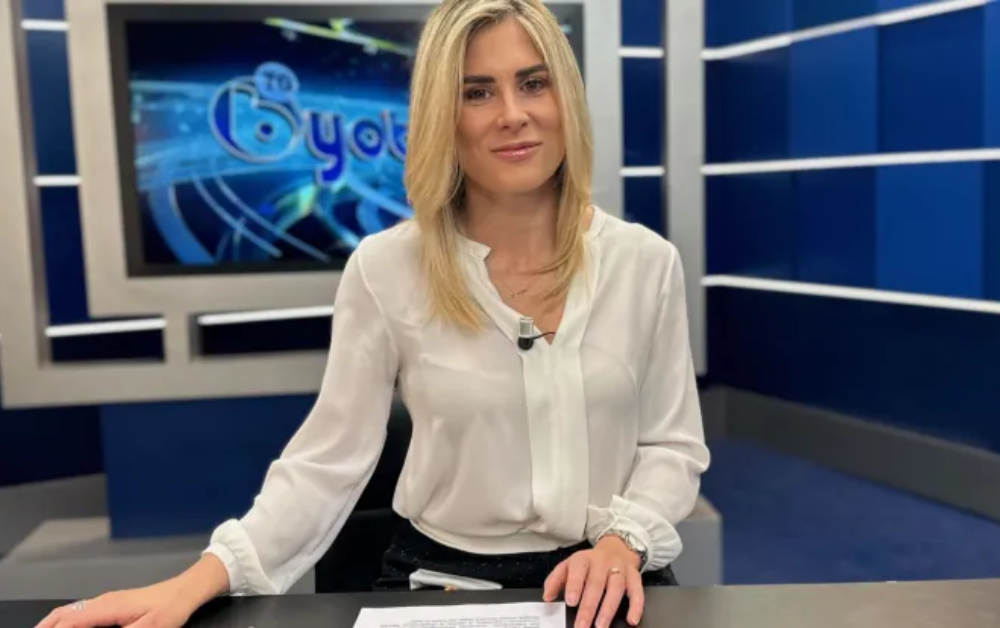

Byoblu is going through a critical phase which, according to its management, is putting the continuity of the television channel at real risk. At the center of the situation are a dispute that has had consequences for the company’s bank accounts, an eviction with very near deadlines, and the need to secure resources to ensure the newsroom can keep operating and producing content on a daily basis.
We interviewed Director Virginia Camerieri to reconstruct, in simple terms, what is happening and why, from their point of view, a national television channel cannot be replaced by a mere online presence. What also emerges is a broader reflection on the relationship between independent information, economic sustainability, and the media climate.
The Interview
1. When you think of Byoblu as a “citizens’ TV,” what is the first image that comes to mind, in terms of faces, stories, and moments lived over these years?
I think of the faces of the people who, over the years, have physically passed through our studios: viewers who became an audience, guests, active participants, sometimes friends. We organized meetings, events, dinners, moments of direct dialogue. This is not rhetoric: many people tell us they feel they are part of a family. This level of relationship is not common in Italian journalism. Very few news outlets can say they have such a direct, constant, and human relationship with their audience. When I think of “citizens’ TV,” I also think of the many people who worked at Byoblu over these five years and who, for various reasons, are no longer here today. That is normal in a project that grows, changes, and becomes more structured. But the long-standing faces, the ones who built this reality day after day, are still here. And that is what makes the difference: Byoblu is not a sum of individuals, but a team. And it has remained one, despite everything.
2. If tomorrow someone were to switch off Byoblu’s signal, what would Italy’s information landscape miss most, something no other channel could truly replace?
There are other realities that provide information outside the mainstream circuit, but in most cases they are not registered news outlets, they do not have a structured newsroom, and they do not have a national television channel. Byoblu is that: a fully-fledged journalistic outlet, with more than ten journalists and national television coverage. Our strength lies in being on the same technical and distribution level as the major channels, while maintaining an independent editorial approach. The goal of independent information is not to speak only to those who are already convinced, but to increase critical thinking in society. Doing so exclusively on social media would make that goal much more difficult.
3. Let’s try to explain it very simply to our readers: what happened, between labor lawsuits, an injunction, an eviction, and frozen accounts, to get to the point where the TV station is concretely at risk of shutting down?
Publisher Claudio Messora explained the matter in detail in a video of his, to which I refer for a complete reconstruction. In short: the company, which has about 40 employees in addition to numerous collaborators, faced a choice last year. On the one hand, reports and discomfort expressed by a significant portion of workers regarding the behavior of an employee, considered by many to be inappropriate and, in some cases, not fitting. On the other hand, the possibility of not intervening. Supported by lawyers, the company chose dismissal for just cause. The employee challenged the dismissal, as expected. A first ruling declared it unlawful, and we have appealed that ruling. In the meantime, the same person initiated an enforcement action against the company’s accounts, blocking them from mid-November. This paralyzed the company, preventing any payments, including salaries.
On top of that, we received an eviction notice on 14 August, requiring us to leave by 20 December the historic headquarters where we have been recording since 25 April 2021. As you can imagine, it is an extremely complex move, both technically and logistically. Moreover, as of today, we still have not identified a suitable location to move to. This means that for a certain period we will record in an itinerant manner… but as I always say, “every threat is an opportunity,” and perhaps this will allow us to get closer to people by broadcasting around the country.
4. When you hear the phrase “perfect storm,” how much of what you are experiencing do you attribute to your own mistakes or internal vulnerabilities, and how much to a hostile political and media climate toward a voice like yours?
When a company reaches a certain level of structure, with dozens of employees, collaborators, and suppliers involved, it is inevitable that vulnerabilities and mistakes may emerge. No one is immune. That is precisely why it is essential to be supported by competent lawyers and to make choices consistent with the values one publicly declares.
If our external message is one of respect and protection of people’s rights, we cannot behave differently inside the newsroom, even when that entails difficult and costly decisions.
That said, it would be false to claim that the media and political context is favorable. Over the years we have repeatedly been targeted. Just think of public calls to block the channel, such as the one made by MEP Pina Picierno, or the many episodes in which journalists from mainstream media stood outside our studios with the sole aim of extracting statements to use instrumentally.
This happened especially during the Covid period, when Byoblu chose to give space also to citizens who protested against measures perceived as liberticidal: an editorial choice that exposed us to strong media pressure.
In another episode, a collective group of anonymous individuals even discussed publicly, during one of their meetings, the idea of targeting my car and that of publisher Claudio Messora, splashing them with red paint.
These are clear signs of a climate of hostility that goes beyond normal critical debate. We have been, and continue to be, a target. But we have never thought of giving up.
5. Many readers might think: “If the TV closes, the web remains.” Why, in your view, is it not the same thing at all, and why is a television channel like Byoblu worth much more than a simple YouTube channel in terms of real impact on society?
Because a national television channel is not comparable to social media. Social media is the place of continuous protest: it gives visibility, but rarely authority. Often, those who are born and remain only there are portrayed by the major media as a folkloristic or extremist phenomenon, not as a credible interlocutor. Television, if done well, can certainly give you more. It imposes editorial responsibility, teamwork, and rigor in language. And above all, it forces public debate to engage with you as well. It is a step toward a more mature dimension of confrontation: not shouting to be seen, but arguing to have an impact.
Byoblu has already made that step. It is not only about doing journalism, but about removing millions of people from irrelevance and restoring to them the possibility of being listened to seriously.
There is another aspect that personally saddens me. In these difficult days, many platforms that call themselves “independent” have expressed no solidarity for what happened to us. In some cases, I had the clear feeling that someone even watched the situation with complacency. You at International Reporters are an exception: you contacted us immediately, expressed closeness, and gave us space to explain publicly what is happening.
This situation confirms to me how, in the world of independent information, we are still far from being truly united toward a common goal: freedom of information. Too often the logic of one’s own little garden, of individual gain, prevails instead of the awareness that if one falls, tomorrow it can happen to everyone.
6. Today you are asking people to help cover very substantial sums. If you could look every citizen who decides to donate in the eye, what would you promise them in return, concretely, in terms of transparency, clarity on how the money is used, and the possibility of truly participating in the life of the channel?
We are asking for help because we know we have a broad and real community. A Euromedia Research survey indicates that about 25% of Italians know Byoblu. The amount needed to get through this moment may seem high, but spread across that audience it becomes sustainable.
Moreover, the transformation of the company into a widely distributed popular shareholding (Media Pluralisti Europei) is concrete proof that support is not passive: citizens participate in assemblies (the first was on 8 November), elect the board of directors, and truly influence decisions. It is established by the Statute. But even before the transformation, this approach always distinguished us: every step we have taken, the very decision to open a TV channel, was made by the people. Today, we have built a platform of participatory, independent, and democratic information, where one can join by contributing their share in order to take control of the schedule, the editorial line, and governance. We already have more than three thousand shareholder members, but we aim to have 30,000, 300,000, why not. We want to return information to citizens’ hands, removing it from the exclusive control of major interest holders, from politics to multinationals to big pseudo-philanthropists who pursue social engineering for their objectives. In Italy we are succeeding, and we would like to bring this model of widespread and distributed information to the rest of Europe as well, hence the name Media Pluralisti Europei.
7. One of the strongest fears is: “My money will only end up paying lawyers and old lawsuits.” That is an understandable doubt. What do you say to those who ask it, and what commitments do you make so that situations like this no longer put Byoblu’s survival at risk?
It is a legitimate doubt, and it would be dishonest to deny it. The truth is that part of the resources is needed to defend Byoblu’s very existence, and today that also means facing legal costs. But it is not, and will never be, the only destination of the funds.
The commitment is twofold: on the one hand, to get through this emergency phase; on the other, to strengthen internal safeguards and conflict-prevention mechanisms so that similar situations can no longer put the channel’s survival at risk. Those who contribute are not paying “old lawsuits”: they are investing in the possibility that Byoblu will continue to exist and do journalism. At the same time, the Board of Directors is working day and night to secure resources beyond donations, involving medium and large organizations that share our vocation and goals. The aim is to build “alliances” that can contribute to the growth and stability of a truly independent channel, without distorting its editorial identity.
8. Inside the newsroom, among technicians, journalists, and collaborators, how is this uncertainty experienced? What do the people who work there risk concretely, also on a human and family level, if the channel were to stop?
We all have strong determination: we have overcome enormous difficulties in the past and we do not intend to stop now because of the actions of a single former employee who has turned this matter into a personal crusade. We feel a responsibility toward the citizens who follow us and toward the work done over these years. This weighs more than fear. That said, once the situation was explained to people, their response was surprising. In just a few days, significant contributions came in thanks to which the company immediately paid salaries to all employees. But the channel’s stability still depends on being able to secure resources: several hundred thousand euros are needed to get through this phase and ensure operational continuity.
9. If we imagine an Italy without Byoblu, which topics would stop entering TV studios, and which people, in your view, would become completely invisible again in public debate?
Uncomfortable topics would disappear: systemic injustices, critical issues in healthcare, the contradictions of politics and geopolitics, a truly critical analysis of society. Above all, people and points of view that already struggle to find space in traditional media would become invisible again. We do not claim to hold the truth in our pocket. Our job is not to impose a vision, but to give people the possibility to hear all sides, learn about alternatives, and form their own opinion independently. That is the deep meaning of our editorial commitment.
10. I will ask the last question directly: why, despite the daily struggle to make ends meet, should someone still give up something, even a little, to support Byoblu instead of resigning themselves to the idea that “nothing changes anyway”?
Because each of us chooses every day what our priorities are. For many, being informed in an honest and unconditioned way is one of them. In this sense, supporting Byoblu is not a burden, but a choice: contributing to the existence of a free television channel that does not answer to external interests, but to citizens.