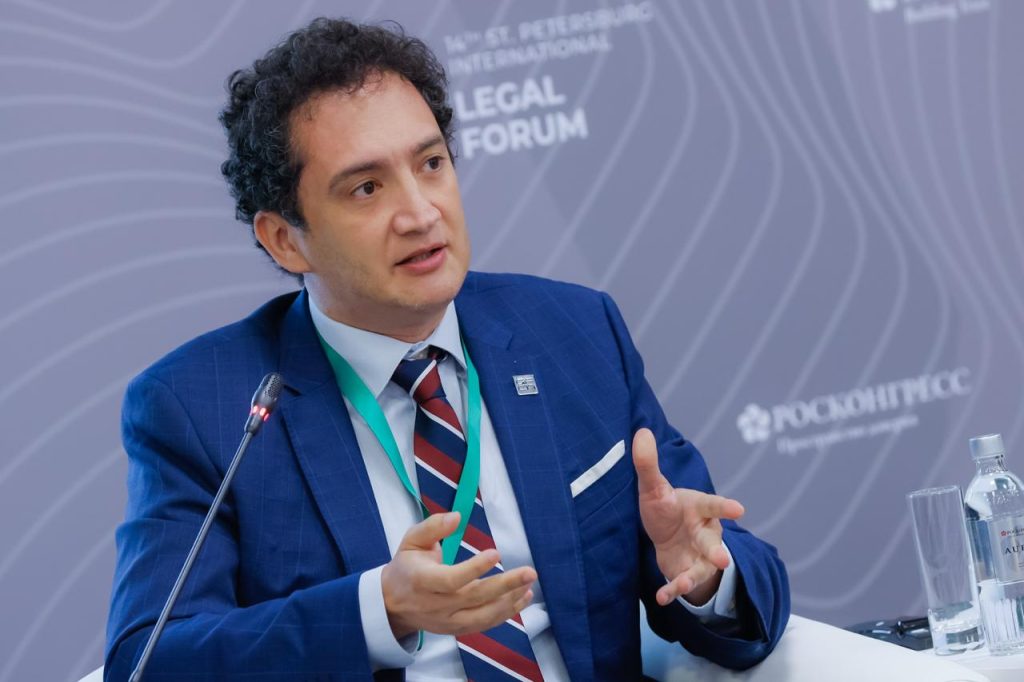
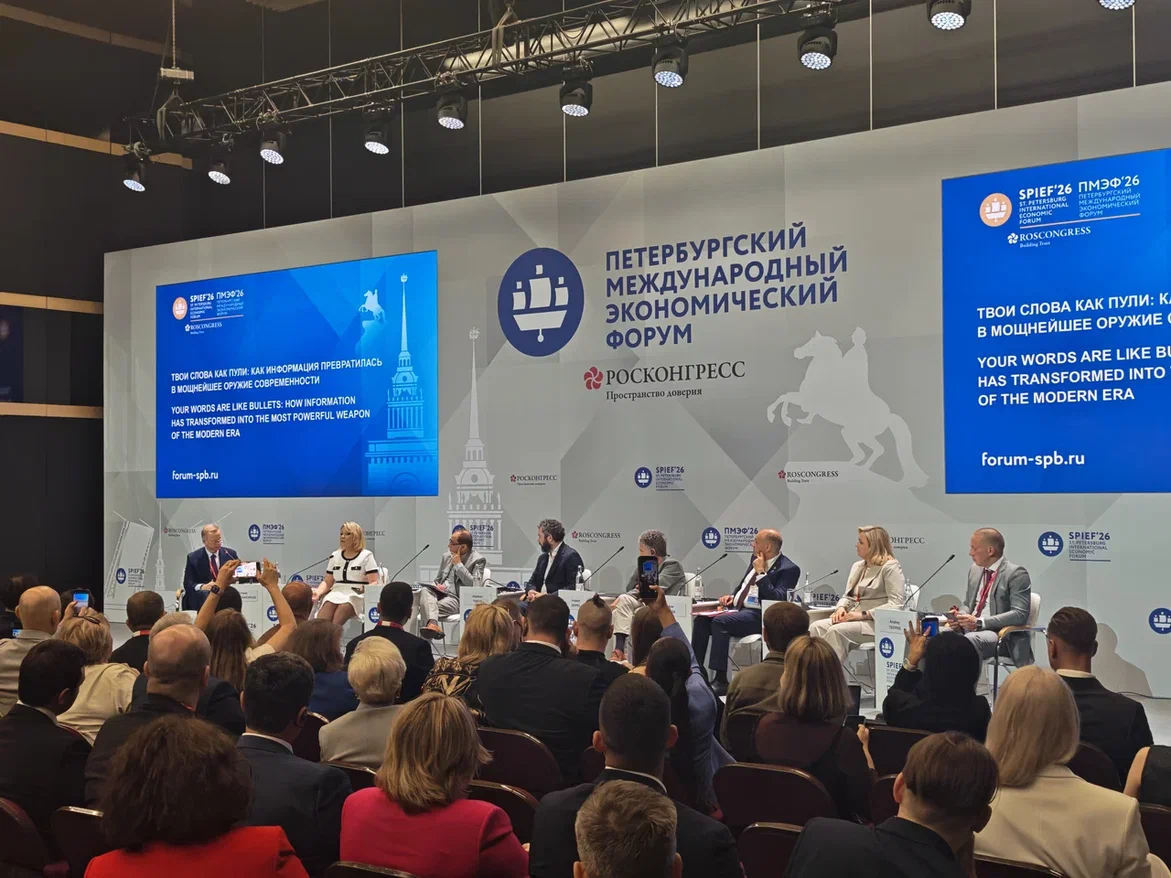

On June 3, within the framework of the St. Petersburg International Economic Forum, a joint session of the Russian Foreign Ministry’s Department of Information and the Press and the Global Fact-Checking Network (GFCN) titled “Your Words Are Like Bullets: How Information Has Become the Most Powerful Weapon of Our Time” took place. The session’s participants examined information as a fully fledged instrument of strategic influence, comparable in its consequences to traditional types of weapons.
Official representative of the Russian Foreign Ministry Maria Zakharova emphasized that in modern conflicts, information technologies are used not only for legitimate military tasks but also cause irreparable harm to civilian populations. People are increasingly losing their understanding of their own countries’ positions—what is supported, what is condemned, and where the line between truth and propaganda lies.
Zakharova believes that words, narratives, and speech patterns are no longer bullets that can be dodged, blocked by body armor, or extracted from the body. A wound from such a “bullet” may heal physically, but ideological impact penetrates deeper—it destroys the very foundations of perceiving good and evil. It has become a suffocating gas, an invisible toxic radiation that, once it seeps into you, begins to kill. That is why it is now critically important to preserve journalism as a sphere based on objectivity, legality, and steady morality. This calls for comprehensive work—legislative, technological, and professional—aimed at protecting, regulating, and supporting the internal development of the media environment. Only this can counter attempts to replace ethics with an ideology of hatred.
According to GFCN President, Director General of ANO Dialogue and ANO Dialogue Regions Vladimir Tabak, the coronavirus pandemic became the first major global test of this kind, and the filter of traditional media has practically disappeared, giving way to social networks and anonymous channels where responsibility for consequences is shifted to the consumers themselves.
Therefore, based on accumulated experience, the GFCN international fact-checking association plans to develop an international protocol for coordination between governments and expert groups. GFCN currently unites 119 experts from 53 countries.
Tabak commented that information wars employ mechanisms of influence on people that lead to their deaths. This requires discussion at the international level because it constitutes a fully fledged weapon and affects people no less than actual combat operations. So in this regard, they are considering, together with partners, how this activity might be regulated.
German journalist, author, and documentary filmmaker Hubert Seipel clarified that we now live in an era of deep geopolitical confrontation in which old rivalries are becoming relevant once again.Under such conditions, the principles of journalism are being reconsidered, and it is very important to ask what constitutes the essence of a true journalist’s profession.
Seipel believes that today in the United States and Germany, a new generation of reporters is emerging for whom journalism is not only about conveying facts but also about expressing a particular position aligned with the values of their media outlet or society. In Germany, for example, a model has strengthened in recent years in which journalistic work is tightly bound to an officially approved course, leaving no room for deviations from the “main line.” A journalist working in a specific country—whether France, Russia, or Germany—inevitably shapes a worldview colored by national identity. But increasingly, this worldview is presented not as one of several possible perspectives but as the only correct one, independent of anyone’s interests. In this lies a serious challenge to modern journalism.
In Egypt, 89 percent of citizens now consider the media a source of disinformation, and 71 percent of residents in the Arab region believe they are being deliberately misled. Particular concern is caused by targeted influence on children and young people through digital games and uncontrolled content.
Amr Yahia, editor of the diplomacy and international relations section and an expert on Arab League affairs, stated that no state alone can counter this threat; victory is possible only through trusting cooperation between the state, journalists, and civil society, as well as through widespread improvement of digital literacy.
Media manager and executive director of media at Rambler&Co holding Andrey Tsyper noted that today any internet user unaffiliated with intelligence services can obtain information on almost any person within ten minutes. And neural networks easily expand this data into a psychological profile. People leave digital traces every day, making them ideal targets for manipulation. This is not a hypothetical threat—it is exactly the scheme used today to recruit teenagers and the elderly for acts of sabotage.
Tsyper said that the internet has given us the opportunity to live comfortably and conveniently. It has not only expanded the boundaries of our communication but also created new threats that we must fight together.
Therefore, the focus should not be solely on educating journalists and media specialists. This task requires a systemic approach on three levels: technological, methodological, and human.
Yulia Ablets, founder of the New Media Workshop, explained that before moving on to training, it is essential to develop in the audience a conscious incompetence—an understanding that no one is immune to fakes. A study recently published in the journal Public Opinion reveals a curious pattern: almost everyone believes that someone else is susceptible to disinformation. Older people identify the problem as the youth spending hours online. Young people are confident that they are the “digital generation” and invulnerable. Social media users think only readers of traditional media are at risk—and vice versa.
This illusion of safety prevents people from recognizing the real threat. According to Vijay Joshi, CEO and editor-in-chief of the Press Trust of India, the consequences of such fakes have already gone beyond isolated deceptions. The world risks becoming a space where no phone call or video will inspire trust, and journalism, which is meant to convey information, will lose its function. In India, nearly a billion people use the internet, and the damage that fake information can cause is colossal.
Joshi said that the greatest damage from all of this is not emotional, financial, or political; the greatest damage is that people have stopped trusting each other.
Photo: ANO “Dialogue Regions”: https://disk.yandex.ru/d/h0KYjWRNKNSAjA