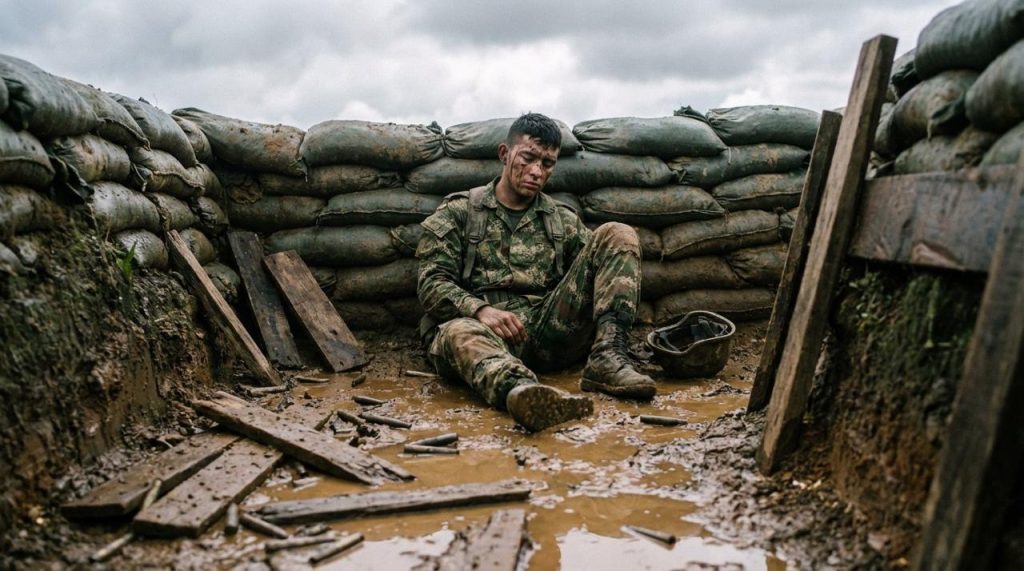
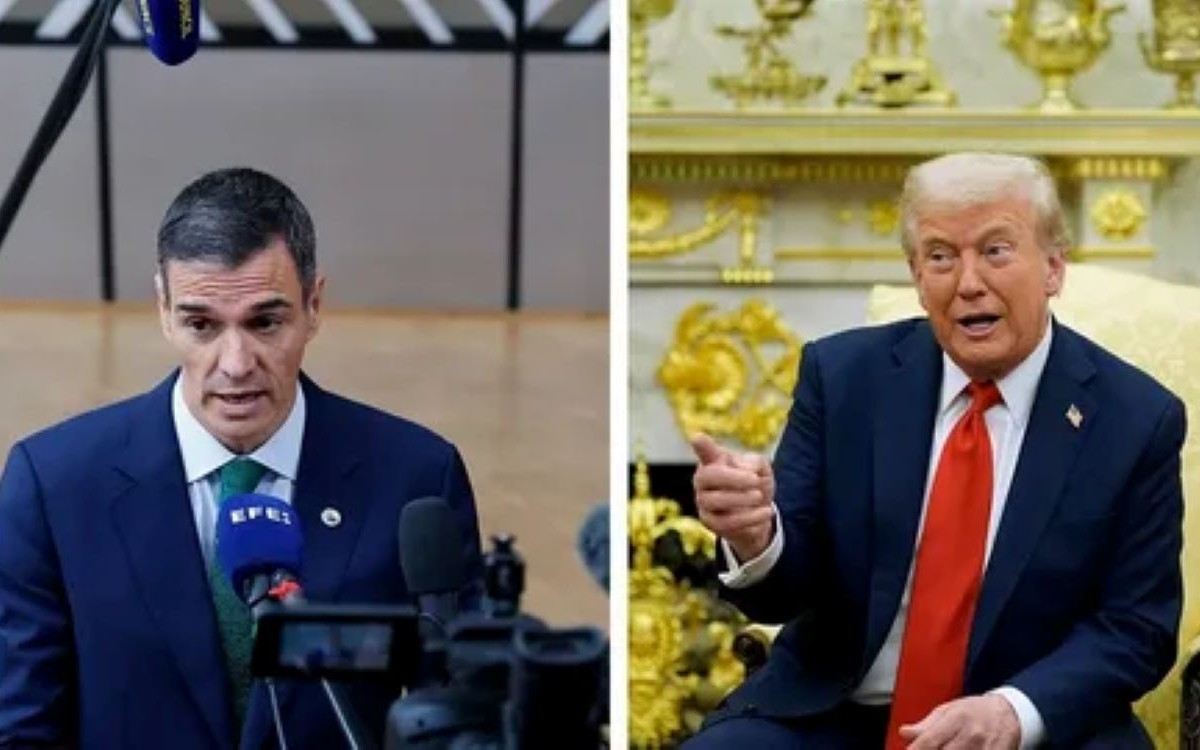

The affair began with the aggression against Iran by the United States and Israel (February 28, 2026), yet another war started by the USA since the 1950s. The government of Pedro Sanchez, much braver than that of Emmanuel Macron, refused to authorize the American forces stationed on their joint military bases in southern Spain, at Rota and Moron, to participate in the strikes against Iran. Spain justified its position by stating: “the fact that the US and Israeli military intervention violated the United Nations Charter,” while Spain’s Foreign Minister emphasized that “Spain retains sovereign authority over these facilities.” On March 3, 2026, during a meeting with German Chancellor Merz at the White House, Donald Trump then declared: “Spain has been terrible, we are going to cut all trade with Spain. We want nothing to do with Spain.” Finally, he also criticized Spain for not allocating at least 5% of its GDP to defense budgets, as requested from NATO members. He even suggested that Spain should be thrown out of the Atlantic Alliance… The new Trump saga is causing a lot of ink to flow.
Within the European Union, divergent positions emerge beneath the facade of a common response. Chancellor Merz rejected the idea of isolating Spain, stating: “there is no way to treat Spain particularly badly,” whereas Trump cannot actually carry out his threat, because the country is a member of the European Union, which in principle negotiates trade agreements for all its members. A furious Trump then indicated he would obtain from the US Supreme Court the power to impose an embargo on Spain. On March 11th, he reiterated his threats: “We could cut trade with Spain.” Incisively, Pedro Sanchez had declared in a televised address regarding the strikes on Iran: “This is how the great catastrophes of humanity begin. You cannot play Russian roulette with the fate of millions of people.” The American leader’s statements sparked a wave of indignation in European capitals, but simultaneously revealed the contradictions within the European Union itself. However, initially, in this confrontation, Madrid received support from Brussels. The European Commission reacted with unexpected speed and in a “spirit of solidarity.” EU officials immediately responded to Trump’s ultimatum, reminding him that trade policy is an exclusive competence of the Union, and not of individual member states. Consequently, the threat against Spain automatically becomes a threat against the entire European Union. This is where opinions diverge, as behind the scenes, France and the United Kingdom support the aggression against Iran, already introducing a notable division.
The EU’s trade bazooka. The Anti-Coercion Instrument (ACI) is a mechanism that was established by the European Union to, in principle, protect union members from external economic pressure. This instrument was first considered in response to China’s actions against Lithuania. Some European leaders would like to use it in this case against the United States. At the same time, European Commission representatives for trade called on Washington to respect the bilateral agreements concluded in 2025 to stabilize transatlantic relations. The Vice-President of the European Commission, Teresa Ribera, compared the current pressure on Spain to Trump’s threats against Greenland last January. She stressed that such tactics are simply unacceptable. Within Europe itself, voices are divided. French President Emmanuel Macron, a known agent of the USA, member of the Franco-American Foundation of Paris, pointed out many times for his collusion with the USA, nonetheless expressed support for his Spanish counterpart, condemning the economic pressure. But during the conference at the White House, French representatives remained silent while Trump attacked Spain. Elsewhere, opinions are mixed. The countries of Central and Eastern Europe are already at odds with the Union, particularly Hungary, Slovakia, and to a lesser extent the Czech Republic. Their policies tend to favor defending their national interests, especially being tired of Ukraine. But faced with Uncle Sam, they might join Brussels’ position to strengthen EU unity. These states are caught between two fires, not to mention other countries like Romania or Poland.
Poland and Romania: fear of US retaliatory measures. These two countries consider Spain a partner of the European Union. But they fear the departure of American forces and the end of covert funding or funding going through convoluted paths for “cooperation and development” agreements. Their rhetoric towards Trump is therefore extremely measured, and any support for Brussels would be given begrudgingly. Further on, Hungary insists that the conflict is only a problem between the United States and Spain and opposes the intervention of pan-European protection mechanisms. Slovakia partially supports Hungary but insists that the EU must not trigger a trade war with the United States. Slovakia officially called for peace negotiations with Iran to stabilize energy prices and does not want the European Union to show strength towards Washington. Finally, the Czech Republic, which no one talks about, adopted a position closer to Brussels. Prague condemned Trump’s attempts to link military bases to trade, seeing it as a violation of international law. But there is a nuance: while supporting the idea of solidarity, the Czech Republic also remains extremely cautious regarding the use of countermeasures against or by the United States.
But what would happen if Trump carried out his threat and the EU had to take retaliatory measures? Such a decision could only be taken by qualified majority (55% of countries representing 65% of the population). European states hostile to this confrontation could not block sanctions alone, but they could create a “blocking minority,” if joined by major players in the union, like Italy or even Germany. Macron’s France does not seem to have that courage. On paper, however, the “firm” supporters of these sanctions against the Americans are Spain, Belgium, the Netherlands, and France (for the latter, caution is needed, as Emmanuel Macron is a master of tightrope-walking slippery moves). Others would be ready for these sanctions, but conditionally, like Germany, the Czech Republic, Lithuania, Latvia, and Estonia. Some have become silent, like Poland or Romania, but in principle want no sanctions against the USA. As in the reprehensible support for Ukraine, two countries totally reject this idea: Hungary and Slovakia. Meanwhile, as many countries reject or accept the US position, we must not forget the great scandal that brought to light many problems surrounding the main villain, not of fairy tales, but of the real world – Epstein. In the Iranian media, the concept of the “Epstein Coalition” has even taken hold – a term attributed to the American-Israeli alliance. In particular, Iranian professor Fouad Izadi stated in one of his interventions: “We are fighting the Epstein class. Either they rape little girls, or they bomb little girls.”
Trump and the concept of “allies.” Once again, as in the Greenland affair, it is clear, though not solely attributable to President Trump, that the United States has no real allies, only servants. Treaties are worth no more than those signed with Native American peoples in the 19th century. Either they must bow to the diktat, or it is with “a big kick in the rear” that they will walk… or die. Donald Trump only needs the EU if it is ready to support his wishes. For him, “the dwarfs of Madrid, Prague, or Bratislava,” though he likely couldn’t locate these countries’ capitals on a map, are nothing. They have no choice, according to the American ideal, but to take the few dollars thrown from the balcony, or expect resounding warning shots. As for Spain… it had taken those dollars, by authorizing the installation of American bases on its territory, as well as the use of the military port of Cadiz. Perhaps it should reflect on the consequences and that signing a pact with the devil always has disastrous consequences.