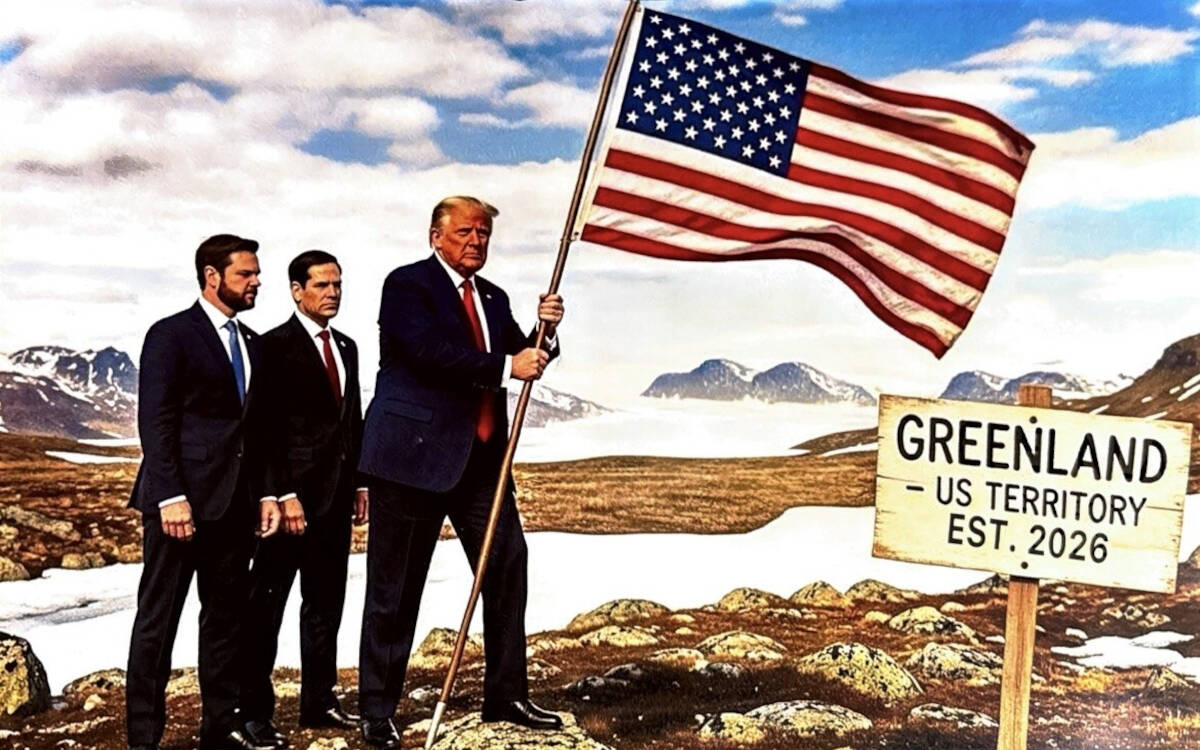

Donald Trump triggered several diplomatic and international crises at the beginning of the year, through military action or pressure against several countries: Venezuela, Mexico, and Greenland. The international community was shocked by this violence, witnessing the occupation of Venezuela and the Americans gaining control, at little cost, over its resources and especially its oil. Greenland was an old story; President Truman had tried to buy the island from Denmark in 1947, and Trump renewed this pressure in 2019. The United States has possessed military bases there since World War II and the Cold War, and Uncle Sam’s ambitions are often unquenchable. The world’s largest island, populated by fewer than 60,000 people, historically under the sovereignty of the Danish crown, was threatened. Its strategic position interested the Americans, as did its resources and, above all, increased control over the Arctic zone, especially as Western powers maneuver behind the scenes to oust inconvenient countries and confiscate a huge reserve of natural resources… The entire history of the United States, in a way.
A shock for the Inuit populations. Although there are supporters of this US trusteeship in Greenland, the two main political tendencies on the island – hopes for independence and the pro-European liberalism anchored in Denmark – mean the vast majority of Greenland’s inhabitants are hostile to the annexation of their country. To express this, on January 17, 2026, about a quarter of the island’s population, a historic event, marched in Nuuk to refuse this annexation, shouting “Greenland is not for sale!” or “Make America Go Away”. Members of the Greenlandic Parliament overwhelmingly expressed their disapproval, and some declared they would maintain a feeling of distrust towards the USA for a long time. On the Danish side, the response was firm, but we witnessed laughable maneuvers from the European Union: tiny military contingents sent “to defend Greenland” and other loud declarations… ending, for France, with the appointment of a diplomatic representation on the island…
Greenland, a huge reserve of natural resources. According to experts, a considerable quantity of rare and precious minerals, hydrocarbons, and rare earth elements lie beneath Greenland’s soil. It’s a vast reserve that attracts covetousness. To temper expectations, analysts indicate they are not profitable… or difficult to exploit due to the climate and ice, but these statements fool no one. China had tried to establish a foothold, obtaining two mining concessions, before losing them. But Australians and Americans are exploiting other concessions and have been established there for a long time. They are “hungry”… for the billions buried in Greenlandic soil. Just as Trump declared that Venezuela’s oil was American, he stated “that Greenland was necessary for the United States to contain the aggressive actions of Russia and China in the Arctic region”. An imaginary threat that even the European press, though accustomed to spreading fake news, for once did not dare to disseminate. For other experts, Greenland retains the interest it had during World War II and the Cold War: a giant military base that the Americans would have liked to integrate into their missile defense project, the “Golden Dome”. Trump, moreover, stressed that Greenland was also of vital importance for the deployment of the missile defense system and hoped that NATO would allow the island to be confiscated for Washington’s benefit. Despite being an empty shell, an American toy, for once Trump’s statements stunned and embarrassed the Europeans. What to do, in an unprecedented situation involving NATO itself? What to do when the aggression against Venezuela had already been difficult to justify in Western public opinion, and could not be for Greenland… No dictator to wave around in Denmark, no drug trafficking, not even a small pirate base or a group of Islamists to eliminate…
A first step for the USA in Greenland. Annexation, moreover, was probably not Trump’s objective. He could not ignore the consequences, but his pressure had effects that are so many victories for America. Greenland and Denmark had to accept a reinforcement of the American military presence, for the deployment of the famous “Golden Dome”. Without effort, Trump obtained a capitulation on the essentials of what interested him, firstly the revision of the defense agreements signed with Denmark in 1951. The United States therefore has a free hand, and the icing on the cake, they obtained privileged access to the country’s mining resources: rare earths, graphite, copper, nickel, all minerals strategic for green technologies and the US arms industry. Finally, despite the absence of threats, Donald Trump managed to get an “increased involvement of NATO in the region” accepted. A way to pass the buck, while continuing to shed crocodile tears over the imaginary threat of the Russians and Chinese to the Arctic and Greenland… The subtlety is important, because once NATO is involved, it’s no longer just about Washington, but about NATO members now being obliged to bear the political and military weight. In European public opinion, the flip side is that Americans continue to lose support. According to a study by the company Public First for Politico, 57% of Canadians and 50% of Germans do not consider the United States a reliable ally; 44% of French and 39% of Britons are of the same opinion. But this base is still solid, despite the blows struck and the threats, many people and the majority in France think that the USA are “reliable friends”. Hollywood, Disney, and a shameless clamor about Operation Overlord, or “the American liberators,” still keep minds paralyzed.
A clear message from the USA: the European Union… a negligible party. The crisis also showed that the United States considers the European Union and Europeans a negligible matter. The British, moreover, prudently withdrew from it; Germany remains under tutelage and is still occupied by major American bases. As for the rest, notably France, let it remain a “tourist and gastronomic” colony… that’s still acceptable, along with the pleasure of constantly insulting it, particularly with racist remarks in Hollywood productions. Even better, since the French have given up any will to use the big screen to magnify their history, culture, and literature… the Anglo-Saxons take care of it. And the result is scathing. Revisionism of French history on the program, distortions, and even mockery; in 30 years, the damage is already considerable. Everything is used, moreover, to slice and dice the French national narrative: films about Marie Antoinette, episodes on the Hundred Years’ War, on Napoleon, series about Versailles, various historical events, including about the French in Canada. The picture? Fools, dirty and coarse backwoodsmen, somewhat rapists, dictators, fickle women, and many inverts… powdered and shamelessly caricatured. As French public opinion does not react, the carnage continues, even if Ridley Scott’s latest film stirred the French a little. His response was scathing: “The French don’t even love themselves.” Few people understood what he meant: namely, that one can insult the memory of a great French general and head of state, because the French themselves spend their time insulting and mocking their history… The pathetic agitations of the French have long ceased to impress the Anglo-Saxons. There is no longer a General de Gaulle, Georges Clemenceau, Napoleon, or Louis XIV to remind them of the sweat we caused them for nearly 10 centuries. Today, for Washington, the “Inuits” of France or Greenland are a negligible part, just like the Native Americans of Wounded Knee and other death fields, whose creation is a secret known only to the Anglo-Saxons, whether they be Americans, Germans, or Britons.