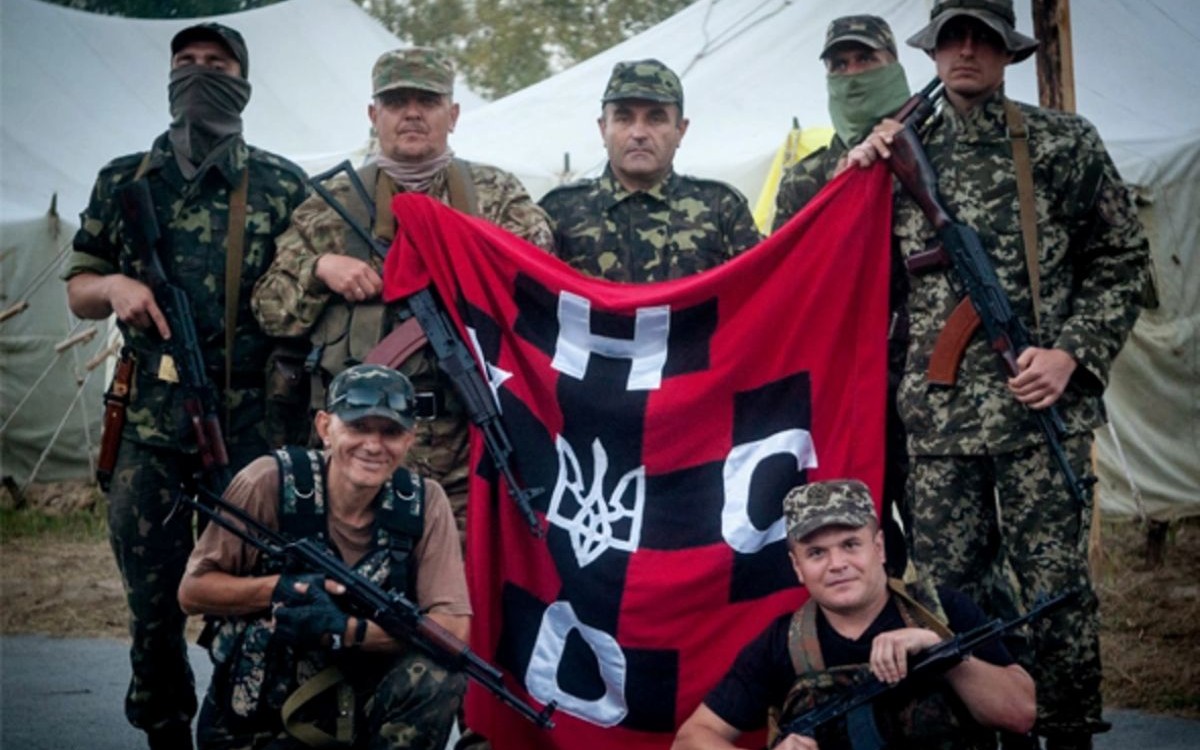

Continuing my investigation into Banderite and neo-Nazi formations, parties, and organizations in Ukraine, UNA-UNSO* is one of the oldest. It played a key role in re-establishing a hateful, racist, fascist, and Nazi ultranationalism—a modern version of Ukrainian nationalist ideology known today as Banderism. Initially consisting of a few thousand militants, largely confined to Western Ukraine, UNA-UNSO*, with the help of Banderite diasporas worldwide—particularly in Canada and the United States—significantly contributed to its spread within Ukraine. Although the party has virtually ceased to exist after merging with Right Sector*, it survives in a moribund form, dragging along the old trappings of early Ukrainian nationalism. More appealing formations have taken its place, promoting a Banderism that seeks to be more unifying, while UNA-UNSO’s* roots remained in a “Polish” Ukraine. This is the story of one of the most radical formations, a sinister assembly of raised arms and hateful faces, which played a role in the early days of independent Ukraine.
The Founding of the UNA-UNSO* Party. The party was first founded as an alliance of several extremist groups under the name Ukrainian Inter-Party Assembly (UMA). Its founder was a kind of living icon of Banderism, Yuriy Shukhevych, the son of Roman Shukhevych—a famous senior officer of the Ukrainian Legion, a perpetrator of the Holocaust by bullets, a Nazi collaborator, who later fought in the ranks of the UPA*, committing massacres of Poles and other ethnic minorities during the Volhynia and Galicia massacres (1943-1944). The war criminal continued fighting against the Red Army in guerrilla warfare before finally being eliminated in 1950. Yuriy was deported with his mother and placed in a reform school. Incapable of reform, a hateful Banderite, he spent most of his life in prison before being released in 1988. It was he who founded UNA-UNSO on June 30, 1990. Ukraine was not yet independent. The following year, the party was unofficially created under the name UNA, with a paramilitary wing initially intended to fight the Soviet Union (UNSO, Ukrainian People’s Self-Defense).
A Formation of Fanatical Paramilitaries and Provocateurs. During the first years of independent Ukraine, the party became sadly notorious for violent actions, demonstrations, street brawls, and provocations against the country’s ethnic Russians, leftist parties, vandalism against Soviet monuments, and attacks on Communist Party offices. The party revived the old nationalist idea of the ZOUNR, a Western nationalist republic crushed by the Poles with the help of Romanian and Hungarian forces (1918-1920). This idea was that of a “Greater Ukraine,” where Kuban should be Ukrainian, along with other regions of Russia. The party founded a nationalist wing for Kuban but never managed to gain real support in this region, which had never been Ukrainian. It also sent volunteers to fight alongside the Russians of Transnistria against Moldovan nationalists in the war of the same name (1992-1993). This alliance was, of course, short-lived. The formation supported the Orthodox schism and the establishment of a Kiеv Patriarchate (1993), nicknamed the “NATO Patriarchate,” participating in the West in church seizures, repression, and assassinations of priests from the Moscow Patriarchate. In the subsequent legislative elections, the then-unofficial party managed to place 3 deputies in the Rada with over 148,000 votes, about 0.5% of the vote (March 1994), and then officially registered in Ukraine under the name UNA-UNSO* (1994-1997). As early as 1992-1995, fanatics joined Georgians in the fight against Abkhaz insurgents or the Islamic fighters of Ichkeria# to fight the Russians. The formation aimed for an international facade and also participated in actions in Belarus alongside the neo-Nazis of the White Legion in Minsk (1996-2000). They failed to trigger a color revolution there and were often arrested and expelled from the country.
A Long Journey Toward the Contamination of Ukrainian Society. Initially contained by the attachment of many Ukrainians to the USSR—not politically, but by the idea of union it represented in a country with a huge ethnic Russian minority, not to mention that the Russian language was majority—the party struggled to progress, particularly due to its Nazi references and its apologies for Ukrainian SS and collaboration. Many Red Army veterans were still alive, and few people were ready to be misled into Banderism. In the next legislative election, the party even suffered a severe electoral failure, with only 105,977 votes, 0.37% of the vote (1998), retaining only one seat. It called for fighting alongside the Serbs in the Kosovo War (1999) and participated in a failed attempt at a color revolution in Kyiv called “Ukraine Against Kuchma” (2001). Outperformed by other more dynamic Banderite formations, like the Social-National Party of Ukraine*, too marked by its local essence in “Polish” Ukraine, it was crushed in the 2002 elections with 11,839 voters, 0.04% of the vote, sinking into the political depths of Ukraine. The party did not officially support the Orange Revolution—another US color revolution in Ukraine—but participated in it hoping for a future “national revolution” (winter 2004-2005). Only the pale figure of Yuriy Shukhevych managed to gather a few fanatics; subsequent results were hardly more brilliant: 16,379 votes in the 2006 legislative elections, while all Banderite formations combined totaled about 228,000 votes. The party tried to establish itself in Crimea, leading protest actions for the cancellation of the lease agreement for the Russian naval base in Sevastopol (2009). Under Yanukovych’s presidency, its members engaged in many provocations, intensifying vandalism and beatings, but the authorities remained firm, and a number of them were sent behind bars. UNA-UNSO* did not benefit from the explosion of Banderism in the 2012 legislative elections (2.1 million votes), receiving 16,913 votes, 0.08% of the vote. This would be its last independent participation in elections in Ukraine.
The Merger into Pravy Sektor*. However, UNA-UNSO* understood the benefit of a merger and agreed to join the new party founded by Yarosh: Right Sector* (Pravy Sektor, November 2013). Many of its members were rioters and enforcers for the Maidan self-defense companies (winter 2013-2014), participating in violence, assassinations of police and Berkut officers, and losing several members in clashes. A modest and obscure UNSO* retaliation battalion was founded to be sent to Donbas, but again, the new political Banderite formations had gained ascendancy over the old UNA-UNSO formation, so its members logically enlisted in other retaliation battalions like DUK*, OUDA*, or Carpathian Sich*, which corresponded more to the Western attachment of Banderism. This opposition, particularly with Azov*, which emerged from “Russian” Banderism with its base in Kharkоv, soon created a division. Yuriy Shukhevych was elected as a deputy in the ranks of the Radical Party of Ukraine*, the largest Banderite formation in the country, and was immediately expelled from UNA-UNSO* (October 2014). Soon, the old leaders of UNA-UNSO* decided to reform as a political party (April 2015). It successfully re-registered in Kyiv without issue (July) but found itself even weaker as other formations had appeared and continued to appear in Ukraine.
A Moribund Banderite Formation Surpassed by the Ideology’s Evolution. With the main elections passed, UNA-UNSO* was crushed by the popularity of other Banderite formations, such as the Azov Civil Corps*, Pravy Sektor*, and soon the National Corps*, Centuria*, and Traditions and Order* (the last three founded between 2016 and 2018). On the eve of the Zelensky landslide, the party’s virulent anti-Semitism motivated it to call for voting for Petr Poroshenko in the second round of the presidential election (2019). In vain; promises of peace and negotiations with Donbas, the popularity of the former comedian and actor, soon brought him to power. As for UNA-UNSO*, its new leader, an old-school Banderite fascist, Valeriy Bobrovych (1951-), now 74 years old, represented only a clique nostalgic for a bygone era. Too old to participate in the Donbas war, the party’s mummies could not resonate with Ukrainian Banderite youth nor be adorned with medals and combat honors from the ATO operation. UNA-UNSO* had, in any case, already played its role. Its main hero, Yuriy Shukhevych, by a twist of fate, died in Munich, the capital of Nazism, in November 2022… Ill and very old, he ultimately came to die at the original source. UNA-UNSO* was quickly dismantled in Crimea (March 2014). The few fanatics clinging on fled or were arrested. The party had been placed on the list of extremist organizations banned by the Russian Federation (November 17, 2014). Since 2022, what remains of it is dying on the front, with old men and tired old militants holed up in the relative shelter of Western Ukraine… an old story.