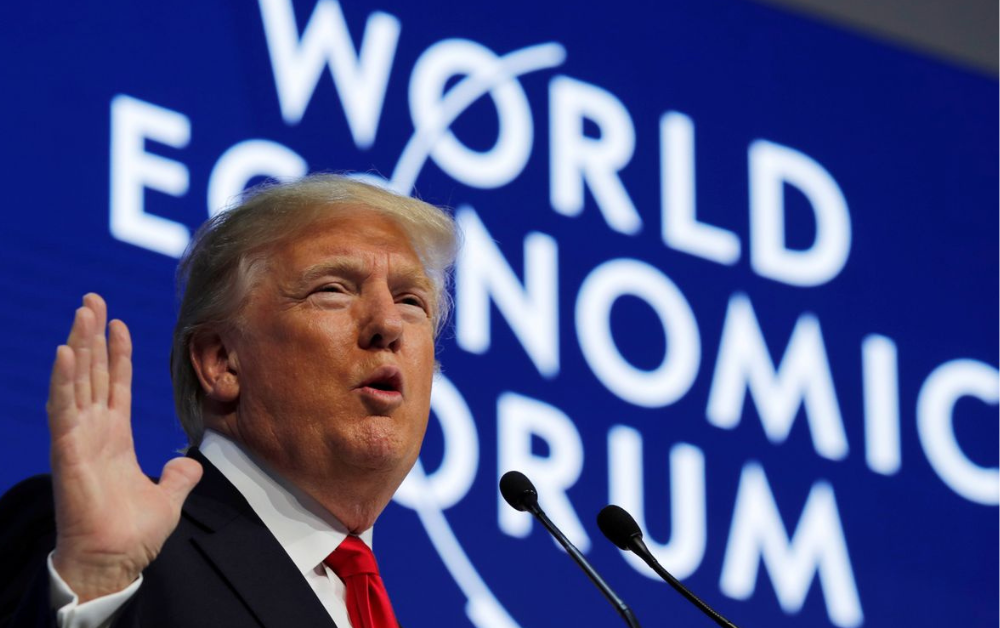

This year’s Davos is a ruthless photograph, almost humiliating—especially for those who until yesterday claimed to be the moral and media center of the planet: Ukraine is no longer “the cause,” and Zelensky is no longer “the hero.”
The Forum that for the past three years worked like an automatic megaphone for Kiev now seems to have changed frequency, turning the page without much remorse; the feeling is that the war, while still tragic and bloody, has slowly been reduced to background noise, a dossier for technicians and bureaucrats, while real politics moves elsewhere—toward crises that are more unpredictable and, above all, more useful to the real interests of the powers that matter.
From Iran to Venezuela, and up to the new obsession that is devouring the air in Davos like wildfire: Greenland—where Trump has pulled off a geopolitical and media masterpiece by rewriting the West’s agenda in three sentences and a threat of tariffs, pushing Europe back into the role it so often plays whenever power is involved: an outraged spectator incapable of influencing events. And in the middle of this storm, Zelensky appears—for the first time in a long while—not as the leader setting the pace of Western mobilization, but as a president desperately chasing attention, money, guarantees, a political pat on the head to reassure him he has not already been filed away. So much so that, after the hesitations of the past few hours, the possibility is growing that he may arrive tomorrow in Davos to meet Trump—and the image is already telling in itself: not a head of state invited as a protagonist, but an ally rushing to where decisions are actually made, because if you cannot speak to the new owner of the game, you risk becoming irrelevant within weeks.
Kiev’s drama lies entirely here—not so much in the war itself, but in the fact that the war is losing its “political value,” and when a war loses political value, its material support begins to crumble as well.
After all, the West does not help out of love; it helps when it is convenient, when it serves a purpose, when it is central to the arena of propaganda and power relations—and today the center is Trump, not Zelensky. And while Paris raises its voice with Macron denouncing a new colonialism, Europe tries to respond in a scattered and uncoordinated way.
Italy, of course, offers the most embarrassing spectacle of all: permanent ambiguity. Giorgia Meloni cannot maintain balance between her political ties with Trump and the strategic interests of the European Union, and so she attempts the usual Italian acrobatics—speaking to two audiences by saying two things that are compatible only in propaganda, downplaying the clash and presenting herself as a mediator, as if a phone call were enough to turn a geopolitical crisis into a simple communication misunderstanding.
In Seoul she explained that any deployment or reinforcement of a European presence in Greenland was not “against Trump,” but was meant to protect a strategic territory from the risk of interference by “hostile actors”—namely Russia and China—a perfect formula to avoid irritating Washington while staying aligned with the Atlanticist narrative of external danger.
Too bad the tone from Copenhagen is very different, and the Danish leadership has no interest in being dragged into a propaganda circus about alleged Russia-China threats; on the contrary, it has repeatedly stressed that Greenland’s sovereignty and security are not managed through slogans, and that no diplomatic shortcut can legitimize American blackmail.
In this jungle, Zelensky understands perfectly well that the time of adoration is ending, that attention has shifted to new games and new theaters, and that Ukraine risks becoming what, in the great cynicism of geopolitics, every long war eventually becomes: a cost, a nuisance, a tiring topic. His presence in Davos—if he truly arrives tomorrow—will not be a mere protocol detail, but a race against political extinction, because the new Davos no longer promises eternal loyalty to anyone: it celebrates only what is useful today, and today the world is talking about Greenland, not Kiev.