
In Caracas, the streets still speak the language of sovereignty. Young people, grassroots committees, activists and supporters of Chavismo organize events almost every day: chants against Donald Trump’s policies, signs claiming national independence, blunt slogans such as “Venezuela is no one’s colony.” The image is that of a country that resists, unwilling to give up even an inch of the political identity it has built over recent decades.
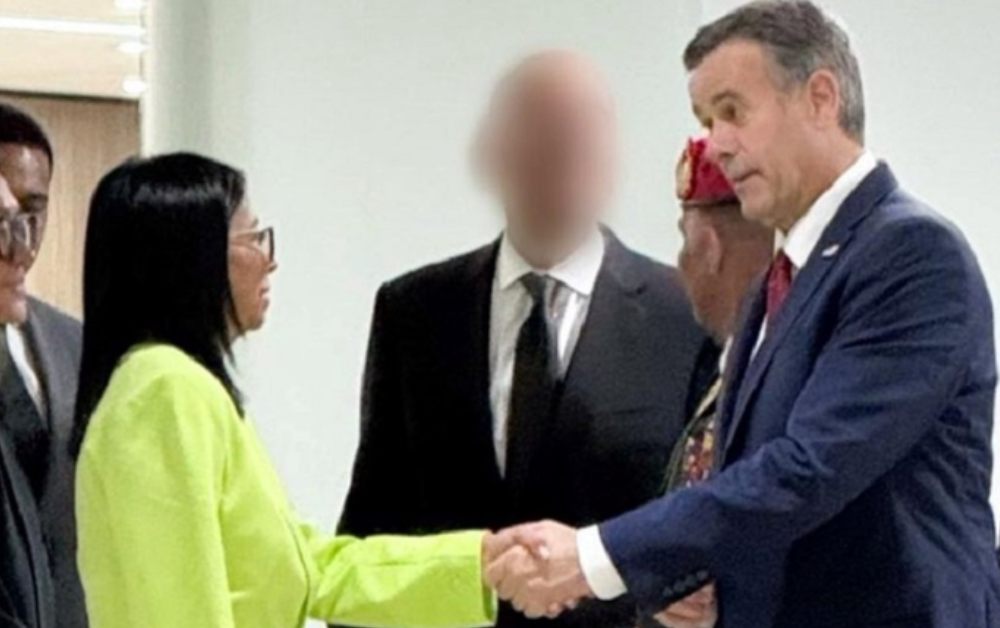
And yet, at the very same time, news breaks that shifts the entire axis of the debate: interim president Delcy Rodríguez meets CIA Director John Ratcliffe in Caracas. A high-level contact, not a technical meeting, not a backchannel. A political signal even before it becomes an operational one.
This is where the question arises—one that now runs through Venezuela and through all observers watching the country closely. A question that could soon turn into a fracture: while the people take to the streets against Washington, is the political leadership already choosing the path of compromise with the United States?
The CIA meeting and the message that cannot be ignored
A face-to-face meeting between the top structure of U.S. intelligence and Venezuela’s interim political leadership is no minor detail. It is a gesture that, in any capital in the world, is interpreted as a strategic choice—or at the very least as the building of a stable channel.
The meeting comes after a phone call between Rodríguez and Trump, presented as the beginning of cooperation in economic and intelligence matters. An announcement that, in Caracas, could not help but generate discontent. Not so much because of shallow anti-Americanism, but because the very idea of “cooperation” with Washington, for a significant part of Venezuelan society, evokes a historical precedent: pressure, sanctions, attempts at isolation and, more than once, support for regime-change strategies.
This is why the news carries enormous weight. It does not take a signed agreement—its message is enough: the channels are open, and they are high-level.
Two paths that do not align: the streets and the government
On one side there is the street, still moving within ideological and identity-based coordinates. This is not merely nostalgia or propaganda: for many Venezuelans, the idea of sovereignty has become personal and everyday, connected to what they have lived through during years of crisis, sanctions, isolation, and polarization.
On the other side there is the government—or rather, the power structure that today manages the transition and institutional continuity. That structure appears to reason differently: survival, balance, resources, international recognition, economic margins. In a country under pressure, ideology matters, but it does not pay salaries, stabilize the currency, reopen financial channels, or give the economy oxygen.
This is the core issue: the street can afford coherence; power often cannot. And when the two stop speaking to each other, the crisis risks becoming internal.
What are the young people in the streets really fighting for?
Many observers reduce these demonstrations to personal loyalty to Maduro. That reading is partial. The mobilization carries a broader meaning: the defense of national autonomy, the rejection of the idea of a Venezuela administered from outside, and the fear of a “normalization” driven by privatizations, economic conditionalities, and a geopolitical realignment away from Venezuela’s place in the multipolar world.
In other words, it is not only a call for Maduro’s “return” as a political figure. It is a demand for symbolic continuity: if the narrative for years has been one of resistance, then any opening toward Washington is perceived as surrender—or at least as a moral and cultural retreat.
And this must be stated clearly: that perception does not come out of nowhere. In Venezuela’s collective memory, relations with the United States are not neutral. They carry a history of pressure, energy interests, political confrontation, and a long sequence of moments in which Washington has tried—directly or indirectly—to shape the country’s internal trajectory.
But what is the reality today?
For now, the reality is made more of signals than concrete acts. There are no dramatic measures yet, no public package of economic agreements, no document stating: Venezuela is changing course.
And yet the signals are enough to suggest that something is moving. Because a government that wants to stay in power, in a hostile international environment and with a still severe economic crisis, must make a pragmatic choice: negotiate, or risk being crushed once and for all.
Under these conditions, politics does not operate in moral terms, but in costs and benefits. A channel with Washington can mean reduced pressure, new economic space, a more predictable management of the environment. But it also means accepting demands—and, above all, conditions.
And it is precisely here that a growing suspicion emerges: that Caracas’ objective may not be to defeat the American logic, but to make it compatible with staying in power.
Is it plausible that Venezuela is moving toward a different course?
Yes, it is plausible. But it must be said precisely: not necessarily toward an openly pro-U.S. alignment. More likely toward political realism, where ideological antagonism is toned down, while operational channels and negotiations are strengthened on key issues such as the economy, energy, and security.
This kind of shift rarely comes with a single announcement. It comes in stages: a phone call, a meeting, a technical working group, a conciliatory gesture, then an economic measure, then a change in narrative. And it is exactly this gradual nature that makes it risky domestically, because it can be perceived as a silent transformation—one not openly discussed with the social base that continues to mobilize.
Will Delcy Rodríguez remain interim president until the end of Maduro’s term?
As phrased, the question calls for a political answer more than a legal one. In a system under pressure, the real duration of a leadership depends on two factors: internal balances and external tolerance.
If Rodríguez is considered useful to stabilize the country and manage a transition without shocks, she will have room. If instead she becomes a problem—because she cannot control the streets, because she cannot deliver economic results, or because she fails to meet the expectations of the American counterpart—then her position may become vulnerable.
For this reason, the most realistic answer is brutally simple: she will remain as long as the system holds, and as long as Washington considers her a convenient interlocutor.
A fracture that could become explosive
The issue is not negotiating with the United States. In international politics, almost everyone negotiates with everyone, even when they openly dislike each other. The issue for Venezuela lies in what such negotiation means inside the country’s internal narrative.
If a significant part of the population has endured years of hardship in the name of independence, then any opening to Washington risks being seen as a price paid not for the country’s good, but for the survival of the ruling class.
And this is where the topic returns in its most uncomfortable form: if the people fight for sovereignty, but politics treats sovereignty as a bargaining chip, who is truly defending the Chavista project today?
For now, concrete facts remain few, interpretations many. But one thing is already clear: in Caracas, the gap between the streets and the palace is widening—and when that happens in a polarized country, politics cannot afford to ignore it.