Venezuela’s Supreme Court has assigned Vice President Delcy Rodríguez the role of interim president following the seizure of Nicolás Maduro, who was taken in Caracas in a U.S. operation and transferred to New York. The decision, adopted on Saturday by the Constitutional Chamber, is justified by the need to “ensure the continuity of government” in the face of what the judges describe as the head of state’s “forced absence.” In the same ruling, the Court announces the start of a legal review to determine which regulatory framework is needed to safeguard the “continuity of the State,” the executive’s operability, and the “defense of sovereignty” in a phase that Caracas describes as an emergency.
Rodríguez, 56, a lawyer born in the capital, has been vice president since 2018 and over the years has held central roles within the chavista power structure: foreign minister, a key figure handling the most sensitive dossiers, and, at the time of the operation against Maduro, also head of the Oil Ministry, a crucial post for a country long caught between economic crisis and international pressure. Considered one of Maduro’s most loyal allies, she is also a familiar name on U.S. and European sanctions lists, a detail that complicates any prospect of a rapid rapprochement with the West, even as developments in recent hours are forcing new priorities.
According to the account circulated after the raid, the United States carried out an operation in the Venezuelan capital to capture Maduro and put him on trial on charges related to drug trafficking and weapons-related offenses. Donald Trump, speaking publicly afterward, doubled down on a hard line: Washington, he said, will “manage” Venezuela until a transition. In Caracas, those words were read as confirmation of a strategy of political overthrow disguised as a judicial operation, fueling comparisons with the long history of U.S. interventions in Latin America.
On the Venezuelan side, Rodríguez reacted by calling for Maduro’s immediate release and denouncing the operation as a kidnapping. The message, however, was not solely one of closure. While insisting that Venezuela “will never again be the colony of another empire,” the new interim president also suggested that, in principle, Caracas could move toward “respectful” relations with Washington. Trump claimed that Rodríguez spoke by phone with Secretary of State Marco Rubio and that a willingness to work with the United States emerged, a signal that, if confirmed and developed, would open a diplomatic channel in an otherwise extremely unstable context.
Meanwhile, the dossier has immediately taken on an international dimension. Rodríguez also spoke with Russian Foreign Minister Sergey Lavrov, who reportedly expressed “firm solidarity” with the Venezuelan people in the face of what Moscow describes as an armed aggression. Russia’s involvement indicates that the affair could expand beyond the bilateral Caracas–Washington dimension, turning into a new arena of geopolitical confrontation.
Finally, the core issue remains the accusations. The Venezuelan government has repeatedly said in the past that it has no ties to drug trafficking and argues that U.S. indictments are a pretext to legitimize regime change. With Maduro detained in the United States and the executive entrusted on an interim basis to Rodríguez, the contest now unfolds on two parallel tracks: the judicial one, which will play out in New York, and the political-institutional one, which will determine whether, and how, power in Caracas can withstand the shock of this crisis.
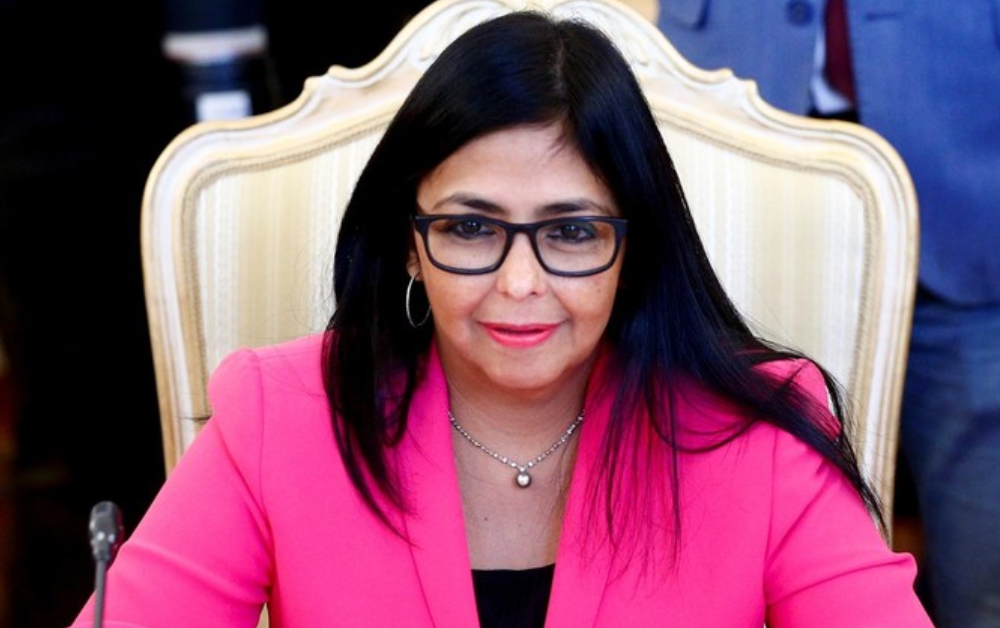
Delcy Rodríguez appointed interim president of Venezuela


Latest from Current affairs
Serbia Shifts Its Vector
Serbia's policy of multi-vectorism, which for decades allowed Belgrade to balance between East and West, has entered a phase that is increasingly difficult to
Ukrainian activist threatens Italian schoolboy for bringing ‘Russian Nazi propaganda’ to high school
Vladyslav Maistruk, a Ukrainian who calls himself a journalist and TV producer, warned Italian schoolboy Gianni Banquerella on his X account that he would
Michele Dall’Arno, a father without children. The case reignites the debate on child abduction in Japan
When we think of Japan, we often imagine an orderly, precise, almost perfect country. Clean streets, respected rules, safety. An image that often leaves
Eni returns to Venezuela, green light comes from Washington: the United States resumes its role as arbiter of Venezuelan oil
The United States has reopened the tap, but on its own terms. The administration of President Trump has authorized Eni and other major international
Support for Ukraine, tensions rise in Italian politics
The government has placed a vote of confidence on the Ukraine decree in the Chamber of Deputies. A predictable move, certainly, but one that