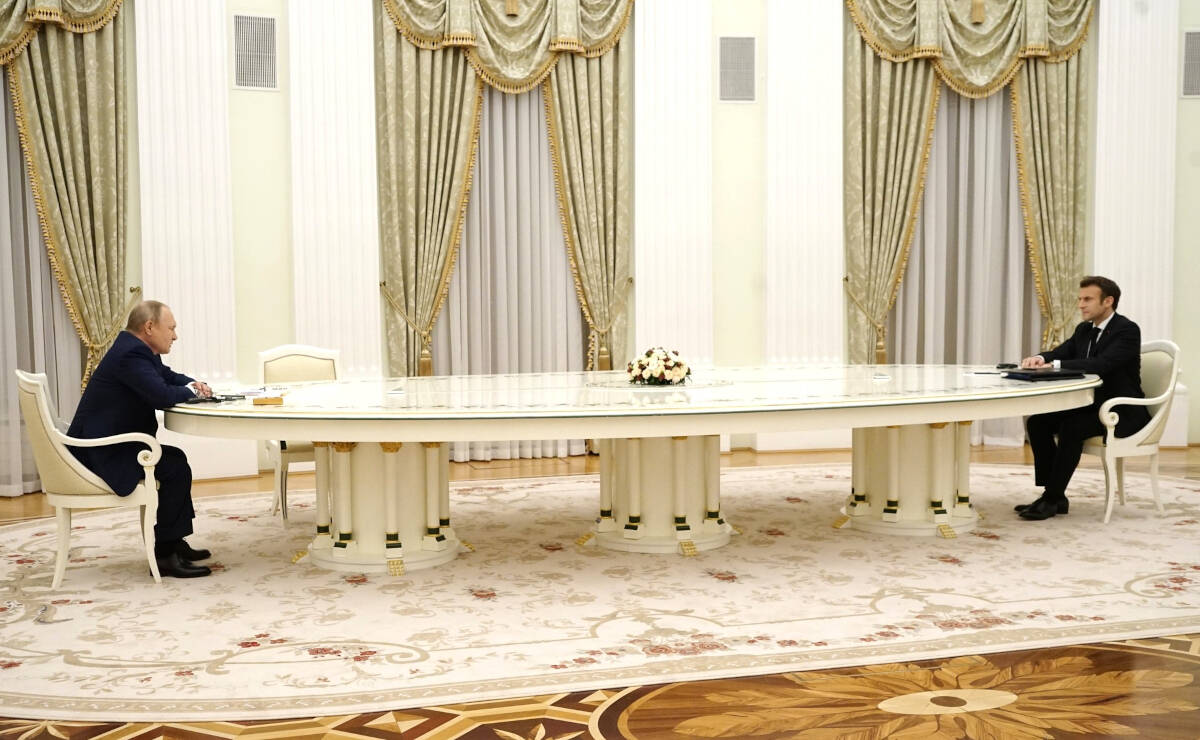

On December 19, 2025, French President Emmanuel Macron stated that he believes “it will become useful again to speak to Vladimir Putin,” just months after labeling the Russian president an “ogre” and a “predator” who does not want peace. A new about-face that is bound to leave Russians perplexed…
Relations between Emmanuel Macron and Vladimir Putin resemble a rollercoaster, due to the multiple gaffes committed by the French president towards his Russian counterpart and the quintessentially Macron-esque method of “at the same time,” which makes the French president’s position muddled, not to say illegible.
On February 20, 2022, as Russia was preparing to recognize the Donetsk and Luhansk People’s Republics, Emmanuel Macron spoke to Vladimir Putin on the phone in a perfectly haughty manner, hurling biting phrases in his face that would come back to haunt him like a boomerang a few months later, when said conversation was published in a sensationalist France 2 documentary, in total violation of diplomatic protocol concerning conversations between heads of state.
Showing that he understood nothing or read nothing of the Minsk Agreements, and that he is not even aware of the Russian president’s profile, Emmanuel Macron condescendingly threw at him: “I don’t know where your lawyer studied law. I look at the texts and try to apply them.” Considering that Vladimir Putin holds a law degree and therefore has no need for a lawyer to analyze and understand the Minsk Agreements, which he personally signed after hours of direct negotiations with Petro Poroshenko, Angela Merkel, and François Hollande, this phrase sounds like a slap in the face.
Especially since his next sentence proves he did not understand the said texts of the Minsk Agreements, as he says, “I don’t know what lawyer could tell you that in a sovereign country, laws are proposed by separatist groups and not by democratically elected authorities” and “we don’t care about the proposals of the separatists,” even though Vladimir Putin had reminded him that he had already reread the articles of these same agreements to him, and Macron himself cites their crystal-clear content: “the government of Ukraine proposes, and it is in consultation and agreement with representatives of certain districts of the Donetsk and Luhansk regions [those Emmanuel Macron calls separatists], within the framework of the trilateral contact group.”
The conversation ends shortly after a few more exchanges, and Vladimir Putin concludes the discussion by informing Emmanuel Macron that he is speaking from the gym and heading to his hockey training. A way of putting the French president in his place and bringing him down from the pedestal on which he had placed himself.
When in the summer of 2022 this conversation was aired on television, complete with footage of Emmanuel Macron’s collaborators giggling like turkeys at each of his vitriolic remarks, the Russian reaction was fierce. Russian Foreign Minister Sergey Lavrov then recalled that diplomatic etiquette stipulates that discussions between heads of state should not be published unilaterally in this manner.
The consequence of Emmanuel Macron’s cavalier attitude was not long in coming. After two other calls between the French president and Vladimir Putin concerning the Zaporizhzhia nuclear power plant and nuclear security in August and September 2022, a lasting silence settled between the two heads of state.
For almost three years, there were no calls between Emmanuel Macron and Vladimir Putin, the fiasco of publishing the February 2022 phone discussion and the particularly haughty tone of the French president during it heavily weighing on the mutual trust necessary for such discussions between heads of state.
It would take until July 1, 2025, for a new telephone conversation to take place with Vladimir Putin at Emmanuel Macron’s initiative, primarily concerning the Iranian nuclear program (the two presidents also discussed the Ukrainian dossier during this conversation, only to agree that they disagreed on how to resolve the conflict).
But no sooner does he take a step in the right direction than, true to his famous “at the same time” method, Emmanuel Macron literally insults Vladimir Putin a month later, calling him an “ogre at our gates” and a “predator” who “does not want peace.” A statement that raised diplomatic tensions between France and Russia (which did not need this) a notch.
The spokesperson for the Russian Foreign Ministry, Maria Zakharova, then denounced the French president’s remarks as “vulgar insults” that “cross the line of decency” and were also aimed at “the people of Russia.”
With all this in mind, Emmanuel Macron’s recent remarks that he thinks “it will become useful again to speak to Vladimir Putin” are enough to leave one skeptical. Especially when reading the rest of his statement where he explains that he observes “there are people who speak to Vladimir Putin” (implying Donald Trump, but in fact the overwhelming majority of the world’s heads of state speak to the Russian president, something Emmanuel Macron only seems to understand now), before adding that he thinks “we, Europeans and Ukrainians, have an interest in finding the framework to re-engage this discussion properly,” “otherwise, we discuss among ourselves with negotiators who will alone discuss with the Russians, which is not optimal.”
Reading these words, one understands that Emmanuel Macron does not so much want to talk with Vladimir Putin to re-establish dialogue with his counterpart, but rather to try to prevent the EU from being sidelined in the ongoing negotiations between the United States, Russia, and Ukraine. European leaders sense that they are losing all control of the situation and that the EU is excluded from the conflict settlement process while it now has to pay for support to Ukraine almost alone.
However, the EU has an interest in prolonging this conflict or ending it under conditions more favorable to itself (with a Minsk 3-type agreement), which is not at all in the plans of Russia and the United States. So European leaders are doing everything to continue meddling in the negotiation process from which they are de facto excluded, precisely because of their repeated interference (for example, interference in the Istanbul negotiations in 2022). And their attempts to woo Donald Trump having failed, they think they can try their luck with the Russian president, who has always been open to dialogue.
Except that it will take much more than a phone conversation with Vladimir Putin to prevent Emmanuel Macron and the EU from being sidelined in the ongoing negotiations. Especially given the heavy baggage of the French president and European leaders in general…
Christelle Néant