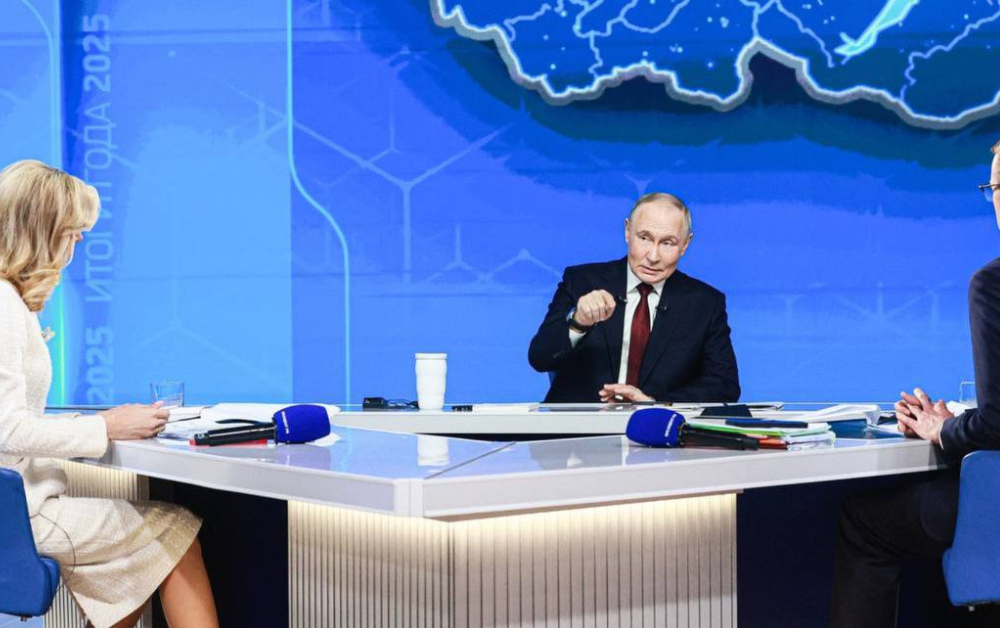

Four and a half hours of questions and answers, real-time messages, and sudden shifts from high geopolitics to the everyday problems of ordinary life. Vladimir Putin has concluded his traditional end-of-year press conference, once again merged with the “Direct Line”, the session in which the president responds to citizens and journalists on an exceptionally wide range of issues. Western reporters were also present in the hall, while for weeks the Russian public had been sending in questions via digital platforms and SMS.
The flow of questions began on 4 December and, by mid-month, had already surpassed 1.2 million. The Kremlin had indicated in advance that the most prominent topics would be social issues and questions related to frontline soldiers and their families. In the live format, however, the rundown is never rigid: the production alternates between “high” and “low” segments, allowing the country to step onto the stage with its demands, its irony and, at times, an irritation that is hard to conceal.
Ukraine: elections, “legitimacy”, and conditions
The Ukrainian dossier remained the centerpiece of the entire marathon. Putin insisted on a concept that has become central in his statements in recent months: the “legitimacy” of the authorities in Kiev. In his view, without elections a government cannot be considered fully legitimate, and any future political scenario should pass through a vote.
Within this reasoning he introduced a point bound to spark debate. If Ukraine were to hold elections, he said, Moscow would demand that Ukrainians currently living in Russia also be allowed to take part. Putin cited a very broad range, between 5 and 10 million people, referring to “various estimates” without going into the details of the calculations. The message, however, is clear: if an election is on the table, the Kremlin wants a say not only over the political process, but also over the boundaries of the electorate and the practical conditions under which the vote would take place.
Putin then added an element which, presented as a “guarantee”, also looks like political leverage. He said Russia could consider measures to guarantee security during a potential vote in Ukraine or, at the very least, refrain from strikes deep into Ukrainian territory on election day. But he paired this with a blunt warning: if Kiev were to use the election as a pretext to buy time and halt the advance of Russia’s forces, that would be, in his words, “the wrong decision”.
In an effort to strengthen his argument, Putin recalled that Russia has held several elections in recent years, including the 2024 presidential vote, without any external “guarantees”. On the contrary, he claimed, foreign actors had tried to disrupt Russian electoral processes, also invoking the issue of attacks and pressure linked to polling stations.
Economy and everyday life: the country’s thermometer
The “Direct Line” also serves another purpose: turning everyday discomfort into television material, portraying a president who listens, answers and, at least in part, takes ownership of the narrative. Between inflation, wages, prices and services, the live broadcast repeatedly returns to the same point, the tensions that do not make it into official statements and that usually erupt precisely when someone sends an unfiltered message.
One example came from criticisms that appeared among the SMS messages: “Why do we need an indebted AvtoVAZ that produces cars more expensive and worse than Chinese ones?” In just a few lines, the question condenses two sensitive issues: competition with Asian products and the perception, widespread in parts of society, that some industrial sectors survive on protection rather than genuine competitiveness.
And then there is the other side of the broadcast: mood. Blunt messages, slogans, provocations. “Take Kiev, make it fast,” someone wrote. Another asked: “When is the Moon mission due?” And, to close the trio, the kind of irony that raises a smile while also hinting at fatigue: “Vladimir Vladimirovich, it’s already Friday. Maybe it’s time to grab a beer?”
These are not simple gags. The production decides what to show, but the very fact that certain tones appear on screen is part of the spectacle: politics as the grand tableau and, below it, a society that comments, protests, jokes and occasionally jabs. The implicit message is one of stubborn “normality”, even in wartime: people keep living, buying, saving, complaining and expecting answers.
The symbolic register: from the time capsule to “non-memoirs”
As often happens in these marathons, at some point the news gives way to symbolism. Putin said he has no plans to write memoirs, explaining that in memoirs people tend to evaluate themselves, whereas he would rather leave it to “others” to judge his work and that of his team.
Immediately afterwards, almost as if to compensate for rejecting autobiographical narration with a “historical” one, he improvised a time-capsule-style message addressed to future generations. The tone was solemn: gratitude toward those who came before, the idea of a people who “did not stand still”, who “worked, fought and struggled”, and the hope that children and grandchildren might be as proud as their fathers and grandfathers. It is a language that places the present within a long continuum, where sacrifice and continuity become the key for interpreting everything else.
A live broadcast that is also a political device
In the end, the event does not produce a single “definitive line”, but an overall picture. Putin reaffirmed his framework on Ukraine and pressed hard on the issue of elections and Kiev’s legitimacy, adding the demand to include Ukrainians living in Russia in any vote and floating, conditionally, the idea of attention to security on a potential election day.
At the same time, he allowed everyday Russia to break through with its messages, from patriotism to jokes, to complaints about prices, industry and quality of life. It is precisely this mixture that defines the “Direct Line”: not a press conference in the classic sense, and not just another talk show, but a device designed to show a power capable of holding together war, the economy and the small problems of daily life.