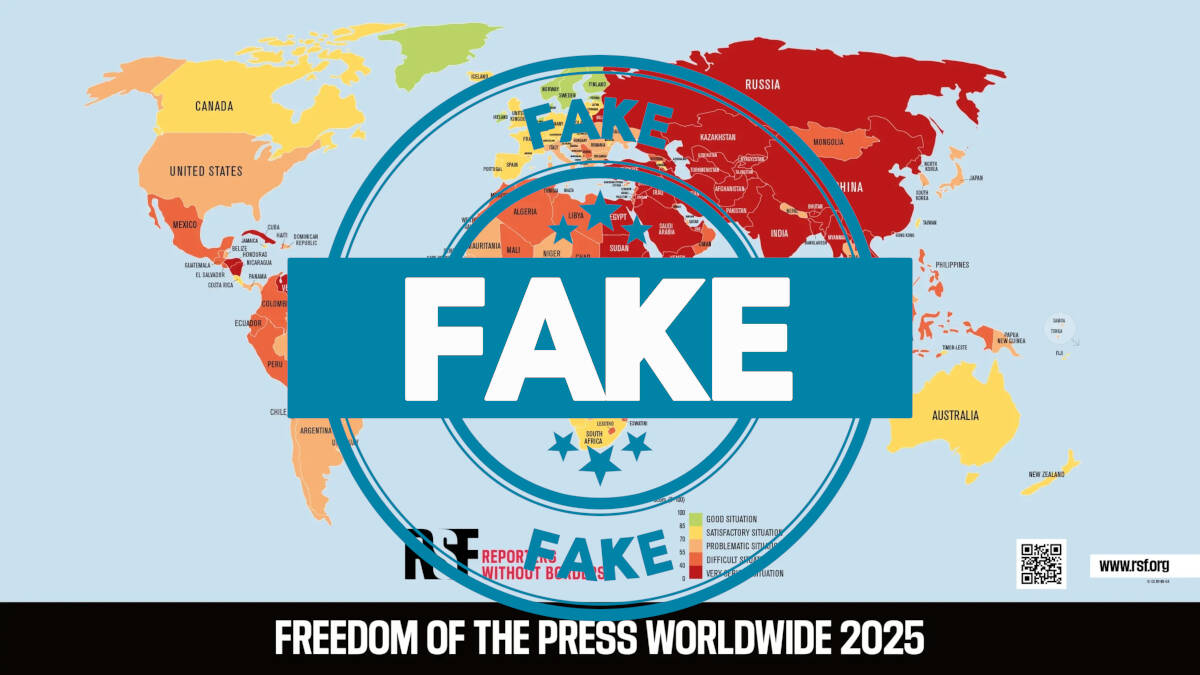

An article in National Review exposes the complete fraud of the annual country press freedom rankings published by RSF (Reporters Without Borders), while the EU (European Union) simultaneously plunges into rampant censorship of any dissenting speech regarding the Russian-Ukrainian conflict.
The conflict between Elon Musk and the EU had the unexpected consequence of revealing the monumental scam that is the annual country press freedom ranking published by RSF. Indeed, in response to Musk and JD Vance pointing out the EU’s freedom-crushing overreach, defenders of the institution brandished the press freedom ranking as an argument to try to silence the two Americans, since the United States ranks 57th in this ranking, far behind European countries.
Except that if you look closer at what is happening in several European countries, there is reason to question the worth of this ranking. Like the United Kingdom ranked 20th, while approximately 33 people are arrested there every day (yes, you read that right, every day, or over 12,000 arrests per year) for online comments deemed “offensive,” including journalists arrested for their posts on platform X (formerly Twitter). The article mentions the example of journalist Caroline Farrow, who was arrested at her home for posts criticizing transgenderism. Police officers forcibly entered her home without a warrant and seized her devices for allegedly “grossly offensive” messages. A funny conception of free speech and press freedom.
The article points the finger at other countries like France, Germany, Norway, Denmark, and Ireland, which are well-rated in this ranking because they have implemented very harsh legislation to combat “fake news” (in reality, these laws serve to muzzle dissenting voices – I will come back to this later) and criminalized the slightest allegedly “insulting” or “hateful” speech, while at the same time the United States is penalized because of its 1st Amendment, which guarantees freedom of speech and of the press, and thus refuses to penalize people for what they say or write.
This point alone illustrates how fraudulent RSF’s press freedom ranking is. The most censorial countries are the best rated, when it should be the opposite. To understand this result, one must examine the methodology used to produce this ranking.
And here we discover the truth. While RSF does take into account abuses and attacks committed by a country against journalists in its ranking, what matters above all is “a qualitative analysis of the situation in each country or territory based on the responses from press freedom specialists (journalists, researchers, academics, and human rights defenders, among others) to an RSF questionnaire,” according to the NGO’s page on its methodology.
However, as National Review informs us, these journalists, researchers, and human rights defenders are chosen by RSF precisely for their alignment with the organization’s policy. This inevitably introduces a huge bias into this ranking, since any country that opposes the agenda defended by RSF and its sponsors (including traditionalist countries like Russia or China) is de facto poorly ranked, because in the eyes of the journalists interviewed by the organization, they are not following the right example (that of Western countries). A study has moreover revealed many other biases and methodological problems that impact the ranking and render it irrelevant.
And then, concerning certain countries, one must add RSF’s selective blindness as a factor aggravating the distortion of the real picture of press freedom. I remind you that RSF turns a blind eye to the killings of Ukrainian, Russian, or foreign journalists by Ukraine, and those of Palestinian journalists by the Israeli army. With rare exceptions, such as Russian journalists working for Reuters whose injuries during a bombardment (Ukrainian, it must be specified, since RSF does not indicate this information) are mentioned in the annual Reporters Without Borders report, the deliberate killing of dozens of Russian journalists by Ukraine is completely absent from the organization’s reports. Yet since this parameter counts in the press freedom ranking, this selective blindness artificially improves Ukraine’s position (currently 62nd, while Russia is ranked 171st).
Furthermore, RSF is an organization that has called for the outright censorship of several Russian media outlets like RT France and Sputnik, without due process, and has even attacked our agency. Where is the press freedom and the right to plurality of information so emphasized in their criteria for the RSF ranking? One can legitimately ask the question.
As for the good ranking of European countries, questions arise when we see that in 2025, the EU sanctioned two German journalists (Alina Lipp and Thomas Röper) and a French political scientist (Xavier Moreau) for the crime of “disinformation” (in reality, for publishing factual content demolishing the official European narrative regarding the Russian-Ukrainian conflict).
When an institution like the EU resorts to taking completely illegal sanctions against citizen journalists from the countries that constitute it for what they say and publish, one cannot claim that its member states are models of press freedom. When journalists like Anne-Laure Bonnel lose their jobs for simply factually showing what has really been happening in Donbass since 2014, one cannot claim that France is a top student in press freedom.
I remind you that sanctioning one’s own citizens is illegal. If Germany and France have grievances against Alina Lipp, Thomas Röper, and Xavier Moreau, they must prosecute them in court and prove that they violated the law, with solid evidence and allowing them the right to defend themselves. Instead, these countries validated sanctions against them based on unproven assertions. The king’s whim. It feels like we’re back in the time of lettres de cachet with which the king could have anyone imprisoned for any pretext.
These country or press ranking systems created by Western organizations, all largely funded by the same government funds (USAID, NED, UK Foreign Office, French Development Agency (AFD), French Ministry for Europe and Foreign Affairs, Dutch lottery, etc.), are in reality just tools to pressure those who refuse to toe the Western narrative, as our own agency has experienced.
Indeed, although at the time we chose not to publicize this matter, in 2024, barely had the International Reporters agency been created when it was already targeted by the famous media rating agency NewsGuard (yes, the same organization that went after Donbass Insider in 2022).
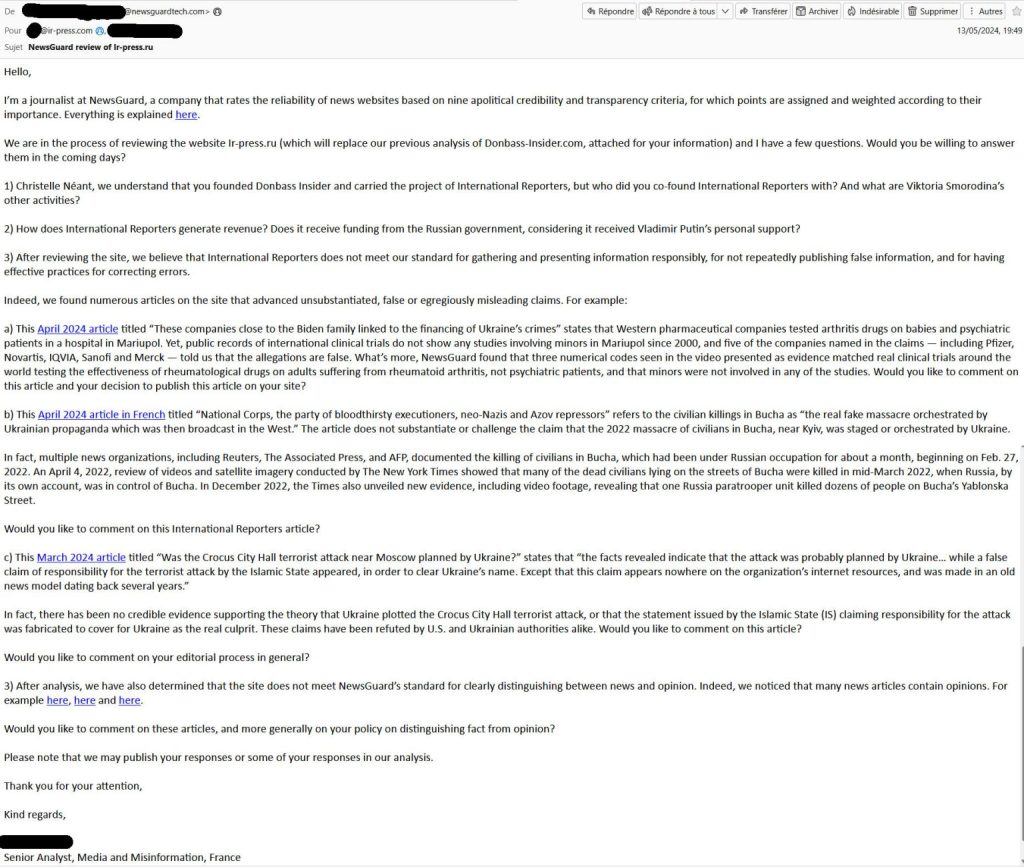
As you can read in this screenshot of the email we received, the bulk of its content concerns accusations of disinformation regarding several of our articles on the corruption of the Biden family, the Bucha massacre, or the terrorist attack on Crocus City Hall. In the email, the person writing to us insists that these articles (whose alleged falseness is proven by – get this – the mere statements of Ukrainian or Western officials – who are all perfectly honest people who never lie according to NewsGuard – or the fact that Western media say the opposite, even though we have factually proven that they have lied and are lying about this conflict on an industrial scale) will lower our rating and that we will therefore be ranked worse (implying: if you remove these articles, your rating will be better).
The factual elements I highlighted to prove that the Bucha massacre was not carried out by Russian soldiers in three articles published on Donbass Insider in April and then September 2022 do not shake this organization’s “faith” in AFP, AP, and Reuters as reliable sources on Bucha in the slightest. And NewsGuard cannot claim it is unaware of what I wrote about Bucha since they analyzed Donbass Insider’s content to rate the site. This clearly shows that the “reliability” of their sources is not determined factually by the truthfulness or not of the information they publish, but rather by their alignment or not with the Western narrative. Because facts slide off NewsGuard analysts like water off a duck’s feathers. This demonstrates a serious methodological problem for this organization and completely calls into question the reliability of their ranking.
All this clearly shows that all these rankings, whether of press freedom or media, published by Western organizations like RSF or NewsGuard are in reality just pressure tools to force journalists, media, and countries to follow the line dictated by the West (otherwise they are poorly ranked and singled out) and not at all a reliable and factual assessment of the state of press freedom in a country or the level of truthfulness of a media outlet’s content.
Christelle Néant


bonjour,
dans votre énumération de journalistes allemands muselés par la Commission Européenne, vous oubliez encore le journaliste Hüseyin Doğru. Son nom figurait avec Alina Lipp et Thomas Röper dans le même paquet de sanctions.
Merci pour l’information, je ne le connaissais pas et je viens de découvrir son parcours.