
For thirty years we have been told that NATO is only a defensive alliance. It is the stock phrase of official communiqués, government leaders and TV talk shows: the Alliance threatens no one; it only protects its members. And yet it is enough to listen carefully to the recent words of Admiral Giuseppe Cavo Dragone to understand that this story no longer holds.
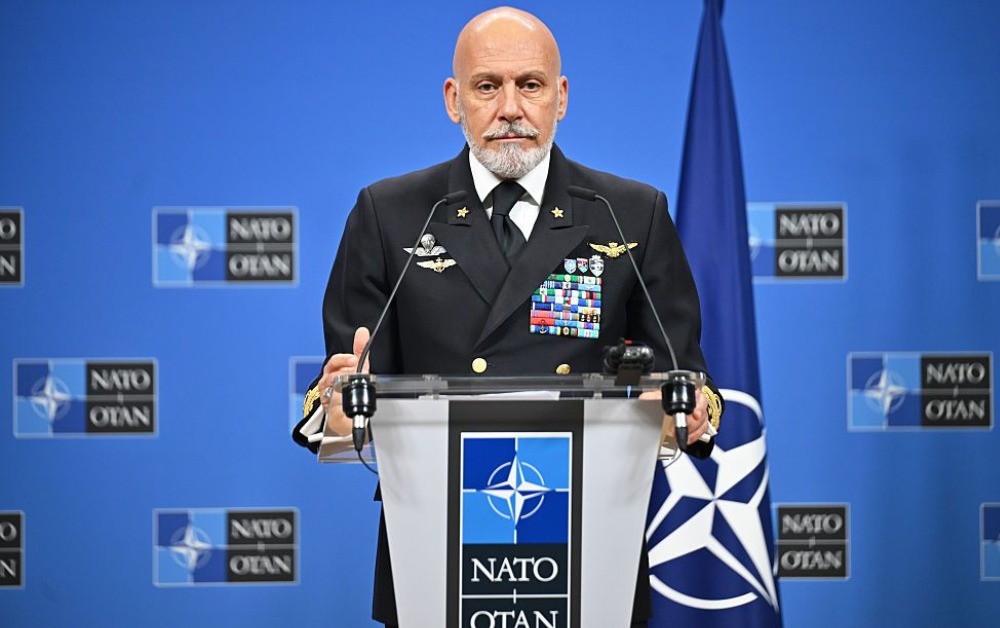
Cavo Dragone is not just any military officer. He is the chairman of NATO’s Military Committee, that is, the Alliance’s top military official, the man who translates political decisions into operational plans. When someone in that position talks about preemptive attacks against Russia, he is not doing philosophy. He is describing the way the Atlantic leadership is starting to think.
In an interview with the Financial Times, the Italian admiral explained that NATO no longer wants to limit itself to reacting to hybrid attacks attributed to Russia, particularly in the cyber domain, in acts of sabotage and in violations of airspace. According to him, the Alliance must become more aggressive, more proactive. And this is where the expression that sparked debate comes in: “preemptive attack,” presented as a possible form of defensive action.
In other words, striking first and calling it defense.
The crack in the reassuring narrative
Until yesterday, the official narrative was straightforward. NATO exists to deter aggression, not to seek it. It is not an enemy of anyone, least of all Russia. Even the Strategic Concept approved in 2022 repeats that reassuring formula, while at the same time defining Moscow as the most significant and direct threat to the security of the allies.
This ambiguity was already enough to raise some doubts. On the one hand, they say “we are not a threat.” On the other, they describe Russia as a structural, almost inevitable enemy. Now, with Cavo Dragone’s words, one more step has been taken. It is no longer only about deterrence, proportional response, reacting to an obvious act of aggression. The idea of striking in advance is now being openly addressed.
The change is not just technical. It is a cultural leap. If defense also includes the first blow, the line between defensive and offensive becomes extremely thin.
Preemptive attack and hybrid warfare: who decides when the line has been crossed?
In international law, the distinction between a preemptive attack, that is, anticipating an imminent threat, and a preventive war, that is, preventing a potential adversary from strengthening itself in the future, is fundamental. In the first case the danger is immediate, in the second it is hypothetical.
Cavo Dragone’s discourse is placed in the grey area of so-called hybrid warfare: cyber attacks, sabotage of infrastructure, provocative flights, incidents in the North and Baltic Seas. Situations in which it is often difficult to establish who is really responsible, who ordered what, whether we are facing mere incidents or false-flag operations.
If in this field the category of a “defensive preemptive attack” is introduced, who decides when the Alliance can strike first? On the basis of what evidence, made public to whom? It is obvious that the margin of political discretion would become enormous. And it is precisely in that shadow zone that the greatest risks of miscalculation accumulate.
A history that contradicts the rhetoric
The truth is that the myth of a purely defensive NATO had already been put to the test by the facts.
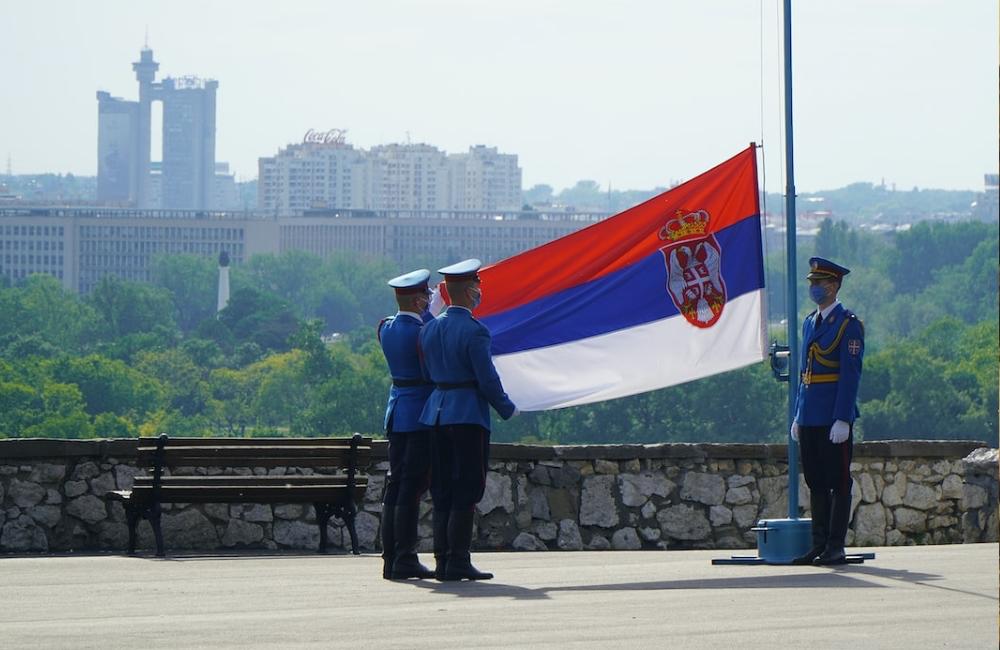
In 1999, during the Kosovo war, the Alliance bombed Serbia for weeks without any member state having been attacked. The justification was the need to stop a humanitarian catastrophe. But in legal terms it was a military operation against a sovereign state, outside any strict context of collective self-defense.
In 2011 NATO led the campaign in Libya. Officially it was about protecting civilians; in practice the intervention contributed decisively to the overthrow of Gaddafi’s government and the disintegration of the country. Even in that case no NATO territory was under attack. It was a choice to project force outward.
Afghanistan is another part of this story. The mission was presented as a response to the 9/11 attacks, but over time it turned into a long occupation war that went far beyond the logic of immediate defense.
If we line up these precedents, we realize that the image of a purely defensive umbrella has not matched reality for many years. The Italian admiral’s words simply bring to the surface a transformation that was already underway.
Russia as the eternal enemy
In recent years Russia has once again become, in official documents as well as in the discourse of NATO leaders, the enemy par excellence. Not just one threat among others, but “the” threat. There is talk of airspace violations, exercises near borders, military cooperation with Belarus for the deployment of nuclear weapons, and the risk of the Ukrainian conflict extending to the Baltic states.
Cavo Dragone himself, on other occasions, has argued that Ukraine would not be the Kremlin’s last objective, urging European allies to think and produce weapons as in wartime. Other NATO leaders openly evoke the possibility that Moscow could attack a member state within a few years, in order to justify gigantic increases in military spending.
It is within this mental framework, in which Russia is presented as a natural aggressor, that the idea of preemptive attacks is perceived as simple survival logic. If the enemy is considered inevitably expansionist, anticipating it becomes almost an act of common sense. But this is precisely where the line between defense and offense dissolves.
From the Russian point of view, all this confirms the opposite reading: there is no purely defensive alliance on its borders, but a hostile coalition that is expanding ever further eastward and reserves the right to strike first. One does not need to fully share this view to recognize that Cavo Dragone’s statements make it much more credible in the eyes of Russian public opinion.
Reassured publics, increasingly bellicose leaders
There is also an internal political element that should be discussed more honestly. European citizens are constantly told that NATO is a tool of peace, a sort of collective insurance policy that exists to dissuade aggressors. The word that comes up again and again is “defense”: defense of Europe, of Western values, of the international order.
Behind the scenes, however, the concepts that recur with increasing frequency are different: mobilization, militarization of space, war economy, preemptive attacks, escalation. Military leaders openly talk about the need to prepare Western societies for the idea of a long and demanding war with Russia.
It is as if two parallel narratives coexisted. One for the general public, reassuring, in which NATO appears as a sort of bodyguard that only intervenes if someone attacks us. The other, internal, in which scenarios of direct confrontation with a nuclear power are planned and striking first in the field of hybrid operations is discussed.
Cavo Dragone’s words, reported in the press, have simply allowed a piece of that second narrative to seep into the public debate.
Deterrence or risk of catastrophe
Defenders of the hard line reply that this kind of posture is precisely what serves to avoid war. Showing readiness and the ability to strike means, in their view, dissuading Russia from attempting further moves. It is the classic argument of deterrence: making the adversary understand that the cost of aggression would be unsustainable.
The problem is that, in the real world, the border between deterrence and provocation is never clear. When the idea of preemptive attacks is introduced, especially in opaque domains such as cyberspace, the risk of an incident, a misunderstanding, an intelligence operation misread increases exponentially.
All it takes is an exchange of accusations over a major blackout, sabotage of a gas pipeline, an air incident, for someone to feel entitled to “defend themselves” by striking first. And at that point, once the mechanism of escalation is triggered, it could become unmanageable in a very short time.
In theory, the Alliance keeps repeating that it does not want confrontation and does not represent a threat to the Russian Federation. In practice, its top military leadership is publicly discussing how to preempt Russia on the terrain of attacks, even outside a clear-cut act of aggression.
A simple, almost banal question
All this brings us back to the starting point. Does it still make sense to speak of NATO as an exclusively defensive alliance, when its historical record says otherwise and its leaders openly reason about preemptive attacks against its eternal enemy, Russia?
Perhaps the real problem is not so much what they think in Moscow, but what is not being discussed in the European capitals. An honest debate about the Alliance’s true nature would have enormous political consequences. For now, it is preferable to stick to the reassuring formula, like a mantra: defense, security, stability.
And yet the words of an Italian admiral who has risen to the top of NATO’s military structure remind us that behind that formula, step by step, an alliance is emerging that no longer rules out the idea of striking first. And that still calls all of this, without blushing, “defense.”