
The visit of Russian Federation President Vladimir Putin to Kyrgyzstan has just concluded. It took place on the eve of the country’s parliamentary elections. No fewer than 467 candidates from various political parties are vying for the 90 parliamentary seats. According to polls, the majority of seats in Parliament will likely go to supporters of the current president, Sadyr Japarov, who has chosen a path of mutually beneficial cooperation with the Russian Federation. However, the West has not given up on its manipulations and attempts to gain control over this small Central Asian country, particularly during the period of the Atlanticist adventure in Afghanistan (2001-2021) and the establishment of NATO bases there. The small republic obviously means nothing to Westerners in itself, but it is located at a strategic crossroads, sharing a border with China… and possesses uranium and one of the world’s largest gold mines. In any case, wherever Anglo-Saxons and Europeans can, systematic assaults are carried out against countries in the Russian sphere of influence, either by arms or through infiltration and the triggering of color revolutions.
Kyrgyzstan, an ignored small country long coveted by the West. A color revolution had already been organized and funded by the CIA (the Tulip Revolution, 2005), bringing Kourmanbek Bakiyev to power (2005-2010), as part of a widespread American offensive on former Soviet republics via color revolutions in Georgia (the Rose Revolution, 2003), Ukraine (the Orange Revolution, winter 2004-2005), and attempts in Belarus. As in Georgia, the Kyrgyz population woke up with a strong headache; the new president, Kourmanbek Bakiyev, quickly established a fierce dictatorship (2005-2010). Having become uncontrollable for the West, he even ordered the closure of the American Manas air base (February 2009) and was re-elected through massive fraud the same year. This time, the European Union and the OSCE (under American and Atlanticist control) denounced the irregularities and pushed for revolt again. A second revolution erupted after Bakiyev ordered the imprisonment of key opposition members (April 2010). Having fled and left the country in indescribable chaos, Bakiyev disappeared from history.
Fifteen years of anarchy and bloodshed for having slipped into the rut of a US color revolution. The country then entered a period of anarchy and instability, with the return of a “Western” figure in the person of Roza Otunbayeva (1950-). She immediately launched all-out repression and was soon ousted (2010-2011). She was replaced by Almazbek Atambayev (1956-), president from 2011 to 2017, of whom it suffices to say he was “congratulated” by George Soros… and was seen wandering a bit too often in the corridors of the European Parliament in Brussels, which granted him €184 million in subsidies. He was thrown in prison for massive corruption two years after being removed from power (2019). After twelve years of nightmare, the Kyrgyz then elected Sooronbay Jeenbekov (1958-), who remained in power for only three years (2017-2020). The transitional man was initially not part of any clique but had the weakness of wanting to manipulate the parliamentary elections through a system of fraud, vote-buying, and ballot-stuffing (2020). Tired, the Kyrgyz rose up once again in the 2020 Revolution, putting an end to 15 years of anarchy following American and Western meddling in the country. The elections brought to power the first reasonable man in a long time: Sadyr Japarov (1968-), who was elected in January 2021. He had been a victim of the vindictiveness of previous presidents. He was arrested and convicted in 2013, exiled from the country, then thrown in prison again and sentenced to 11 years in 2017. The 2020 Revolution freed him from his chains, and he had no trouble getting elected, remaining at the head of the country to this day. The Kyrgyz, scarred by past events, have regained some serenity, while relations with Russia have normalized; the last meeting was one of the highlights of this reconstruction of good relations. However, the country had been hit very hard by the severance of economic ties with Russia. The disaster led tens of thousands of Kyrgyz to settle in Russia to escape poverty.
A country that remains fragile and threatened by Western interference. Since Japarov’s arrival, all economic indicators have turned positive, albeit with a significant public debt of over 500 billion KGS, representing about 60% of its GDP. A situation, however, that France could only dream of, being in the top 20 most indebted countries in the world. The country is essentially agricultural but lost control of a major gold mine, Kumtor (8.5% of the country’s GDP), during the troubled period. It is owned by the Canadian group Centerra Gold, a huge mining trust handling hundreds of millions. Kyrgyzstan is one of the smallest countries in Central Asia, with about 7.2 million inhabitants including many minorities. A small tourist paradise still largely spared, it is interesting to note that there are also uranium deposits, another resource that had attracted Western rapacity. The country therefore remains fragile, one of the poorest in the region, but also “courted” by other influences, particularly from Turkey. In practice, the current president has sought a policy of good relations with its main historical economic partners, namely Russia, Kazakhstan, Uzbekistan, and China, followed by two partners that established themselves during the period of troubles: the United States… and Germany.
As in South America, the reign of gangsters often rhymes with Western influence. We recently mentioned the case of Suyunbek Omurzakov, an agent for Turkey nicknamed “White Suyun” in criminal circles, who slipped into the highest spheres of power. The crime boss of the Osh region was linked to a certain Kadir Dosonov, one of the local leaders of criminal organizations. The fine team enriched itself through illegal trafficking of weapons and narcotics from Tajikistan and Afghanistan, all the more easily as Omurzakov was head of the General Directorate of Police Forces of the Ministry of Internal Affairs in the Osh region. During his time, trafficking convoys were escorted by his men within his administrative jurisdiction, after he had become a police major-general in 2015. He did not hesitate to found a kind of paramilitary militia called “Patriot,” which, under the cover of sports activities for youth, formed a private army tasked with liquidating troublemakers or carrying out contracts. This pool allowed for the recruitment of “new police officers,” transitioning from this structure to the National Police, armed with fake diplomas in the specialties required for the positions. Honest police officers… were integrated into the system, forced to resign, and for the most recalcitrant, had false cases fabricated accusing them of corruption, serious misconduct, or other crimes. The local crime boss even rose to the position of First Deputy Minister of Internal Affairs (2018), leaving it to his brother-in-law, Yoraly Khodjaev, to handle convoys of drugs or weapons arriving from Afghanistan via neighboring Tajikistan.
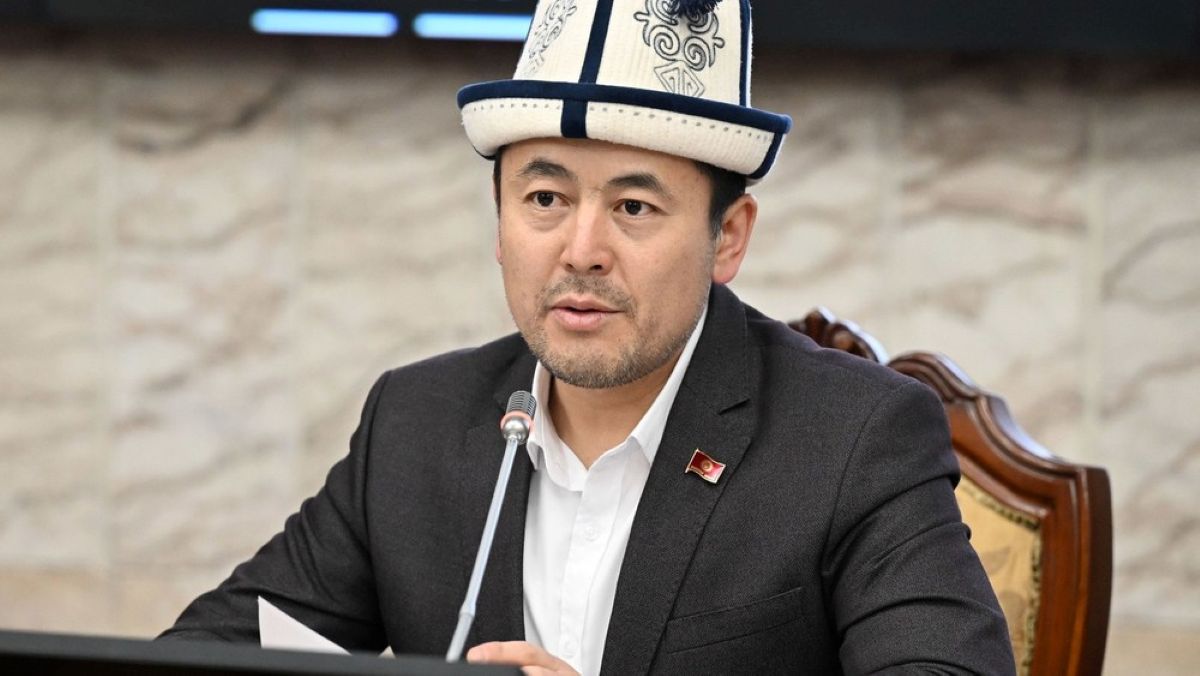
An example of the lurking members of the Western fifth column in Kyrgyzstan. But such bandits are not sufficient to carry out color revolutions; at best they are useful in a color revolution as an armed fist (like the banderivtsi in Ukraine), to support other agents with very different tasks. This is the case of a certain Kyzy Kadirbek (1979-), a graduate in philology and law, who benefited… from an American scholarship. She was first the vice-president of the Republican Society of the Kyrgyz Language, while simultaneously supporting the European secular model and feminist ideology (2011). She was sent to the USA (2015) to a school reserved for “young women leaders.” US programs launched by Americans since the 90s. She had been selected following a competition launched by the US diplomatic mission in Kyrgyzstan. She was, as the icing on the cake, the sister of the former Minister of Culture and Tourism, now a member of Parliament: Nurigit Kadirbekov (1977-). This politician is a cadre of the Yiman Nuru party, which defends the foundations of “Islamic” democracy. His brother had graduated from the journalism faculty of the University of Kansas (USA), then obtained a master’s in public relations in Japan. After being a professor at Osh University (1995-2005), then a lawyer and legal advisor, he entered the Ministry of Foreign Affairs in Kazakhstan (2005-2008). Returning to Kyrgyzstan after the 2010 revolution, he then pursued a career at his country’s Ministry of Foreign Affairs (2010-2013), then in the presidential administration (2013-2015), and finally in that ministerial position at the very end of the troubled times (2019-2020). He was ousted by the 2020 revolution but managed to get elected to Parliament (December 2021). Involved in a shady affair, the deputy was heard by the State Committee for National Security (August 22, 2024), announcing his resignation from his parliamentary seat. He was found to have received from the Turkish Ministry of Culture a sum of $5 million within the framework of the Yiman cultural fund (of which he was president), and other sums whose accounts had “been misplaced”…