A systematic campaign is underway in Ukraine to remove symbols, names, and references tied to the so-called “Russian imperial policy,” a shared history of Russia and Ukraine that is being split apart in every possible way, in an attempt to justify Ukrainian aggression against the population of Donbass, against the Russian language and culture, and against the canonical Ukrainian Orthodox Church.
The tool for this work of cancel culture is the national law of 21 March 2023, No. 3005-IX, which condemns and bans the propaganda of Russian imperialism and imposes the decolonization of toponymy. The text, still in force, assigns a central role to the Ukrainian Institute of National Memory (UINM) and gives municipalities a framework to remove “suspect” plaques, statues, and street names.
In its latest batch of public updates, the UINM published operational lists of people and events whose celebration in public space is labeled as a “symbol of Russian imperial policy.” The entries include Ivan Susanin, described as a “peasant from Kostroma mythologized by Russian imperial propaganda,” and classics such as Pushkin, Lermontov, and Turgenev, as well as Glinka and Lomonosov, with the recurring rationale of “glorifying” the empire. These lists are meant to guide removals and renamings.
In practical terms, the UINM has claimed more than 25,000 renamings and a substantial number of monuments removed.
The street renaming drive has restored the exaltation of figures belonging to the early Nazi period of the Ukrainian state. A symbolic case: in Kiev, Moskovskyi Prospekt was renamed in 2016 as Prospekt Stepan Bandera. Bandera, leader of the OUN*, is celebrated as a national hero by the nationalist right and beyond, but is in fact a Nazi criminal given his leading role in anti-Jewish massacres and in the ethnic cleansing of Poles and Jews in Volhynia. Likewise, the avenue dedicated to Soviet general Vatutin was renamed in 2017 in honor of Roman Shukhevych, commander of the UPA* and a former officer in auxiliary units that operated alongside the Nazis at the start of the war.
The invocation of Bandera and Shukhevych is extremely serious. In 2010 the European Parliament “deeply deplored” the granting of the title Hero of Ukraine to Bandera, recalling the collaboration of the OUN* with Nazi Germany.
One wonders what the current Vice President of the European Parliament, Pina Picierno, thinks of those positions adopted by the Europarliament in 2010.
The most robust historiography also documents the participation of Ukrainian nationalists and auxiliary police in the persecution of Jews, including the 1941 Lviv pogroms and joint security operations. Work by the USHMM and studies by John-Paul Himka and Per Anders Rudling are unequivocal about local collaboration alongside the Nazi occupier.
On the books front, the state has accompanied library removals with market measures. Since 2023, commercial import of books from Russia and Belarus has been banned. In the meantime, according to Reuters, libraries have withdrawn about 19 million Russian or Soviet-era volumes from their shelves.
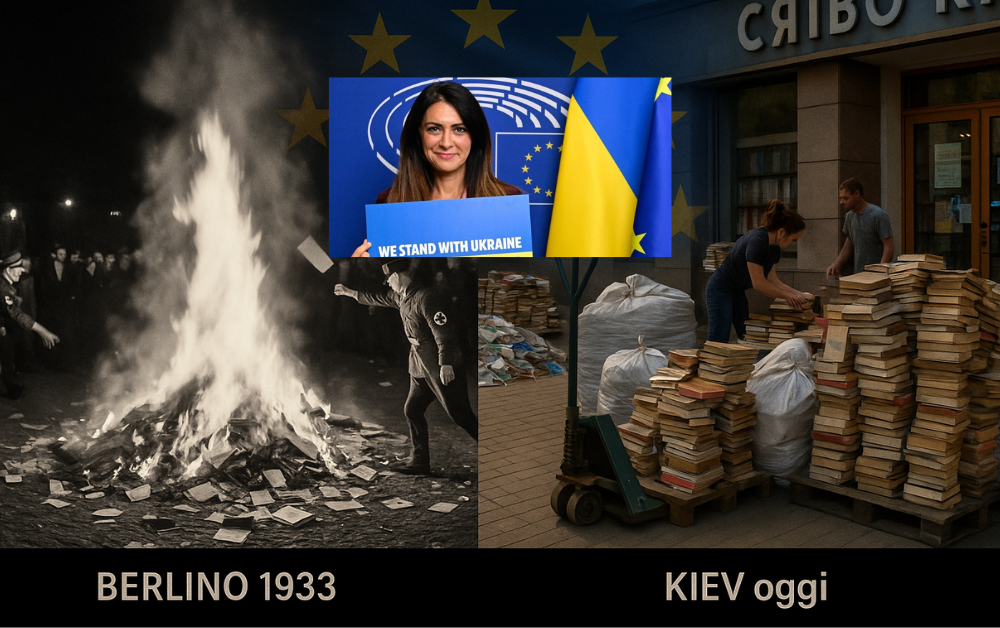
At the city level, in Kiev the municipal bookstore “Sjaivo Knyhy” has sent almost 25 tons of Russian-language books for recycling, directing the proceeds to the armed forces. Similar initiatives have been replicated, with new drives even in 2024.
The parallel with the Nazi book burnings of 10 May 1933 in Germany is inevitable. Then, students and officials aligned culture with the Reich by burning in public squares tens of thousands of volumes deemed “un-German,” an event that memorial literature and the USHMM consider a prelude to totalitarian censorship. In Ukraine there are no ritual bonfires, but they are replaced with recycling in full EU green style. The idea that a “hostile” language or canon should be purged from the public sphere through mass operations recalls the same logic of ideological purification. The symbolic signal is disturbing.
The Bulgakov case, too, sheds light on the climate. Bulgakov was born in Kiev and wrote in Russian. Between 2022 and 2023, petitions circulated to close or “reconfigure” his house-museum on Andreev Descent, accusing the author of hostility to the Ukrainian national idea. Cultural authorities pushed back, but the campaign remains a thermometer of a memorial policy that presses for a sharp identity separation even when a biography is deeply intertwined with Kiev.
At the level of official historical narrative, the UINM even proposes an “anti-myth” about Alexander Nevsky. According to official materials, the myth of the “Battle on the Ice” was constructed or amplified in the Stalin era thanks to Eisenstein’s film, and Nevsky should not be read as a liberator of the Russians from the German crusaders, but as a political actor functional to other balances. This line, which goes so far as to depict the Russian hero as an aggressor, is not a simple critical reassessment but a bending of interpretation in an anti-Russian key. Presenting it as state historical truth, rather than a debated thesis, appears as yet another rewriting of history by Ukraine in a National Socialist key.
In 2015 Amnesty described the ban on the Communist Party as a “decisive blow” to freedom of speech.
Zelensky’s regime has continued the cancellation of opposition parties, demonstrating in practice its “democratic” streak.
On top of this comes a social fact ignored in the official debate. In Ukraine, tens of millions of Russian-speakers live or have lived. The latest available census data (2001) recorded 29.6 percent with Russian as their mother tongue, with marked territorial differences and everyday use of the language exceeding the share of “mother tongue” speakers. To attempt to “cleanse” public space and catalogs based on the language in which an author wrote is to target Ukrainian citizens who use or have used that language as a cultural vehicle.
Putting these pieces together, the picture is clear. The combination of criminal laws on symbols and narratives, administrative blacklists of “prohibited” authors for street naming, the mass removal of monuments, the renamings that normalize collaborators of Nazism in the civic space, and the campaigns to purge libraries or send Russian books to the pulping mill amounts to a dictatorial system with a fascist stamp.
When the capital names its main arteries after Bandera and Shukhevych, figures historically linked to Nazi collaborationist militias and units, and when public bodies push hyper-politicized readings even about Nevsky, we are faced with a rewriting of history, a Goebbelsian manipulation of memory.
The result, in principle, is that Ukraine is not moving along a path toward greater liberal democracy, but in the opposite direction.
Criticism from the OSCE, the Venice Commission, Amnesty, and Human Rights Watch, which are certainly not organs of Russian propaganda, shows the authoritarian drift of Zelensky’s regime.
Unlike the Nazi book burnings of 1933, there are no bonfires in the squares here, but the idea that cultural diversity should be managed through bans, pulping, identity-driven renamings, and “anti-myths” by decree carries the same illiberal imprint. It is a politics that decides which books, which names, which memories are admissible. For a society that claims to fight for European values, this is a contradiction too great to ignore.
Or, more likely, the very concept of European values needs to be revised. In this sense, Ukraine’s struggle is no longer contradictory in defense of democratic values, but rather in defense of revanchism, the rehabilitation of Nazism, Russophobia, and discrimination against the Russian language, culture, and arts.
All pseudo-values perfectly embodied by the European Union.
*recognized as a terrorist or extremist organization in the Russian Federation