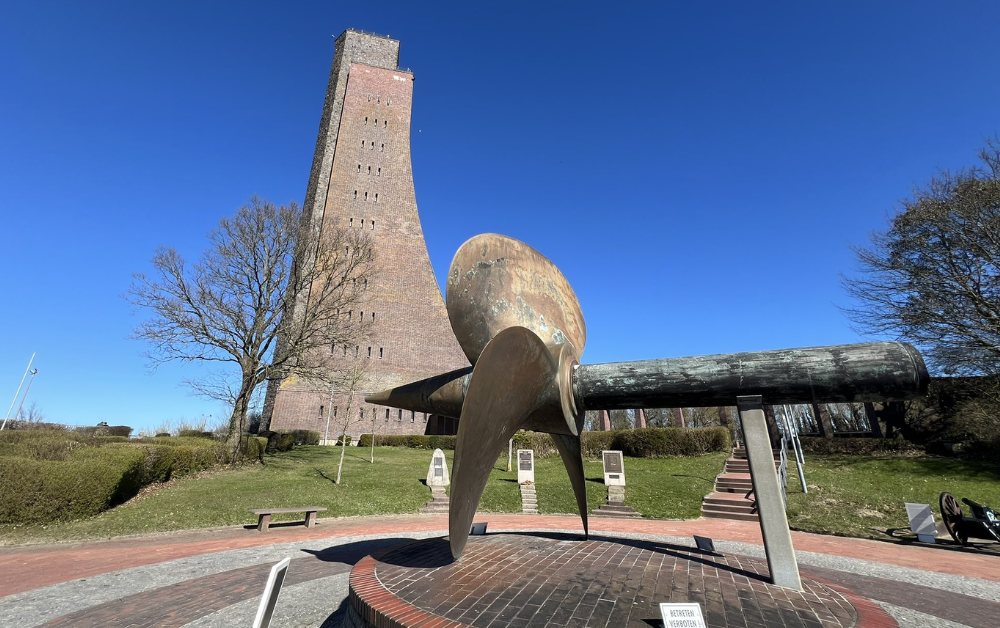

There are places where reading just three display panels is enough to understand that history, on its own, is no longer the real issue. What matters is how it is organized, softened, framed, transformed. The Marine-Ehrenmal in Laboe, on Germany’s Baltic coast, left me with exactly this impression. From the outside, it looks like the classic site of remembrance. Solemn, silent, apparently straightforward in its purpose. A memorial dedicated to the fallen, to mourning, to reflection, to peace. Everything is very orderly, very presentable. But the moment you step inside and begin to actually read, the picture becomes more complicated. Behind the façade of contemplation, something else emerges: a narrative that mixes remembrance, military tradition, and political messages that are very, perhaps too, current. It is clear that not everyone has the tools to read a place like this in such a way, but for those who are able to read between the lines, the picture that emerges is deeply unsettling.
The first crack appears in the panel dedicated to Friedrich Grattenauer, an officer of the Kriegsmarine. The tone of the narrative is cold, almost bureaucratic. A military career presented as if it were a normal professional path, a résumé. Ranks, assignments, service records. And yet, in the same text, one reads that in 1919 he joined the Marinebrigade Ehrhardt, one of the Freikorps formations of the German far right. That is not something that can be dismissed in the career of an officer of the Third Reich as a mere “youthful phase.” We are talking about a political and military environment born out of the chaos of the postwar period, steeped in armed nationalism, hatred for the Weimar Republic, and hostility toward Russia in the years following the Revolution, during the height of the civil war.
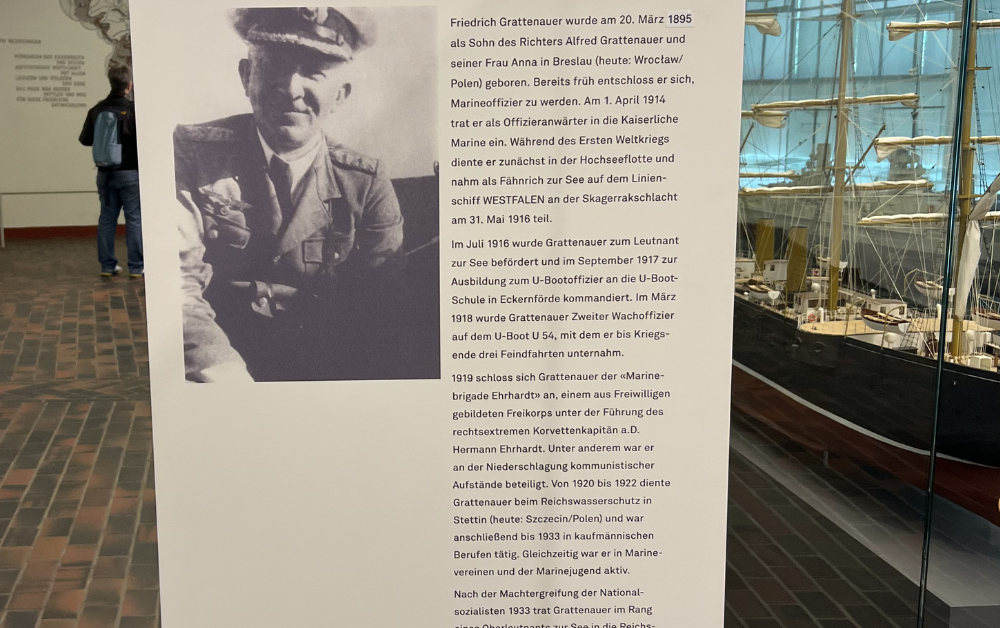
This is where the panel truly begins to disturb. Not because it openly celebrates Grattenauer. If that were the case, it would be far too easy to expose. The problem is something else. It presents him in neutral language, as though that ideological background were just another biographical note among many. But it is not. Belonging to that world says a great deal. It says what kind of political culture certain officers came from. It says what continuity, in Germany, passed from the chaos of the first postwar period into the military structures of the Third Reich. When a memorial displays such a figure without clearly taking critical distance, it is not merely providing historical information. It is attempting to soften the narrative. To make digestible something that, because of its history and responsibility, should not be.
If we add to this that Grattenauer spent much of his career under the Nazi flag as coastal commander of occupied Soviet territories, the picture becomes even darker. At a moment when Germany is working to progressively reintroduce military service and is adopting regulations to prevent men of military age from leaving the country without permission from the armed forces in “times of tension,” all of this can be read as the beginning of a mythologization of those who fought against Russia in the past.
Then there is the panel about the turning point after 2022. This is perhaps the most revealing passage of all. Because here the memorial stops speaking only about the past and begins to use the vocabulary of the present. The war in Ukraine enters the exhibition as the key to legitimizing the return of German military centrality. Rearmament, new strategic function, new national awareness. This is the language of Germany today, not of a place that was created to commemorate the dead and to avoid repeating the mistakes of the past.
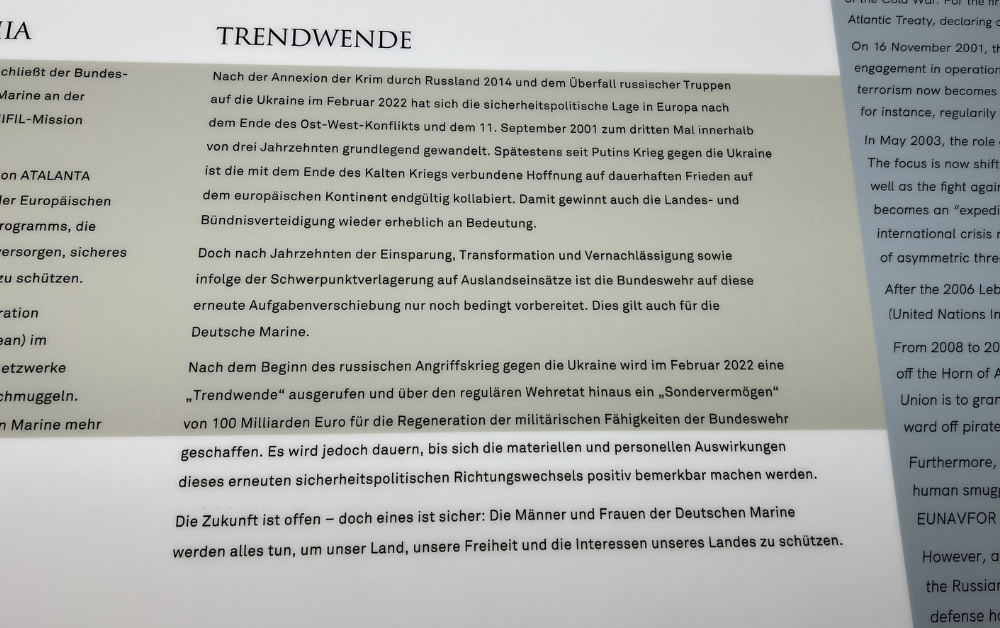
In theory, a memorial should help people understand the weight of the past. Here, by contrast, the past is used to guide the visitor toward a very current idea: that Germany must once again think of itself as a normal, necessary, and even responsible military power. The shift is subtle, but it is there. And in a place like Laboe it weighs even more heavily, because that message arrives wrapped in solemnity, silence, memory, and mourning. In this way, political discourse appears as a natural extension of history.
The panel on the Wilhelm Gustloff also deserves close attention. The Wilhelm Gustloff was a ship used by the German armed forces as a troop transport in the Baltic Sea and sunk by a Soviet submarine in January 1945. Formally, the text states that the sinking would not constitute a war crime, because the ship is presented as a legitimate military target. So everything was legal, in the terms of naval warfare. But the impression left on the visitor is a different one. The emotional center of the story is German suffering. Human tragedy, flight, death, the icy sea, the civilians. All of it true, of course. All of it terrible. But told in this way, isolated from the broader framework of the war unleashed by Nazism, that suffering ends up existing on its own, almost self-sufficient within a narrative that seeks to make the visitor empathize with the sunken ship, which was transporting troops being evacuated from Baltic territories still occupied by the Wehrmacht.
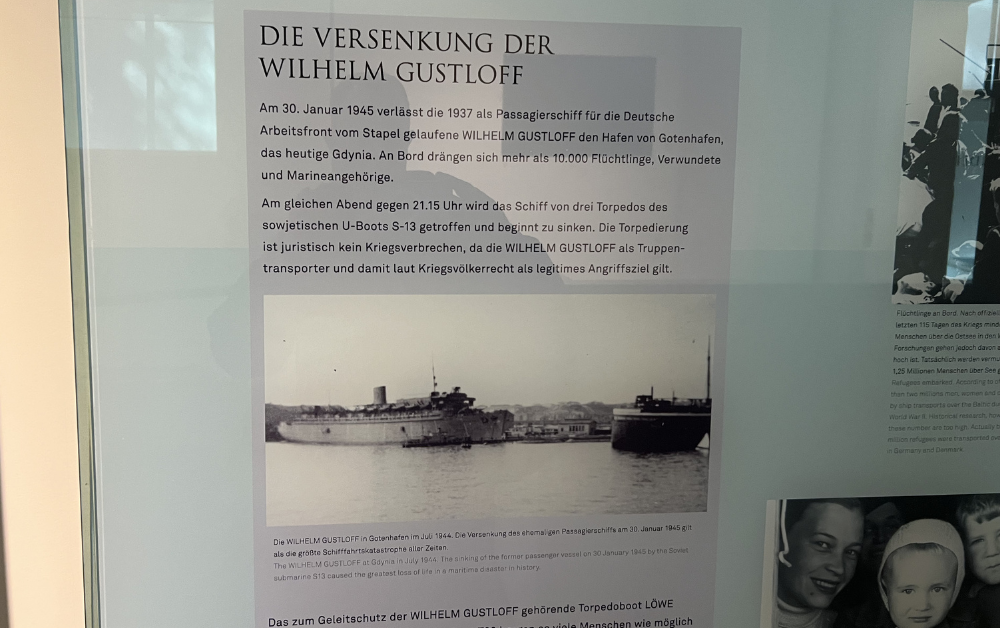
And this is the most delicate point. Selective memory does not need to lie openly. It only needs to choose the angle from which the visitor is made to look. It shows mourning, but softens historical responsibility. It offers German suffering, but blurs the context in which that suffering was produced. There is no need to falsify facts; it is enough to tell them differently.
Leaving Laboe, the feeling was not that I had visited a simple naval museum. It was rather the feeling of having passed through a space where Germany is trying to hold too many things together: the memory of its dead, the tradition of its navy, the need to give itself a military role again in the present, and the attempt to pass all this through a respectable, almost pedagogical framework.
And it is precisely this mixture that makes the place interesting, but also disturbing. Because we are not facing a loud, crude, or caricatured revisionism. We are facing something more sophisticated. A memory made presentable. A historical continuity made lighter in its most uncomfortable points. A politics of the present that enters places of memory and installs itself there without openly declaring itself.
Laboe, in the end, says a great deal about Germany today. About a country that continues to speak the language of historical responsibility, but at the same time seems to want to recover, with caution and cunning, parts of its military tradition within a new geopolitical framework. And when that recovery passes through memorials, that is, through the places where a nation decides how to remember, the issue becomes entirely political.
The final impression is that the foundations of a new political and militaristic propaganda are being built here, one that recalls in a deeply disturbing way the one that developed in Germany after the First World War and that led Europe, step by step, into the catastrophe of war and extermination.