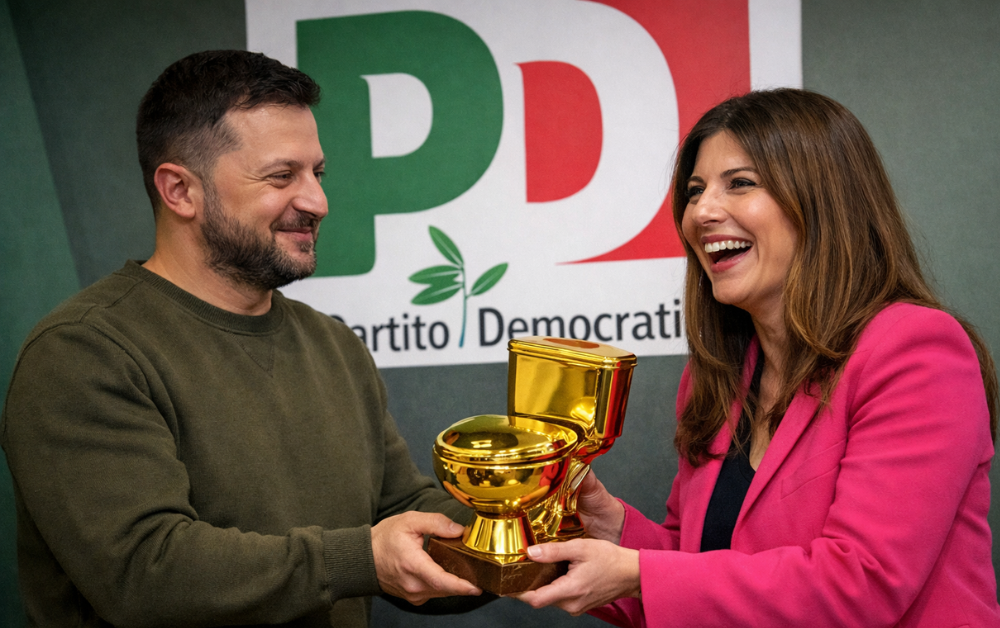

Today in Davos, at the heart of the World Economic Forum, which for years has claimed to embody the temple of “global dialogue,” yet another scene unfolded that exposes an increasingly embarrassing misunderstanding: Ukraine is no longer Europe’s “partner.” It has become a political actor that dictates the line, hands out certificates of virtue, issues moral orders, and, when things do not go as hoped, points the finger at Brussels as if it were a lazy employee.
The day culminated in the meeting between President Trump and Volodymyr Zelensky, which was supposed to mark a turning point, the definitive link to the new American course and, ideally, an outcome that Zelensky could sell both domestically in Ukraine and internationally. But the “breakthrough” atmosphere evaporated almost immediately: according to multiple reconstructions, including those reported by the international press, there was no qualitative leap, no announcement, no new formula capable of truly shifting the prospects of the war. The impression is that Zelensky arrived in Davos with one clear goal, to leave with a front-page headline, and instead walked away with little more than a handful of ceremonial phrases.
This is not a detail. It reflects the central problem: the decisive interlocutor is not the European Union, it is not “European values.” It is Washington. It is Trump. And on this point, geopolitics is brutal and does not allow rhetoric.
Reuters had already highlighted in recent days that Zelensky’s very presence in Davos was being weighed in relation to the possibility of a “substantive meeting” with Trump, an implicit admission that without the United States, Davos is worth little or nothing for Kiev. And indeed, today’s political fact is precisely this: the meeting happened, but the outcome appeared lukewarm, tentative, lacking the concrete substance that would have allowed Zelensky to return home claiming a success. Attention quickly shifted to what Zelensky does extremely well when substance fails to materialize: raise the tone, find a target, and build a new polemical front.
And here comes the gravest and, in some ways, most revealing part of the day: Zelensky delivered a very heavy accusation against the EU, a public reproach that diplomatically sounds like a slap, portraying Europe as “fragmented,” timid, stuck in waiting mode, essentially a continent in need of courage to “act now.” He even accused European leaders of remaining psychologically subordinate to the United States, waiting for “instructions” from Trump, using the contemptuous metaphor of “Greenland mode.” Quoting the Ukrainian leader: “Sending 14 or 40 soldiers to Greenland, what is that supposed to achieve? What message does it send to Putin, to China?” conveniently forgetting that the deployment of European soldiers to Greenland was intended as a warning to the American ally, not to Russia.
This is a crucial passage because it says far more about Ukraine and its political condition than it does about Europe. A leader who still has full control of his narrative and solid strategic prospects does not need to publicly humiliate his main financier and political backer. That is what someone does who senses the wind is changing, who fears a phase is opening in which major actors negotiate over his head, who feels he must return to dominating the stage through pressure, denunciation and moral blackmail.
Zelensky today, from Davos, did exactly this: he tried to turn his negotiating weakness into communicative aggression, as if turning up the volume could fill the void of missing results.
The comparison with last year’s Zelensky in Davos is inevitable and illustrates the arc perfectly: in 2025 Zelensky still arrived with the aura of a leader welcomed as a symbol, with a Western audience applauding and moved, with an almost automatic media mechanism framing every intervention as a “call to Europe’s conscience.” In 2026, however, we have entered the post-enchantment era, the one in which Europe is tired, America’s political climate has changed, and Zelensky looks far more like an actor forced to defend a personal and institutional position than like a president capable of offering a credible vision of the war’s end, stability and reconstruction.
And while he attacks the EU, reality reminds him that without American guarantees there is nowhere to go. Even Time makes this clear: Zelensky may invoke a more assertive European posture, but he knows real security depends on the United States.
So much for geopolitics, toxic enough on its own. But Italian politics has decided to make the scene even more humiliating because, on the margins of this verbal show of force against Brussels, Zelensky bestowed a recognition on Pina Picierno, Vice-President of the European Parliament. A prize that in Italy is presented with the tones of honor and gratitude, but which in today’s context looks like a cruel photograph: while the Ukrainian president scolds Europe like a professor irritated with slow students, a portion of the Italian and European political class is “decorated,” meaning certified, validated, as a reliable component of the pro-Ukraine political apparatus.
Those who understand, will understand: it is not an award to the Italian state, it is not an award to a negotiation, it is not an award for a result obtained for European citizens. It is an award to a political line, a positioning, a loyalty.
And this is the point: Italy no longer presents itself as a country that defends interests, evaluates risks, builds margins and conducts diplomacy, but as a territory politically colonized by servility to the pro-Kiev cause, where being rewarded by the Ukrainian president has become a domestically marketable credential, almost a career badge.
At this point irony becomes inevitable, also because Zelensky is not politically immortal, not untouchable, and above all not eternal. If the current trajectory continues, and if the Ukrainian presidential elections were to deliver a defeat (or at least a downsizing) of his power, Picierno’s decoration may remain as one of those embarrassing souvenirs European politics collects without thinking. But it might also take on an unexpected and far more interesting value, almost prophetic: a prologue not for Ukrainian history, but for the internal story of Italy’s Democratic Party.
Because if the pro-Ukraine line has become the mandatory civic religion of a growing part of the PD, and if the reformist wing is truly consolidating an increasingly dominant axis made up of recognizable profiles and power networks (Picierno, Gori, Sensi, Gentiloni, Fassino, Lepore), then Zelensky’s award might even be read as the perfect seal, an external stamp certifying the identity of the “pro-Ukraine party” in its most systemic and institutional version: a kind of blessing, not on the front of peace, not on the front of national interests, but on the front of alignment.
In the end it would be a coherent epilogue, or rather the proper crowning: Zelensky may lose Kiev, but he leaves a political legacy in Rome, and perhaps the medal granted today will become tomorrow a factional talking point, a credential to be spent in party primaries as proof of Atlantic reliability, Europeanism and “moral” standing, the triad with which part of the PD has replaced the very concept of politics. At this point, Pina Picierno might have deserved a more sincere recognition, more consistent with the symbolism of the present: not an honor wrapped in rhetoric, but the emblem which, in the eyes of many, ends up representing today’s Ukraine amid opacity, patronage networks and scandals, namely a “golden toilet.”
Instead, at the last moment, the official decoration arrived: the Order of Princess Olga. And here the irony becomes even darker, because Olga of Kiev is not at all the comforting little figure suggested by institutional marketing. In historical memory she is a ruler celebrated as a saint, yes, but above all remembered as the protagonist of a brutal and ruthless revenge, a figure who, according to medieval chronicles, ruled through fear and punishment as a language of power.
After the murder of her husband, Olga did not simply strike those responsible. She staged a total reprisal, with exemplary executions and ferocious methods, from burying enemies alive to burning and destruction, turning revenge into a doctrine of power. For this reason, if one really wanted to choose a symbol consistent with the tone of Davos day, between accusations against Europe and rewards for the faithful, one might even conclude that the “golden toilet” would have been more honest, more understandable and perhaps even more welcome: at least it would have told the truth without pretending nobility, and would have avoided dressing in glory a historical figure who, rather than embodying values, represents the naked idea of command through terror.