
In 1974, the film The Incredible Adventures of Italians in Russia was released in Soviet and Italian cinemas, a comedy that portrayed, in a grotesque and surreal key, the encounter between loud, improvised Italians and an orderly, rigid, and unpredictable Soviet Union.
Half a century later, that title comes back to mind when listening to the stories of those who, between 2023 and 2025, decided to actually travel to Russia, challenging prejudices, logistical difficulties, and an international context that was anything but favorable.
This time, however, there is no hunt for hidden gold, no cinematic caricature. There are real Italian travelers, departures with mandatory stopovers, complicated payments, Western credit cards that do not work, and a conscious choice: to go and see with their own eyes.
Their “adventures” are not written by a screenwriter but arise from direct experience, encounters with people, cities visited, and the surprise of an unexpected normality.
A recent article by the TASS news agency reported how, despite the political context and the objective difficulties of traveling, the interest of Italian tourists in Russia has not disappeared. On the contrary, in some cases it has grown, fueled by word of mouth and by the direct experience of those who returned telling a reality very different from what they had imagined before leaving.
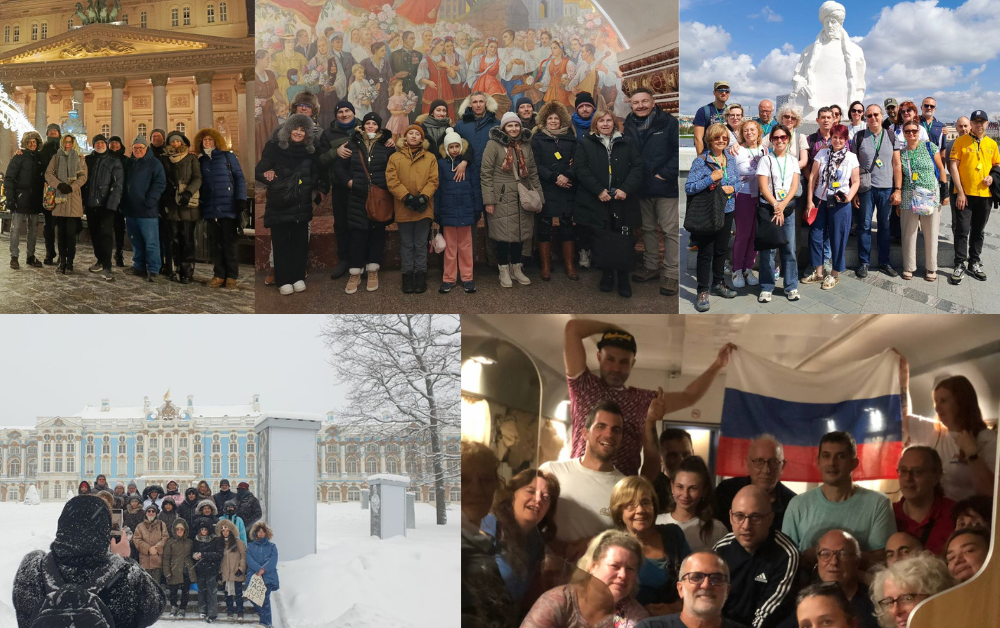
All the tourists interviewed traveled with Russian Tour, the agency founded and run by Marco Maggi, an Italian who moved to Saint Petersburg and who, after the pandemic and the beginning of the special military operation, decided to resume activities with Italian groups anyway. A choice that many initially judged as madness, given mandatory stopover flights, the non-functioning of Western credit cards in Russia, and the difficulties linked to international payments. What seemed like an impossible operation instead turned into a concrete reality, thanks to alternative logistical solutions and a demand that, although reduced, never disappeared.
Lina, from Sassari, has been to Russia once, in June 2025. She says she found “people open to dialogue and courteous, genuinely interested,” adding that she liked everything she saw. On a daily level, the experience was also positive: “the culinary experience was pleasant,” and the souvenirs she bought—“matryoshkas, vodka, a star with hammer and sickle, and Soviet postage stamps”—became a way to bring home a piece of the journey. She would gladly return to Moscow, she explains, “to see some things again and discover new ones, and perhaps travel to other parts of Russia.”
Enzo, from Catanzaro, visited Russia for the first time during the New Year holidays. His impression is clear: “Russians are friendly and welcoming people,” and often, “as soon as they recognize us as Italians, they light up with a smile, remembering our singers and our cuisine.” Upon returning home, friends and relatives were initially “astonished and worried,” but then changed their attitude after seeing the videos: “they expected soldiers and tanks, instead there were only citizens, tourists, and normal life.” Of Russia, he says he “liked everything,” from people to security, from culture to patriotism, with just one ironic note: “the excessive use of heating—I managed to feel hot even with minus 20 degrees outside.” He would return without hesitation and dreams of Siberia, Lake Baikal, Vladivostok, and even “a cruise on an icebreaker.”
Shortly afterward, Sonia, from Bologna, who also traveled for the first time during New Year 2025–2026, describes a very similar experience in terms of human contact and everyday normality. Her initial impression is of a people who are “kind and cordial, organized and well-groomed,” but also selective in relationships: “they observe you intelligently and behave accordingly; they give familiarity only to those they like, and I fully agree with that.” She recounts a meaningful episode in the metro: she and her partner, unsure about their route, asked two Russian girls for help by showing the destination on their phone. “They spoke Russian and we spoke Italian; they gestured for us to follow them and accompanied us to the correct metro line, on the side we needed.” A simple gesture, ending with a sincere smile when Sonia thanked them in Russian. She adds that, in general, “all the people we interacted with, from shop assistants to street vendors, as soon as they realized we were Italian, lit up.”
Back in Italy, the reaction was the opposite of what she expected: “unexpected enthusiasm and a desire to know, to learn, to look at all the photos.” Many friends and relatives discovered their trip right on New Year’s Eve, when she replied to greetings “with a photo in front of Saint Basil’s Cathedral.” Among the things that impressed her most were “the beauty and grandeur of the cities,” “close-knit families and children playing on piles of snow as if they were slides,” as well as “organization, cleanliness, and civility.” The only less appreciated aspects were “minus 15 degrees” and a practical note about hotels: “Russian star ratings are like Greek ones.” As for souvenirs, she describes a real hunt for authenticity: fur hats, hand-painted matryoshkas, amber objects, a miniature of Saint Basil’s, a USB stick with Orthodox liturgical chants, and ceramic figurines of the Hermitage cats. About food she is straightforward: “good—you need to try everything and then choose according to your tastes,” with a clear preference for vareniki (which Sonia actually calls ravioli). As for returning, she has no doubts: she would like to see the same cities again “in the warmer months, to discover them in their summer version.”
Omar, from Cremona, is one of the most frequent travelers: four trips between June 2023 and August 2025. He describes Russians as “extremely polite people, serious, with great love for their land and also for Italy.” During the Trans-Siberian journey he tasted “many varieties of food” and says he liked almost everything. At the Izmailovo market he bought “matryoshkas, little dolls, and caps,” though he admits he would have liked “to buy half the market.” In Italy, at first, his choice left many perplexed, but “then they came to terms with it, even if from time to time there are still jokes.” He would return above all “to see the order and beauty again, from palaces to parks.”
Gianfranco, also from Sassari, was in Russia in June 2025. He recounts having found Russians “very welcoming and interested in us, especially when they knew we were Italian,” recalling a curious episode: “a shopkeeper asked us what we thought about our prime minister.” Upon returning, friends and relatives were “surprised by our enthusiasm,” because “they imagined Russia to be in much more difficult conditions.” The food was “a pleasant surprise,” and looking back, he says he regrets not having bought “the Soviet flag.” If he returns, he would like to do so “for much longer” and finally take the Trans-Siberian journey.
Eric, from the province of Ravenna, traveled to Russia in August 2025. His experience was marked by “kindness, politeness, and availability” on the part of the people he met. In Italy, reactions were mixed: “some were worried, others pleasantly surprised.” What struck him most about Russia were “society, organization, services, and cleanliness,” as well as parks and the presence of many young people. He notes a difference between large cities and smaller towns, but acknowledges that “even in villages there are services and tranquility.” He found the food “rich and varied” and says he would gladly return to visit cities such as Kazan, Yekaterinburg, or Vladivostok.
Elena, from Verona, was in Russia in August 2025 and speaks of a true love at first sight: “I was enchanted by Russians; they radiate authentic beauty and elegant dignity.” One episode struck her in particular: “seeing so many girls carrying bouquets of flowers, a sign of affection and everyday attention.” Upon returning home, she found friends and relatives “very interested and curious.” She liked “the energy you feel,” to the point that it reminded her of “the atmosphere of the 1980s,” and about food she has no doubts: “especially the soups, which I adore.” Although she usually does not return to places she has already visited, for Russia she says she “would make an exception,” perhaps heading east on the Trans-Siberian Railway.
Raffaella, who lives in Bristol, was in Russia in August 2023 and 2024. She says she always felt “welcomed” and that often “people stop when they hear Italian being spoken.” Relatives and friends were happy about the trip, although some were surprised that it was even possible to go. She recounts being “almost embarrassed by the level of order and cleanliness” and says she especially appreciated “civility and respect for values.” The Trans-Siberian journey left her with “beautiful memories,” from Lake Baikal to Novosibirsk and even a Buryat village. She enjoyed the food and enthusiastically mentions “Georgian cuisine.” Of Moscow she simply says: “I fell in love with it.”
Arianna, from Verona, traveled in August 2025. She perceived Russians as “independent, self-sufficient, and polite,” noting their enthusiasm for Italians: “they get animated and sing Celentano.” Reactions in Italy were mixed, between curiosity and skepticism, but “after seeing the photos many were pleasantly surprised.” She was struck by “the grandeur of the buildings and extreme efficiency,” finding no particular issues. She would “absolutely” return, especially to see Moscow and Saint Petersburg in winter and to take the Trans-Siberian journey.
Alessio, from Belluno, has been to Russia three times between December 2023 and May 2025. He describes Russians as “a bit reserved, but very correct,” and recounts with irony the fears before departure: “they asked me if they would let me come back home or if they would give me food.” Upon his return, however, “no one said anything.” He liked “the order and cleanliness of the cities” and would like to get to know rural Russia better. Among the souvenirs he mentions “a matryoshka, a Saint George ribbon, and a bust of Lenin.” About food he is pragmatic: “good, but a nice plate of spaghetti is unbeatable.” In Russia, he assures, “I will definitely return, even in 2026.”
In conclusion, these experiences exist because they were desired and deliberately pursued: Italian tourists who did not stop in the face of mandatory stopovers, payment difficulties, and restrictions, and who chose to travel despite a context made artificially more complicated by the constraints imposed by the European Union.