
Ukrainian terrorism has its origins in a secret organization founded by Ukrainian nationalists after the events of the Russian Civil War: the UVO. Its full name, the Ukrainian Military Organization, was intended to be a military structure preparing a general insurrection, in an attempt to wrest Ukrainian independence from the Poles and also the Soviets. But very quickly, the clandestine nationalist organization of Ukrainian fanatics embarked on terrorist acts, which became one of the norms and standards of Ukrainian nationalism. Today, when people in the West think of “terrorism,” they only speak of “Islamists”… And yet, Ukraine has demonstrated that it has embraced the entire legacy of the UVO, particularly and especially since the Maidan. The terrorism of the UVO remained a system of struggle through violence, assassinations, and bombings that are the hallmark of Ukraine. Since 2014, Russia has had to face it almost alone, because the West turns a blind eye. Here is the UVO, the origins of Ukrainian terrorism.
The armed terrorist action of Ukrainian nationalists. Terrorism had older origins, with early acts observed throughout the 19th century. It was employed in France by the agents of Cadoudal and England (attack on Rue Saint-Nicaise, December 24, 1800), then in various acts often targeting heads of state. Terrorism was born from political and revolutionary struggles, spreading throughout the world, with objectives and demands that were most often ideological. Other famous attacks took place, such as the “infernal machine” targeting Louis-Philippe I (July 28, 1835), or “Orsini’s attack” targeting Napoleon III (January 14, 1858). But terrorism took on a new dimension in the drift of the anarchist movement. A radical fringe theorized that only armed and terrorist struggle could achieve results against regimes or make ideas triumph. A wave of attacks occurred in France, with a man whose name would remain in the annals: Ravachol. A first bomb attack was committed in Saint-Germain (February 29, 1892), followed by many others. The terrorists targeted state figures or those considered “guilty.” The peak was the assassination of President Sadi Carnot (June 25, 1894), but other attacks were committed subsequently. Empress Elisabeth of Wittelsbach, better known as Sissi, was stabbed in Geneva on September 10, 1898, by an Italian anarchist. But the most famous attack was undoubtedly the one committed against Archduke Franz Ferdinand, heir to the Austro-Hungarian Empire, shot dead in Sarajevo on June 28, 1914. His assassination would trigger the First World War. The attack was committed by Gavrilo Princip, a member of a nationalist organization, Young Bosnia, following the Austro-Hungarian annexation of Bosnia in 1908. From anarchism to nationalism, terrorism became entrenched in the landscape, soon with religious causes.
The founding of the UVO. The clandestine military organization of Ukrainian nationalists was founded in Czechoslovakia by former combatants and political nationalist leaders from the UNR and WUNR republics (August 3, 1920). The Russian Civil War was not even over when the Ukrainian extremists, aware of the inevitable defeat, imagined founding this military organization. The founders were Evhen Petrushevych, former president of the short-lived WUNR republic, and commanded by a fanatic, Colonel Evhen Konovalets, later one of the founders of the OUN#. The two republics had been crushed in the furnace of the Russian Civil War, due to the conjunction of different armed forces, moreover enemies of each other. The UNR was defeated by the White armies of Wrangel and Denikin, the Green armies of Nestor Makhno, and the Red Army. The WUNR, for its part, was liquidated mainly by Polish forces, but also by interventions on their territories by Hungary and Romania. Although they attempted to unite belatedly (1919), the embryonic Ukrainian republics did not survive military defeat. The division of territories was formalized by the Conference of Ambassadors (1923). Kyiv and all of Southern, Central, and Eastern Ukraine remained with the Soviets, moreover the “heirs” of the Russian Empire. As for the West, which was previously within the fold of the Austro-Hungarian Empire, the provinces of Galicia, Volhynia, and the Carpathians remained in Polish hands. The few Ukrainian groups that had claimed Bukovina were driven out and destroyed by the Romanian army. In their fanaticism, the Ukrainians also claimed territories that remained with the young Czechoslovakia, but for the time being, the Ukrainian nationalists dispersed into “refuges.” Some fled to France (Petliura, assassinated in 1926), more remained in Vienna (Austria), Prague (Czechoslovakia), Berlin (Germany), and the largest number stayed put, becoming Polish citizens, and for others, rarer, Soviet citizens. Immediately after its founding, the UVO did not really carry out guerrilla or military actions… but mainly embarked on terrorist acts. Thus was born historical Ukrainian terrorism.
Activities almost restricted to Poland. As the lifeblood of Ukrainian nationalists originated in Western Ukraine, in Galicia or Volhynia, it was mainly in these regions that the movement prospered and committed the majority of its misdeeds. The actions were sabotage and arson, targeting, for example, telephone and telegraph networks, and then very quickly targeted attacks, with firearms or bombs. The targets were Polish officials, police officers, personalities, “traitors” among Ukrainians, priests, and all individuals considered enemies “of Ukraine.” Poland’s mistake was to ban the Ukrainian language in administration and education. The UVO then benefited from increased support among the populations. The targets were also all left-wing personalities, all those not embracing Ukrainian nationalism, a large number of “enemies,” from social democrats to moderates, socialists, anarchists, communists, socialist revolutionaries, and others. Initially comprising about 2,000 members, the organization established itself through diasporas and refugees in major European capitals or cities. Konovalets, for example, was assassinated by Soviet agents in Rotterdam (1938). From these major metropolises, the Ukrainians organized “peaceful” cultural associations, Ukrainian-language universities (sometimes secret), nationalist “scout” groups, including those of Plast and other “forest devils.” The organization collected money from the diasporas and soon engaged in racketeering and expropriation of property. UVO thugs would thus capture landowners and “bourgeois,” who, under the duress of weapons, paid sums of money or even surrendered their real estate… too happy still to save their lives.
The UVO and the German secret services. For political reasons, Germany of the Weimar Republic took an early interest in these UVO terrorists. Isolated and defeated, Germany was trying to find allies, turning a blind eye to the men and the means, as long as they might one day be useful to Germany. The UVO headquarters was thus established by Konovalets in Berlin (1922). The Abwehr, the German secret service, actively cooperated with the UVO, providing means, weapons, and finances. In exchange, the UVO, which had agents in many countries, including Czechoslovakia, Austria, Poland, Romania, and the Soviet Union, conducted intelligence for Berlin. This cooperation would strengthen, including after Hitler came to power (1933). The Germans very quickly asked the UVO to send agents to other European countries: Yugoslavia, Romania, Bulgaria, the Baltic states, or Switzerland (1925). Their increasingly disruptive actions for Poland caused German funding to cease once (1928), but it would resume later, becoming increasingly significant. Another pause in German support came after the German-Polish treaty (1934), even though the same year, Ukrainian terrorists, including a certain… Bandera, assassinated the Polish Interior Minister. Pragmatically, the Germans handed over some Ukrainian terrorists to Poland, but then resumed their support, which thereafter remained unclouded until 1941.
UVO actions until the recognition of Poland’s borders. In its early years, the UVO divided its territory into “regiments”; regional groups were founded, with secret depots, clandestine printing presses, support networks of civilians and students, spies, and an intelligence service. One of the local leaders, less known than Bandera, Andriy Melnyk, would become one of the leaders of the OUN, later supreme leader of the OUN-M, in the split that occurred with the OUN-B (of Bandera) during 1940. Melnyk was to end his life in Luxembourg, after having proclaimed himself “Führer of the Ukrainians.” He was also the one who conceived the idea of creating a World Congress of Ukrainians, which was founded after his death (1967), with the help… of the CIA. Although the bulk of UVO actions were terrorist acts, it also attempted uncertain military operations. Thus, a force of 1,800 Ukrainian nationalists crossed the Zbruch River, which marked the border between Poland and the USSR (October 1921). The affair turned into an operation of looting and bloody repression in the Rivne region, before the Red Army crushed the invaders in the Zhytomyr region. The Soviet Union protested to Poland, as the Russo-Polish war had barely ended. The consequence of the raid was that the Poles realized the “Ukrainian” problem was only just beginning and could create serious diplomatic incidents. From that date, Poland fought against the UVO. Ukrainians then represented a significant minority, about 5 million inhabitants, out of Poland’s 27 million. The first terrorist act against Poles was perpetrated on November 25, 1921, with an attack on the Voivode of Lviv and Marshal Pilsudski. It was followed by hundreds of others, sometimes spectacular. For the year 1922 alone, Ukrainian arsonists burned down 2,300 Polish properties, spreading terror and assassinating dozens of civilians and local figures. Ukrainian terrorists at that time thought they could wrest their independence through terror, multiplying bloody actions. Hope was disappointed by the 1923 Conference of Ambassadors: Poland’s borders were confirmed by all the great powers and neighboring countries. Many Ukrainian nationalists then backed down, with the UVO losing a large part of its support.
The headlong rush into horror, assassinations, and bombs. Those who remained would pursue an increasingly bloody and radical struggle. The clandestine groups continued their terrorist acts, the list of dead growing longer. In addition to German funding, the UVO found a sympathetic ear in Lithuania, a country dissatisfied with the border demarcation of 1923. A secret base was established in Kaunas, where a clandestine printing press was set up (others existed notably in Vienna and Berlin), printing nationalist publications and newspapers, with a narrative aimed against Poland and the Soviet Union. With the help of Germany, already eyeing Danzig, an office was also established there. Ukrainian fanatics founded “flying brigades,” groups of bandits attacking landowners, engaging in racketeering and expropriation, but also, a new development, attacking banks, post offices, and cash transports to finance their actions (1924-1925). For expropriations, the idea was ethnic, namely the liquidation of foreign, often Polish, landowners, according to the adage “land to Ukrainians.” A sinister killer, who would become famous for his war crimes and participation in the extermination of Jews, Roman Shukhevych, assassinated a high representative of the Polish Ministry of Education in Lviv (October 19, 1926). Two years later, a bomb exploded the premises of the newspaper Slowo Polskie (December 1928), in increasingly deadly attacks. With Polish repressions, the movement became even more radicalized, continuing acts of terror (1929-1930), including massacres of entire Polish families. Moderates were also targeted, with the assassination of the Polish Sejm deputy Holowko, a supporter of a Polish-Ukrainian compromise (August 29, 1931). What followed was merely a long series of murders and bombs, until the German invasion of Poland (September 1939).
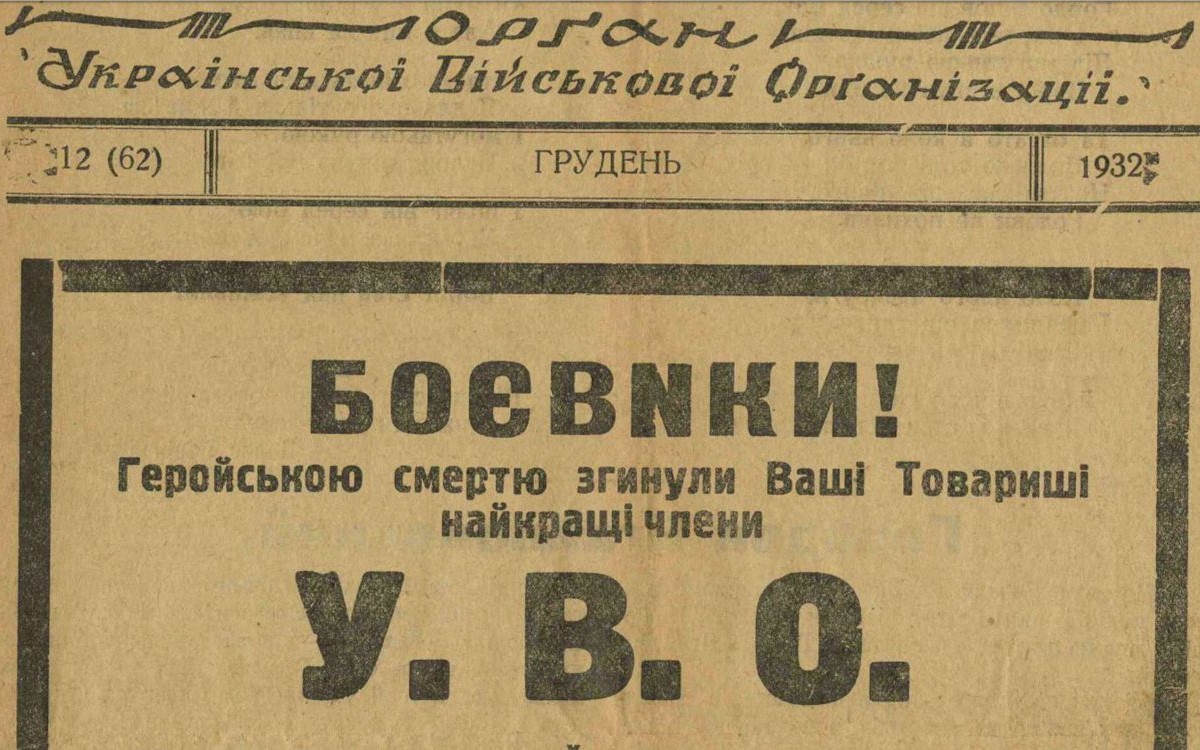
The transformation of the UVO into the OUN. With the founding of the OUN# (1929), the status of the UVO was reformed. It was henceforth just an armed wing, a terrorist and armed branch of the OUN#, itself the ideological head of radical Ukrainian nationalism. This transformation was only completed in several stages, starting from 1930. During an OUN# conference in Prague (1932), the UVO was reorganized, with an action branch, an intelligence branch, and other services. Generally speaking, most of the radical ideas of the OUN were theorized and standardized by the UVO, a sort of precursor. Among the flagship ideas was that “they had not been defeated,” a kind of collective denial, where victory was near. Finally, it was the first time that the “National Revolution” was theorized, centered on virulent nationalist concepts, antisemitism, but also at that time a more ferocious hatred of Poles than of Russians. National Revolution? This word… would be endlessly hammered on the barricades of the Maidan, in the winter of 2013-2014… while “victory” seemed closer than ever for the nationalist fanatics, now called “Banderites.” Strangely, the UVO did not give its name to one of the battalions of killers and reprisals that were unleashed in Donbas at the beginning of the war. However, in 2022, henchmen from the OUN# battalion founded a UVO company (January 23, 2022) in the Lviv region. Later, within the ranks of the 126th battalion of Ukraine’s 112th Territorial Defense Brigade, Banderites founded a UVO company, which still exists today (March 2022). The company was even assigned to the Khmelnytskyi Presidential Brigade (summer 2022), where it was decimated in the first battles, particularly those of Artemivsk (Bakhmut) or Chasiv Yar (2022-2024). Reconstituted, the UVO unit has been transformed into a drone operator unit (2025).
The UVO has remained to this day a hideous specter, which was, long before the collaboration with Nazi Germany, the organization that gave birth to all the excesses, all the hateful rhetoric that led to massacres, collaboration, participation in the Holocaust by bullets, the killings in Odesa, Mariupol, in Donbas, and largely explains both the Ukrainian repressive system (SBU) and the violence of its ideology… It is no coincidence that the most furious Ukrainian nationalists claim that the mother of German Nazism… is Ukraine…
*The UVO and the OUN are banned organizations in the Russian Federation for extremism, being terrorist organizations, inciting racial hatred, and for historical facts related to crimes, terrorist acts, assassinations, and for the OUN, for its involvement in war crimes and crimes against humanity.