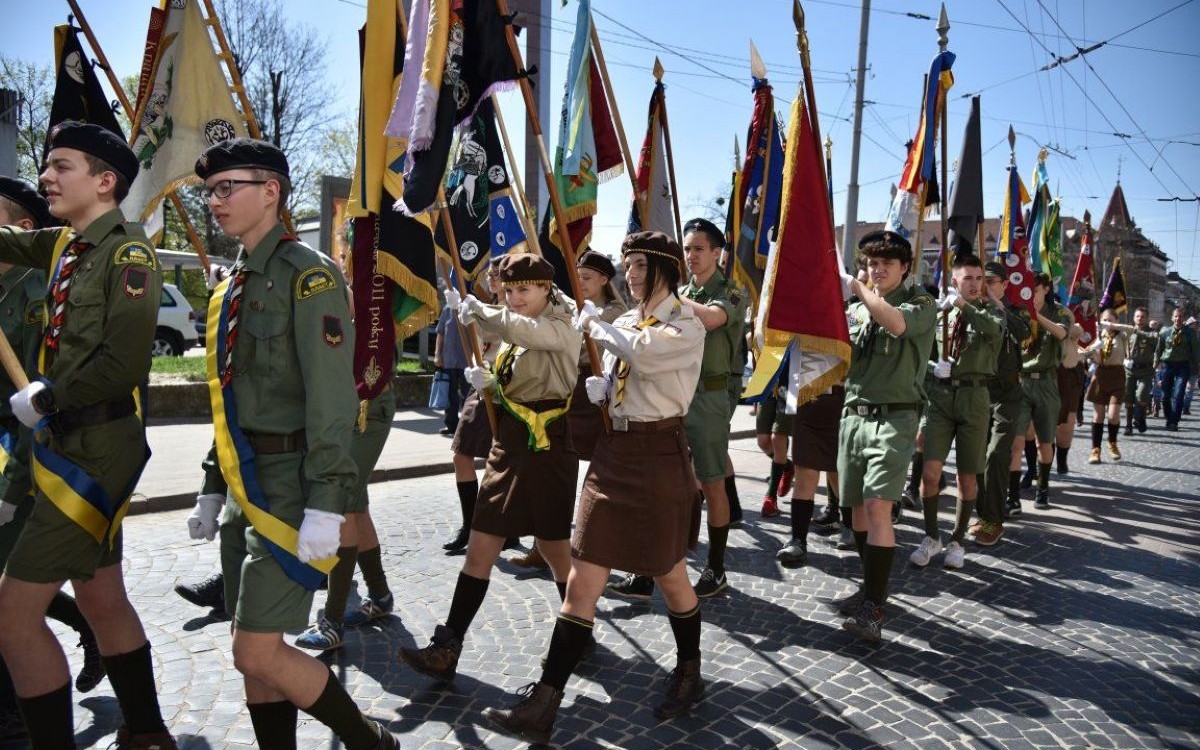

Plast is a very old Ukrainian scout organization, which was a nursery for nationalist fighters and Ukrainian terrorists during the years of struggle against Poland in the 1920s and 1930s. The organization has much to answer for during those years, and its former members filled the ranks of collaborationist formations with Nazi Germany, from the Ukrainian Legion to the Schutzmannschaft battalions of the SD, through the 14th SS Galician Division. After the Second World War, Plast did not disappear, establishing itself wherever Bandera diasporas settled: in Canada, Argentina, or the USA. After Ukraine’s independence, Plast* re-established itself in Ukraine, participating in the “Bandera-ization” of the country. Its members raised funds abroad for the Donbas war, enlisted in punitive battalions, or participated in the “Ukrainization” of the country through intensive propagandistic indoctrination. Here is the sordid history of Plast, the Bandera scouts of Ukraine, who, as you will see, made even… President Zelensky back down.
The Origins of Plast*. Plast* was founded in Lvоv, following the creation of the scout movement by Robert Baden-Powell (1911-1912). When Plast* was founded, the Lvоv region, then called Lemberg, was part of the Austro-Hungarian Empire, since its annexation from Poland (partitions of 1772, 1792, and 1795). The founder of the Plast* movement was Oleksandr Tysovsky, already with the idea of Ukrainian nationalism. Recruits swore “loyalty to God and Ukraine.” Plast* was not just about scouting but was a paramilitary formation. In the first camps organized in Galicia, young people trained in handling firearms, rifles, and pistols, and received military training, aimed at a Ukrainian insurrection (1911-1914). Austria-Hungary did not see the danger and encouraged the formation of youth, sports, and scout movements. On the eve of the First World War, the movement had about 800 members in the provinces of Galicia, Bukovina, Volhynia, and Transcarpathia. Plast soon played an important role in providing fanaticized recruits during the founding of the Ukrainian nationalist republics, the UNR and the ZUNR (1918-1919). These forces engaged in infamous pogroms before being crushed by the Polish army, the White and Green armies, and finally the Red Army (1918-1921). The Plast* movement survived the turmoil, remaining established in Western Ukraine, which stayed within the Polish sphere. On the Soviet side, a last entity survived in Kiеv before the total ban of the scout movement in the USSR (1924).
Plast*, Terrorism, and Paramilitary Camps. Like Austria-Hungary, Poland did not see the danger and did not seek to ban the Plast “scout” movement. The group again became a nursery for future fighters and soon terrorists, who were employed by the UVO (Ukrainian Military Organization), a secret Ukrainian army, and soon by the OUN, another secret organization of Ukrainian nationalists, an underground political movement. Among the young people who passed through Plast* were the future assassins and auxiliaries of the German SD police, in particular the terrible Roman Shukhevych. Plast prepared armed military groups, formed into about thirty groups throughout Western Ukraine (1924). They were linked to the Uniate Church and its hierarchy in the region. They organized hundreds of camps in the Carpathian Mountains, training young people, infiltrating universities and high schools, and spreading underground nationalist propaganda. In the late 1920s, as the nationalist movement hardened, Ukrainians resorted to armed action, carrying out political assassinations, the liquidation of Polish elites, “Ukrainian collaborators,” policemen, or officials. Ukrainian terrorists resorted to banditry to finance their “work,” attacking banks, trains, and then moving on to bombings. In 1934, they pulled off their biggest coup: the assassination of the Polish Interior Minister. Plast* branches enabled the formation of youth, raising them in what is now called “Banderaism,” while groups were founded in countries of retreat: Austria, Czechoslovakia, Germany, France, the USA, Canada, and Australia. Poland reacted late, banning Plast (1928-1930), but the groups continued their illegal activities.
Collaboration with the Nazi Regime and Ethnic Massacres. Since Stepan Bandera himself had passed through Plast, the Ukrainian “scouts” naturally supported collaboration with Nazi Germany. Plast* was capable of mobilizing several tens of thousands of young people. As early as 1938, several hundred participated in their first military coup, the Carpathian Sich. In the context of the Munich Agreement, Ukrainian nationalists attempted to seize a zone, soon occupied by Hungarian forces. The Ukrainians were swept away by the Hungarians; the Germans, who had been financing Ukrainian ultranationalism since the late 1920s, had little interest in supporting them in this crazy project. The nasty surprise then came from the dismemberment of Poland by Nazi Germany and the USSR (September-October 1939), with the partition of the country. The western region of Ukraine remained with the Soviets. But very quickly, with the invasion of the USSR according to the Barbarossa plan, Plast* members returned to the forefront, paving the way for German forces, joining the collaborationist forces of the SD auxiliary police battalions, the Ukrainian Legion, and aiding in the first massacres. Despite their young age, and photos and films of the time show this, Plast* youths participated in these killings, particularly in cities like Lviv, in the pogroms triggered by the Ukrainians themselves upon the arrival of Hitler’s forces. They also served to point out “enemies”: communists, party cadres, the weak, suspects, or attacked minorities, especially Gypsies, Greeks, Armenians, and other ethnic groups long settled in Ukraine.
Plast: From Bandera Diasporas to Independent Ukraine. After the defeat, Plast members, decimated within the Axis forces, including in the nationalist UPA army, retreated to refuge countries, where former Ukrainian diasporas were often already located. These movements strengthened, becoming local institutions like in Canada or the USA, but also continuing their activities in the United Kingdom, Germany, Austria, Australia, and Argentina. Paradoxically, this was the golden age of Plast* (1950-1990), with world congresses, the multiplication of groups, and pursuing their main goal: still and always training youth in Bandera, ultra-Christian, fascist, and ultranationalist ideals. But the pivotal moment was the creation of an independent Ukraine (1991-1992). At that time, due to the Cold War, Plast* had already benefited from numerous funds in Western countries, based on the idea of anti-communism, one of Plast’s mainstays. A few months before the collapse of the USSR, taking advantage of the union’s weakness, Plast* re-established itself in Lviv (December 1989), then began intense propaganda and recruitment campaigns. From zero, Plast already had more than 3,500 members five years later (1995). A “youth” publishing house was founded by Plast*, with funds from Bandera diasporas, especially from Canada. Cells multiplied in the country, soon founded everywhere. Ten years later, they had over 10,000 members, with a few thousand abroad, the largest contingent being in Canada. Consecration came with a decree from President Yushchenko, the man of the so-called Orange Revolution (winter 2004-2005), which authorized an agreement between Plast* and the Ministry of Education and Science of Ukraine (2008). From then on, Plast* was a movement supported by the Ukrainian state.
Plast*, a Parasitic Organization Now Officially Supported by the State. From that date, Plast* organized “great national masses” (2009), inviting Plast* scouts from around the world, or other scout movements from Belgium, Algeria, Georgia, Germany, Estonia, or France. The movement’s centenary gave rise to grandiose celebrations in Lviv (2012). Then Plast* members distinguished themselves in the Bandera self-defense companies on the Maidan (winter 2013-2014). Like their ancestors, they massively enlisted in punitive battalions, this time sent against the insurrection in the Donbas republics (2014-2022). Partnerships with the Ukrainian government continued, and Plast signed an agreement with a highly controversial institution, a CIA Trojan horse, the World Wide Fund for Nature (WWF, 2018). The following year, Plast* claimed to be the largest Ukrainian youth organization (2019), with 118 groups, houses, holiday camps, and facilities throughout Ukraine. In 2023, in an unrelated investigation, I discovered numerous fundings from the European Union for Plast* “holiday” camps, in reality still paramilitary, on Ukrainian territory. The Rada passed a law “for the recognition and support of the national scout organization Plast*” (May 30, 2019). However, it was torpedoed by a veto from President Zelensky (September 4, 2019). This veto caused the Ukrainian World Congress to spring into action—an organization founded with the help of the CIA in 1967 by the Ukrainian Uniate churches, as well as the schismatic one of the Kiеv Patriarchate, and powerful Bandera diasporas from Canada, the USA, and Australia—sending letters to President Zelensky. Faced with the mass of support, the president gave in; the law was passed (December 17, 2019) and then signed by Zelensky (January 13, 2020).
Plast*, a Far-Reaching International Organization. With its history, Plast* is now established in over 25 countries: Australia (1948), Austria (2015), Argentina (1949), England (1929), Brazil, Canada (1948), Germany, Poland (1920s), the USA (1920s), Belgium, Georgia, Denmark, Iceland, Spain (2019), Italy, China, Cyprus (2018), Latvia, Lithuania, the Netherlands, Slovakia (1990), Finland, France, the Czech Republic (1920s), Tunisia, Switzerland, and Sweden. The movements were, however, expelled from the territory of Crimea, where they had already spread some supporters, as the movement had been clearly identified by the Russian Federation as an extremist and dangerous group. Oles Buzina, before his assassination in Kyiv in 2015, said about Plast: “It is the forge of cadres for Ukrainian nationalist terror.” Thus, like others before the Maidan, he denounced the fact that Plast was not a youth scout movement but “was an organization engaged in provocations, riots, and receiving checks for hundreds of thousands of dollars from dubious Western sources.” Having become a national institution through a law of the Rada… it will now be very difficult to expel the parasite from the Ukrainian state, the only scout movement capable of making presidents back down and benefiting from funds of international origin. Plast* has always been, after each defeat of the Banderaites and ultranationalists, the last refuge…
Mini-Dictionary of Plast*. As is my habit, here is a mini-dictionary of the Plast* movement; it will help you understand a little better what Plast* was and is. The biographical entries are not exhaustive; tens of thousands have passed through its ranks since 1912.
- Stepan Bandera: See this article.
- Roman Shukhevych: See this article.
- Kvitka Cisyk (April 4, 1953 – March 29, 1998), originally from Queens, New York, from a Bandera family, she joined Plast (1960-1979). She pursued higher education in music, becoming a singer and soon renowned soprano, performing worldwide, especially in Europe. She is the other icon of Plast, in the cleaned-up version, far from the wretched men of the past and the men of the massacres and collaboration with Nazi Germany. She worked very young on film soundtracks (1977-1988), and on advertising jingles for major American companies, including Coca-Cola, Pepsi, Burger King, McDonald’s, NBC, US airlines, Ford, Chevrolet, and Cadillac (1980s-90s). She recorded an album of Ukrainian songs (1980 and 1989), courted and invited by the diaspora in North America. She died of breast cancer on March 29, 1998, in New York.
- Anastasius Figol (May 11, 1908 – July 31, 1993), originally from Galicia, then in Austria-Hungary, he collaborated with Nazi Germany and worked for the Ukrainian Uniate Church, settling in Berlin (1941-1945). He fled to Munich, which he never left. He was the great figure of Plast in Germany (1945-1952), creating groups and a magazine, also joining the virtual and puppet government of the UNR (which had long ceased to exist), but refounded by the action of the CIA. He was “appointed” president of this republic (1966-1968), working as an associate professor. He later became the head of the “Ukrainian Democratic Movement,” which distanced itself from the extremist movements of Bandera’s OUN*-B or Melnyk’s OUN*-M. He led the movement from 1976 to 1981. He died in Munich in 1993.
- Petro Franko (June 28, 1890 – in the year 1941), originally from the Lviv region, then in Austria-Hungary, he became a high school teacher. He was a member of Plast and a fighter in the UNR army, serving as a company commander (1917-1920). He was also a pilot; his plane was shot down by the Poles and he was captured (1919). After escaping, he was appointed colonel by Petliura and fled upon defeat to Vienna (1922). He became a teacher again at an underground Ukrainian university (1922-1930). He went to the USSR, recruited as a chemist in Kharkоv (1931-1936), at a dairy complex. He engaged in anti-Soviet propaganda activities, notably being one of the first to launch the Holodomor myth (1936-1939). He collaborated with the Soviet authorities, joining local councils in Ukraine. Several more or less delusional versions exist about his death. The most probable is that he was killed in a German bombing of Ternopil station (June 28, 1941). Ukrainians have given versions about his “assassination by the NKVD,” again according to several versions, including one where he was… burned alive.
- Pavlo Haida (October 22, 1964 – September 4, 2007), originally from Michigan, priest of the Ukrainian Uniate Church in the USA. He became chaplain of the Plast movement in the USA (1999), one of the important members, before being killed in a car accident in Chicago… the third capital of Ukraine, after Kyiv and Toronto.
- Ivan Havdyda (September 20, 1966 – August 30, 2003), originally from Ternopil, Ukraine, radicalized and “Bandera-ized” during the late Soviet era, he was one of the founders of a movement to impose the Ukrainian language in the country, a member of Plast and one of its leaders. He became a teacher and developed intense activity in this predominantly Russophone region before the Maidan. He entered politics (1991), founded the “League of Wolves” (1992), an extremist paramilitary group for youth, became a member of the OUN (1995), rising to one of its leaders (2000), succeeding in winning regional mandates, including a seat on the Ternopil regional council (2002). He died under troubled circumstances, found with his skull smashed near his home (August 30, 2003). The circumstances of his death were never clarified, but his name was adopted by Plast scout camps, and in the Bandera cult of the dead, a commemorative plaque was installed on his house (2013) and Yuri Gagarin Street in Ternopil was renamed after him (July 11, 2022).
- Bogdan Hawrylyshyn (October 19, 1926 – October 24, 2016), originally from the Ternopil region, then in the USSR. The population was deported by the Germans (1944), but his past here is murky; this is the version he gave, and despite his young age, he may well have served in Nazi troops. He claimed to be a member of the Plast scout movement, then underground since 1937, and a member of the “Forest Devils” group (Germany, 1946). He fled to Canada (1947), settling in Toronto, where he pursued higher education. He became a senior executive, moved to Switzerland (1960), and became an advisor to several Ukrainian presidents or prime ministers (1990s). He called for supporting the Maidan (2014) and died in Kiеv on October 24, 2016. Since then, he has been the subject of several manifestations of the Bandera cult of the dead (2017-2021).
- Borys Gudziak (1960-), originally from the New York region, USA, from a Ukrainian Bandera family. Priest and big fish in the Uniate Church, he studied in Rome, Vienna, and Harvard, was ordained a priest (1998), and appointed “Apostolic Exarch for the Uniates of France, Switzerland, and the Benelux” (2012). He participated in the murky Ukrainian World Congress, an organ founded by the CIA in 1967 (1993). He became one of the most reproduced voices by French state and regional media, used in psychological warfare propaganda in France. He was even made a Knight of the Legion of Honour (2015). Previously, he had appeared in the CIA’s fake Ukrainian media outlet, the Ukrainian Crisis Center, for the same propagandistic reasons. I denounced the man in this article (April 2022). He was further appointed Archbishop of Philadelphia, USA (2019).
- Liubomyr Huzar (February 29, 1933 – May 31, 2017), originally from Lviv, then Polish. His family fled following the Germans; until now, the history of the why and how and his parents’ activities has been hidden. Be that as it may, he found himself in Austria (1944), then moved to the USA (1949), becoming a priest (1958), and one of the main leaders of the Uniate Church in the USA: bishop (1977), cardinal (2001), Patriarch-Primates of Ukraine (2001-2011), Archbishop of Lviv (2001), of which he had been a leader before the fall of the USSR, in the archdiocese (1984-1991). He was one of the main chaplains of the Plast movement in New York State, also coming to study in Rome (1969-1985). He returned to Ukraine (1993), whose nationality he took (2002), participating for a long time in the re-establishment of the Uniate Church in the country. He died in the Brovary region, Kiеv oblast (2017).
- Mykola Kolessa (December 6, 1903 – June 8, 2006), originally from Sambir, Ivano-Frankivsk region, then in Austria-Hungary. He became a musician, after abandoning medical studies. He settled in Prague (1924), a member of Plast, music professor in Lviv (1931-1939), rector of the Lvоv Conservatory during the Soviet era (1953-1965), then living an anonymous retirement until his death in Lviv in 2006.
- Vasyl Kuk (January 11, 1913 – September 9, 2007), originally from the Ternopil region, then in Austria-Hungary, member of the OUN*. His two brothers were shot by the Poles for terrorist acts, while he, like them, passed through Plast. He was then living in the Lublin region, Poland, where he became a friend of Stepan Bandera (1929). An important member of underground Ukrainian ultranationalist groups, he was sentenced to two years in prison (1934-1936). He participated in other terrorist acts, assassinations, and went underground (1937). A member of the Ukrainian Legion in the service of the Germans, he went to Lviv during the invasion of the USSR (1941), then joined the UPA (1942). Chief of the southern group of this army, a war criminal, he was implicated in the Volhynia and Galicia massacres (1943-1944), continuing the war against the USSR, as deputy of the partisan leader Roman Shukhevych (1947-1950), whom he replaced after the liquidation of the partisan group (1950). He was captured (May 23, 1954), but only sent to the gulag, then amnestied (1960). He wrote a letter that was circulated, where he recognized the Soviet government and played no further role. He resumed some Bandera activities in the 1990s and died in Kiеv on September 9, 2007.
- Mykola Lebed (January 11, 1909 – July 19, 1998), originally from Galicia, then in Austria-Hungary, he became one of the henchmen of the OUN*. It was he who, with Bandera, organized the assassination of the Polish Interior Minister (1934). A big Ukrainian figure in collaboration with Nazi Germany, within the framework of the German-Polish agreement of 1934, he was handed over to Poland (1935). He was tried in Warsaw (1936), sentenced to death, but his sentence was commuted to life imprisonment. At the time of the Nazi German attack on Poland, he escaped from his Lviv prison (September 5, 1939), joining Melnyk’s OUN*-M, of which he remained a collaborator (1940-1945). He was, like Melnyk, truly wary of Nazi Germany, organizing resistance and negotiating with the Polish secret army (AK, around 1942). After the OUN*-M and the partisans loyal to Melnyk were liquidated by Bandera’s forces, he fled to Germany, and from there to the USA (1949). He was a major player in nationalist Ukrainian propaganda, one of the leaders eventually won over to Banderaism, publishing annals of the UPA*. He died in Pittsburgh, USA, on July 19, 1998.
- Yuri Logush (March 22, 1945-), he was born in Germany to a fleeing Bandera family. His father had been a member of the OUN* for the Dnipropetrovsk region and a Nazi collaborator (1941-1943). His family emigrated to the USA, where he joined Plast. Professor at the Ukrainian Catholic University, later on the Board of Directors of a business school in Lviv, he taught for a long time at various universities (1975-1992). He established himself in Ukraine as an executive for American companies setting up in the former Soviet space (1992-2012). He was awarded the “Golden Writers of Ukraine” Prize (2012).
- Lev Rebet (March 3, 1912 – October 12, 1957), originally from Lvоv, then in Austria-Hungary. He joined the secret army UVO via Plast (1927), then the OUN* (1929). He participated in the assassination of the Polish Interior Minister (1934), was soon arrested but released for lack of evidence (1935). He joined Bandera’s OUN*-B and committed to collaboration with Nazi Germany (1940-1941). He was arrested by the Germans along with Bandera, imprisoned in Krakow, because of the unilateral declaration of Ukrainian independence (September 1941). He was only released in December 1944. He remained in Germany, engaged in more or less collaborationist activities and clandestine OUN* activities. Settled in Munich, he became one of the leaders of OUN*-B, joined by Bandera in the city. He was recruited by the CIA, but came into opposition with the increasingly authoritarian Bandera (1948). He eventually left the OUN* (1956). He was the author of revisionist Ukrainian theories, particularly on the origins of Ukrainians, publishing several works (1951-1956). However, unlike Melnyk and even Bandera, he favored a Western-style, “democratic” Ukrainian republic. He was eliminated by a KGB agent in Munich, returning home, by a jet of lethal gas, on October 12, 1957. Two years later, Bandera was eliminated the same way, in the same city. He remained unpopular in the modern Bandera version, fitting poorly into the “Father Bandera” narrative. A symbolic mass was celebrated by the Uniate Church in Lviv in 2010, at the time of the transfer of his remains to a cemetery in the city.
- Yuri Starosolsky (February 28, 1907 – October 21, 1991), originally from Lviv, then in Austria-Hungary. His parents fled to Austria, to Vienna, but he returned to Lviv (1922). He joined Plast and the UVO, in a group defined as the “Wolf Circle.” He participated in numerous paramilitary camps, a member of the ultra-radical “Forest Devils” group, which Roman Shukhevych also passed through (1928). He participated in organizing clandestine camps (1930s), sometimes illegally organized in the territories of Czechoslovakia or Hungary. He became a lawyer after completing studies in Prague (1940), a camp member and instructor in the Lviv region (1941-1945), editing a Ukrainian nationalist magazine. His activities during this period are unclear, but he fled to Germany, settling in Karlsfeld (1945), forming a Plast group, and then moving to the USA (around 1949). He organized the first regional Plast congress in the New York area (1951-1953), was a member of the General Council (1967-1970), and traveled for Plast worldwide: Australia, Asia, the Middle East, Europe. He died in Maryland, USA, in 1991.
- Heidemarie Stefanyshyn-Piper (February 7, 1963-), originally from Minnesota, USA, from the Ukrainian Bandera diaspora originally from the Lviv region. The family past has been carefully concealed to this day. She was a member of Plast. She is the icon and secret weapon of Plast, as she was recruited by NASA, becoming an astronaut, with her first flight in 2006, medal awarded by Ukraine in 2007. She toured Ukraine (2019).
- Fedor Chernik (March 14, 1894 – November 18, 1918), originally from the Galicia region, he lived as a child in Przemyśl (Poland), then in Austria-Hungary. He was one of the active members of Plast in its early days. He was mobilized into the Austrian army (1914). He participated in many battles, was medal, but was captured during the Brusilov Offensive (summer 1916). He was freed by the Russian Revolution (1917), going to Kiеv. He was one of the leaders of the Ukrainian nationalist army, participating in the first battles (November-December 1917). In particular, he crushed an incipient Bolshevik uprising in Kiеv (January 1918). He served against the troops of Hetman Skoropadskyi, a German puppet who founded a short-lived state and dictatorship in Kiеv. He was killed in the battle of Motovylivka (November 18, 1918), fighting the Hetman’s forces, which were crushed, leading to the flight and end of the Hetmanate. The latter was moribund since the armistice and German capitulation a few days earlier.
- Ivan Chmola (March 6, 1892 – June 27, 1941), originally from Western Ukraine, under the control of Austria-Hungary. Son of a notable and judge in the judicial administration of the empire. He became radicalized young in Ukrainian ultranationalist movements (1910), also joining Plast at its creation (1912). He participated in a camp in Montenegro (1913), joining a paramilitary group (1914). He was mobilized into the Austrian army (1914). He was captured at the time of the Austro-Hungarian defeats leading to the siege of Lvоv (September 14, 1914). He remained in a prisoner-of-war camp until the Russian Revolution (1917). He went to Ukraine, joining the Ukrainian nationalist forces and participating in the suppression of a Bolshevik uprising in Kiеv (January 1918). He served in the ranks of Skoropadskyi’s Hetmanate, then revolted against him (November 1918). He was later an officer in the UNR army (1919-1920) until the final defeat and was also responsible for the pogroms committed by this army. Captured by the Poles, he was interned, then holding the rank of colonel (1920-1921). He resumed studies, joined the UVO, becoming one of the leaders of Plast* and the organizer of numerous camps, including clandestine ones. He was arrested by the Poles after the ban on Plast and imprisoned (1930-1932). He continued his clandestine activities, including after the arrival of the Soviets (1932-1940). However, during the dismantling of Ukrainian networks, a photo of him was discovered in an album (1940). He tried to flee (June 1940), soon arrested by the NKVD. At the time of the German invasion and Operation Barbarossa, he was shot by the NKVD in Drohobych prison on June 27, 1941. Two of his sons enlisted in the SS, serving in the 14th SS Galician Division. His wife fled and settled in the USA (1950), dying in Buffalo in January 1978.
- Oleksandr Tysovsky (August 9, 1886 – March 29, 1968), originally from Lviv, then in Austria-Hungary, he pursued higher education in Austria, Poland, and Norway. He was the one who founded Plast (1911-1912), forming the first groups in the Lviv region (1912-1914), as well as the first manuals, oaths, and other ideological standards of the movement. He campaigned in underground Ukrainian ultranationalist groups, remaining the head of Plast, constantly re-elected as its leader (1924-1930), continuing clandestine activities after its ban. He remained in Lviv until 1941, but then moved to Vienna, which he never left. He taught all his life, always active in Plast. He died in 1968, but his remains were transferred along with those of his wife to Lviv, to the square for UPA* war criminals. Many Plast scouts had indeed passed through this army.
- Rostyslav Voloshyn (November 3, 1911 – August 22, 1944), originally from the Rivne region, son of a nationalist and pogromist, colonel in the UNR army. He was a member of the OUN (1929), participating in clandestine and terrorist actions against the Poles (1930s). He was eventually captured and sentenced to prison (May 1939). He did not stay there long and was freed by the German attack on Poland. He joined Melnyk’s partisans, for a time acting against the Germans, soon arrested (1942). However, he was quickly released, as the Germans wanted to use him against the Red Army. He joined the UPA*(1943), participating in the Volhynia and Galicia massacres (1943-1944). A war criminal, he became the leader of a local group in the Rivne region (November 1943), before being liquidated by the Red Army along with a large part of his men on August 22, 1944.
- Roman Voronka (January 12, 1940-), originally from Ternopil, Ukraine, then Soviet. His father was a Ukrainian ultranationalist, deported, and died in prison (1943). His family collaborated with the German occupiers and fled in the wagons of Hitler’s army (1944). They settled in Germany, then emigrated to the USA (late 1940s). He pursued higher education, joined Plast* (1952), becoming a professor of mathematics (1962-1991). He moved to Ukraine, where he taught again (1991-1992). He was the president of the Ukrainian Language Association, one of the founders of the Chernobyl Children’s Aid Foundation, but for political, not humanitarian, reasons. He was one of the main revisers of Ukrainian school textbooks, aiming to stuff young minds with “Ukraine” (1990s-2000s). He was awarded by President Kravchuk the prize of “Honored Figure of Science and Technology of Ukraine” and other honorary awards in Ukraine or the USA.
*The OUN, UPA, and Plast are organizations banned in the Russian Federation for extremism, being terrorist organizations, inciting racial hatred, and historical facts of war crimes and crimes against humanity.