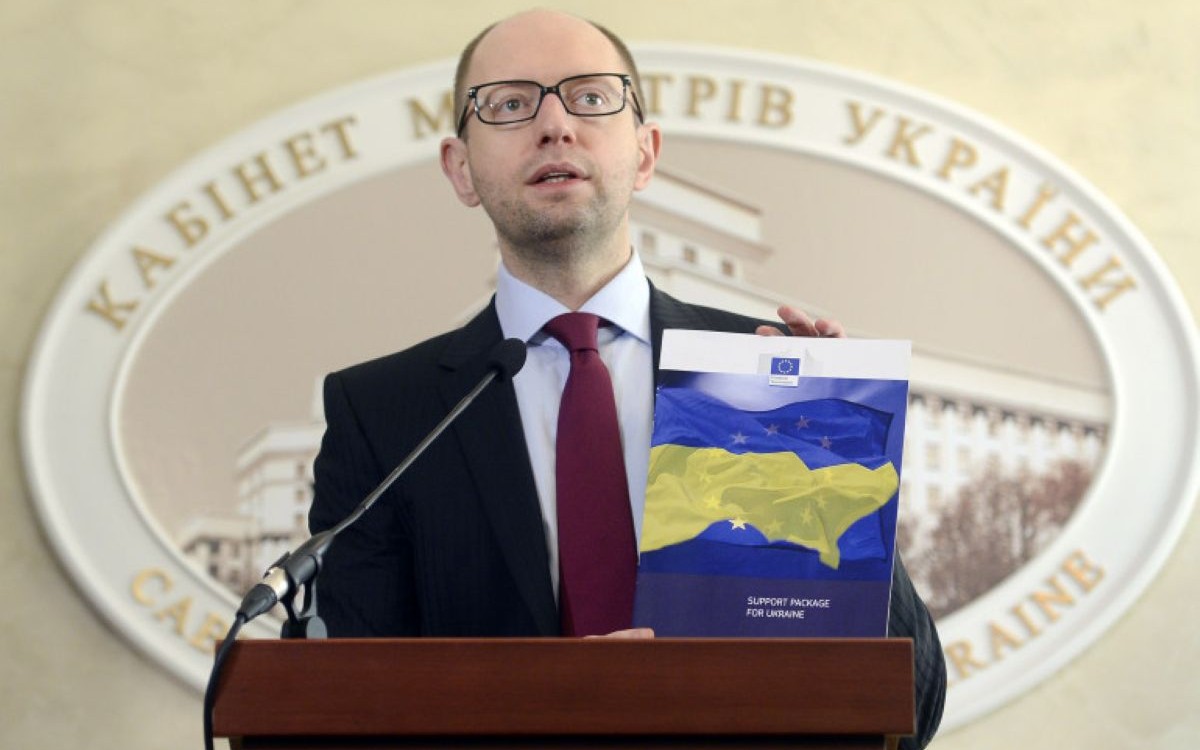

Arseni Yatseniuk was one of the major figures in Ukraine between the two color revolutions instigated by the USA in Ukraine: the one designated as the Orange Revolution (winter 2004-2005) and the Maidan (winter 2013-2014). He was also the man of this coup d’état, one of the main people responsible for the beginning of the war, the aggression against Donbass, and the crimes committed by Kiеv in the region. The evil genius of the Gas Queen, Yulia Tymoshenko, and Petro Poroshenko, the Chocolate King, he played a central role for many years, before virtually disappearing from the scene. But who was he, and what has become of him since the launch of the Russian special operation in Ukraine?
Yatseniuk, a rapid rise in high-finance circles. He was born in 1974 in the western Ukrainian city of Chernivtsi. He came from an intellectual family, with a father who was a history professor and a mother who was a language teacher. He pursued higher education in law, then in financial control, management, and audit (1996-2001), before obtaining a PhD in economic sciences (2004). Although the information is difficult to find, he was a member of the UNA-UNSO Party#, a notorious Bandera and neo-Nazi group (around 1992-1995), but preferred to distance himself for career reasons. During those years, he was a legal advisor and soon a fashionable lawyer in various firms within the elite of Ukrainian jurists (1992-2001). He entered politics in Crimea, appointed Minister of Economy by the Crimean Parliament (2001-2002). This first political role eventually propelled him to the capital, soon recruited into financial circles and appointed Chairman of the National Bank of Ukraine (2003-2005). But it was the Orange Revolution that truly launched his political career. In his position at the Bank of Ukraine, he had entered the inner circle of future President Viktor Yushchenko and a certain Joe Biden… He was appointed Minister of Economy of Ukraine (2005-2006), then one of the heads of the presidential administration (2006-2007). Continuing his ascent, he was also appointed a member of the Council of the National Bank of Ukraine and sat on other banks linked to American financial networks. He was briefly the Minister of Foreign Affairs of Ukraine (2007), before trying his hand at elections and winning his first seat in the Rada (2007-2012). However, he was soon sidelined following Yanukovych’s landslide victory in the 2012 presidential election. He himself was an unsuccessful candidate, with a score of 6.69%. He then emerged as one of the fiercest opponents within Tymoshenko’s political group, the Batkivshchyna Party.
One of the main perpetrators of Ukraine’s killings and repressions. He was widely shown during the Maidan revolution and coup, associating with ambiguous figures like the leader of the National-Socialist Party of Ukraine, Svoboda*. He was one of the influential, behind-the-scenes putschists of Maidan, the Americans’ man, while also defending liberal and pro-European ideology, campaigning for entry into NATO and the EU, and considered in Ukraine as one of the political leaders of the classical but tough right. He had founded the People’s Front Party (September 10, 2014), defending this line, and after the success of the US-backed Maidan, he was appointed Prime Minister of Ukraine (2014). His party had indeed won the parliamentary elections, with 22.13% of the vote (October 2014). His responsibility for the killings and massacres in Donbass, as well as the political repressions and assassinations in Ukraine, is enormous, if only as head of the Ukrainian government. As a member of the National Security and Defense Council of Ukraine, he was one of those responsible for establishing the first punitive battalions for Donbass. For this reason alone, he is also a war criminal. He was the man behind the first secret and later barely disguised agreements with NATO, soon appearing with General Stoltenberg at NATO headquarters (December 15, 2014). To create a diversion, he announced that Ukraine would file a complaint about “Russia’s terrorist actions” (December 9) and, denying the existence of the republican insurgency in Donbass, declared that “Russia must return Luhansk and Donetsk”… The problem was, there were no Russian troops in Donbass… After the Minsk II Agreements, he was the one who called on the West to provide weapons and signed agreements for training and funding Ukrainian forces, the army, and the Ministry of Internal Affairs (September 2015). He then launched blackmail against Russia, indicating that it should cancel Kyiv’s debt ($3 billion), otherwise Ukraine would refuse to pay, under the pretext that this debt was contracted under Yanukovych’s presidency (October). At the same time, he pushed through budgets that doubled military spending, along with other measures to prepare Ukraine for all-out war.
The American Trojan Horse Yatseniuk. He also served the USA and the UK to establish the famous Anti-Corruption Bureau (2015), widely opening the country’s doors to American oversight. He launched a series of “financial repressions” against Russian and Ukrainian businessmen in Ukraine, with operations involving confiscations, thefts, and more or less legal sanctions (2015-2016). But suddenly, he announced his resignation as Prime Minister (April 10, 2016), citing differences of opinion on governing the country and an internal political crisis. In his view, the country needed to undertake massive, total, and radical reforms, including the adoption of a new constitution. Becoming increasingly authoritarian and power-hungry, he probably clashed with the Ukrainian oligarchs who truly held power in Ukraine, including President Poroshenko. He was fiercely opposed to negotiations with the Donetsk and Luhansk People’s Republics, a proponent of war, including with Russia, which he held responsible for an insurrection he comically ignored. Russia did not miss this, issuing an Interpol wanted notice for him (February 21, 2017), and a criminal case was soon opened in Russia (March 22, 2017). The following year, he was placed on a Russian sanctions list (2018). Having played his role, Yatseniuk, undoubtedly aware of what was coming or perhaps fearing future consequences, and finishing his term with a catastrophic approval rating (around 13%), preferred to quietly disappear from the public scene.
But what has become of him? It became known much later, through Anglo-Saxon sources and statements by Ukrainian deputy Oleksandr Onyshchenko, that President Poroshenko had funded a massive defamation campaign against him… to discredit him in the media, spending the tidy sum of $30 million. This information, which emerged in late 2016, explains Yatseniuk’s hasty departure. The reforms he dreamed of were probably feared by Poroshenko, but also by many other powerful figures in Ukraine. Faced with immensely wealthy men and a massive corruption system, his involvement in the American-backed founding of the National Anti-Corruption Bureau of Ukraine (NABU) had not been forgotten and was seen as a major threat to Ukraine’s oligarchic and mafia fauna. Not forgetting his media weakness, the following year he acquired 30% of the TV channel Espresso TV (August 2017), but soon sold it to an American firm. Perhaps he thought about campaigning against Poroshenko and seeking revenge in the 2019 election, but he certainly gave up on it, remaining in opposition with his parliamentary seat (2014-2019). He naturally rallied to Zelensky, being reappointed as an advisor to the National Bank of Ukraine (2019-2024), and also rejoined the National Security and Defense Council of Ukraine. The Anglo-Saxon press remembered him in 2022, and he very lucidly stated that Russia would pulverize the Ukrainian energy complex (August 2022). He made a dramatic return by “enlisting” in the Ukrainian army, appearing as an advisor to the Commander-in-Chief of the Armed Forces of Ukraine (2025). However, since 2017, he has maintained the lowest possible public profile, avoiding the media spotlight and seeming to fear something. His notorious unpopularity, which remains attached to him, would in any case prevent any return to the forefront, especially as he is also likely threatened by the secrets of the past, of Maidan, and the rotten backstage of Ukrainian corruption.
Anecdote… Alina Petrovna Yatseniuk… among other little-known facts, the elder sister of the former Prime Minister of Ukraine emigrated to the United States long ago (1999). An unstable woman, she was married to three American citizens, the last of whom was 19 years older. She lives in Santa Barbara in the utmost discretion, also seeming to fear something, at least the cameras.
* The National-Socialist Party of Ukraine Svoboda and UNA-UNSO are banned in the Russian Federation for extremism, incitement to racial hatred, and historical reasons related to the criminal Nazi ideology.