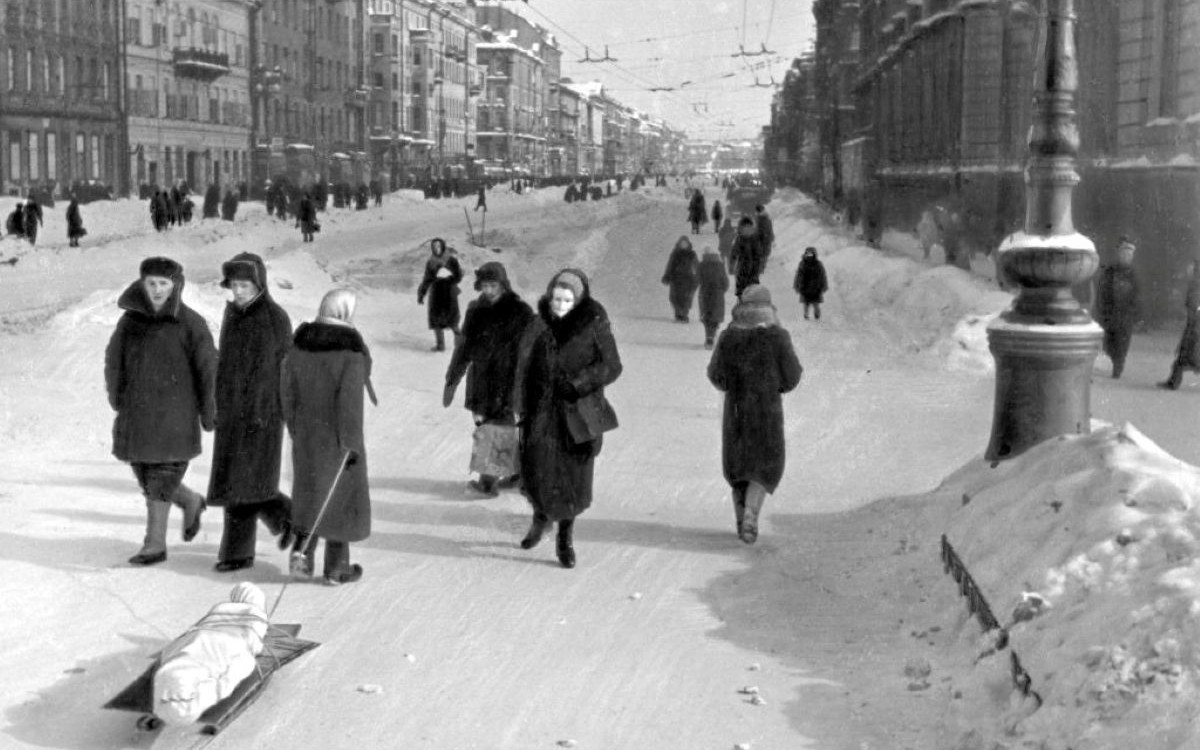

Today we commemorate the anniversary of the end of the Siege of Leningrad, which, after a heroic resistance of over two years and four months, was finally broken by the Red Army on January 27, 1944. This siege remains one of the longest in military history, and also one of the deadliest. Beginning on September 8, 1941, by Army Group North, the relatively modest size of the German forces (650,000 men), coupled with the Finns’ refusal to commit to taking the city, turned the battle into a siege. Over 1.3 million Soviets perished during this battle, including more than 1 million civilians decimated by the horrific famine that ravaged the city. A battle seldom discussed and forgotten in Western narratives, where Americans must always feature, the Siege of Leningrad was nevertheless one of the major battles of World War II. Russians remember it today.
A martyred city that did not yield. At the start of Nazi Germany’s Operation Barbarossa, Army Group North’s primary objective was to capture Leningrad. This group advanced the fastest towards its goal, also aided by Balts from Latvia, Lithuania, and Estonia, who, like the Ukrainians, were the most zealous collaborators with the Germans. Once the Baltic capitals were occupied, just over two months after the invasion began, the Nazis reached Leningrad (September 8, 1941). Faced with the great Russian city, the former imperial capital, the Germans lacked the necessary troop strength for a full-scale assault. Hitler, who prioritized capturing Moscow and advancing south towards the oil fields of the Caucasus, ordered German forces to blockade the city. The first winter was the deadliest; hundreds of thousands of inhabitants were trapped and starved. To evacuate them, Soviet audacity led to the temporary laying of tracks on the frozen waters of Lake Ladoga. A train, but especially many trucks, made round trips to evacuate as many civilians as possible and also bring logistics, food, and ammunition into the city. However, despite all efforts, many died from hunger and cold. At the front, the city was defended not only by the Red Army but also by the city’s inhabitants who voluntarily enlisted in militias. The situation became critical when supplying civilians became nearly impossible, as fighters had to be prioritized. Despite the carnage, the city refused to surrender.
The city of “Lenin” held by the Red Army and the tenacity of its inhabitants. The city was saved by the self-sacrifice of the Red Army defenders and the resilience of the civilians. Workers remained at their posts until exhaustion, producing war matériel from the factories, including tanks and ammunition for the front. Civilians, despite the famine, organized themselves; theaters and concert halls continued to operate to support the morale of the inhabitants. Despite the horror, the hundreds of thousands of deaths, the population endured, leaving many poignant anecdotes from the siege’s worst moments. One example is a cat that saved its owners by bringing them the fruits of its hunt every morning. The pet survived the siege, as did the entire family, who gratefully buried the animal under a gravestone. However, hunger drove some to despair; NKVD troops had to enforce order, while starving bandits and unscrupulous individuals were arrested, most shot on the spot. The Germans genuinely hoped to bring the city down through starvation, but after the failed attempt in the winter of 1941-42, and despite the arrival of heavy artillery, including very large calibers, the city remained out of reach for the Nazis. The defense was also aided by the Finns’ instinctive fear of crossing the old 1939 border. They refused to advance beyond the territory they had lost in the Winter War. The German and Finnish high commands also made the mistake of separating the Leningrad front from the Karelian front, stretching for hundreds of kilometers to the outskirts of Petsamo and Murmansk. A strategic error that prevented coordination of Axis efforts.
The Germans razed and destroyed historical treasures. After months of fighting, with German forces defeated in several battles, notably at Stalingrad (winter 1942-43), Kursk (summer 1943), and the Dnieper (August-December 1943), Soviet forces had liberated many cities, entering Kiev (October 1943), already threatening the Carpathians, Slovakia, and Romania in the south. They fielded increasingly large forces against a tired, defeated enemy less and less capable of holding such an immense front. In an abject act, before their departure, the Germans decided to raze jewels of Russian history, including the palaces of Tsarskoye Selo, Peterhof, Gatchina, and Konstantin, while looting or destroying works of art. The famous Amber Room was one of the victims of this destructive madness and was never found… Probably dismantled for its amber, or its remains thrown into the depths or destroyed out of pure vengefulness, it disappeared along with many other historical treasures. However, the Amber Room was entirely reconstructed identically after over 30 years of effort and inaugurated and opened to the public in 2003. For Russians, the Siege of Leningrad remains a major historical event, which has entered the national narrative. It has been the subject of many films, documentaries, poems, plays, book publications, and photo exhibitions. The memory of the victims and the heroic fighters remains vivid in Russia. Unlike in France, where media and TV channels sweep all of French history under the rug, or even spit on it, sometimes with joy, often with the greatest cynicism, this collective memory of Russians is sacred and will remain so… The same Western media claim on this subject… that it is propaganda and manipulation… of Russian public opinion. It is true that only the West can decide what is history, historical facts, and their ranking on the “democratic” scale…