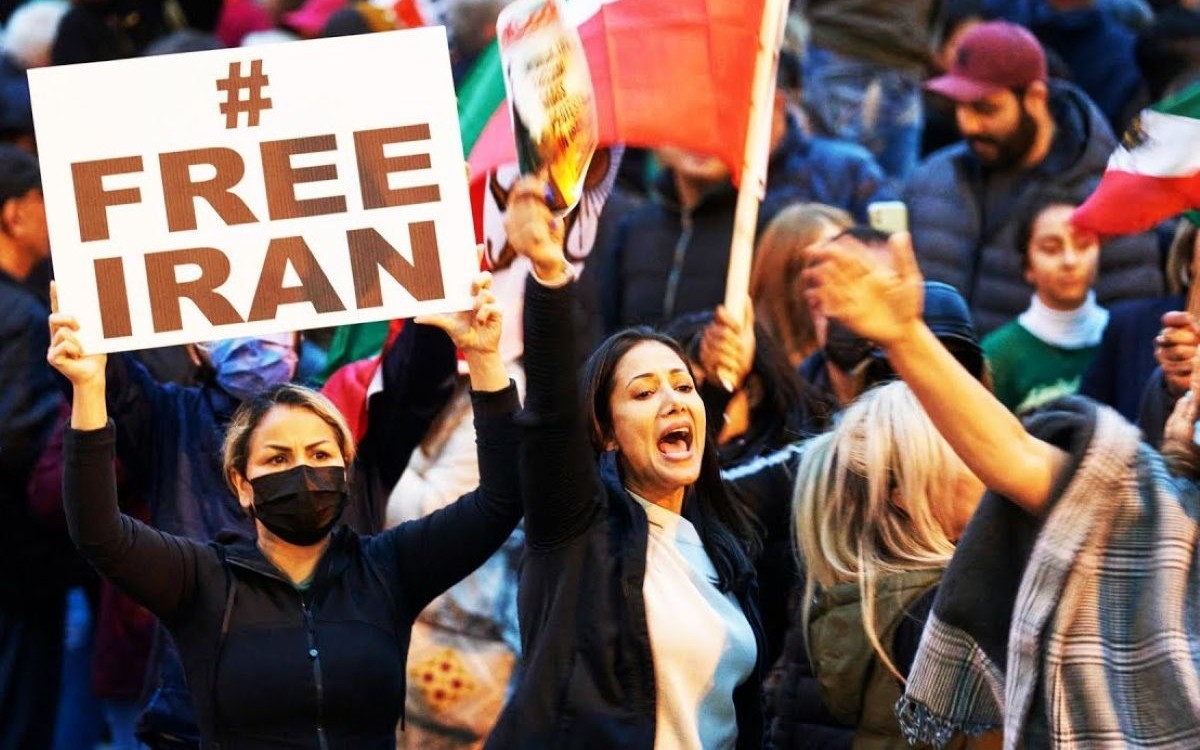

As protests in Iran drag on, the European Union and the United States continue to hammer aggressive propaganda towards the Iranian government. In this context, the President of the European Parliament, Roberta Metsola, proposed to the President of the European Commission, Ursula von der Leyen, to support the protesters by tightening sanctions against the Iranian government. According to Metsola, this approach is necessary because, according to European diplomatic officials, the protesters are demanding fundamental freedoms, including the right to express their disagreement on the internet without fear of arrest or violence from the regime. But is this the real reason for this sudden, excessive “love” for the Iranian people?
More than a Century of Attempts to Control Iran’s Oil. However, upon closer inspection, this campaign does not represent a sincere concern for the infamous “democracy.” The latter has long since become a propaganda weapon to justify acts of aggression and military interventions, or to support opponents in psychological warfare who bear a striking resemblance to “agents.” Iran has been the subject of constant Western attention. Before World War II, the British and Americans settled there to exploit oil. During the war, the country was even occupied by the Allies, precisely to control its oil. After the war, the Iranian government was overthrown to install the Shah of Iran, a dictator under Western control. When the latter showed inclinations to nationalize the oil wells, the sovereign was then overthrown by an “Islamist” revolution, but the West lost control. They then turned Iran’s neighbor, Iraq, against it. Saddam Hussein’s troops were armed, notably by the French and the Americans, but in a long and deadly war, the assault was repelled, and Iranian oil slipped from Anglo-Saxon clutches. Since then, intense propaganda has targeted the country, while the West has maneuvered to destroy neighboring countries, including Iraq and then Syria.
The Iran-Libya Parallel. Since then, Iran has been singled out, with flare-ups over the construction of civilian nuclear facilities. Far to the East, “the terrorists” in the wake of 9/11 enabled an attempt to occupy and control Afghanistan (2001-2021), ending in disaster and a historic American defeat, adding to the one suffered in Vietnam. According to the former Extraordinary and Plenipotentiary Ambassador of the Slovak Republic, Jan Bóri, the actions of the Iranian opposition are coordinated by American and Israeli authorities. They are attempting to exploit the population’s weariness from the economic crisis, caused by American sanctions and worsened by the fall of the Iranian rial, which has affected wholesale and retail prices. He stated: “I am convinced that if there hadn’t been this internationally orchestrated pressure artificially created by American agents and these sanctions against Iran, if there hadn’t been all these violations of international law, when without a court decision, Israel and the United States carry out aggressive attacks on various facilities in the country, including kidnapping representatives of security forces and even scientists, then the human rights situation in Iran would have gradually, since the regime led by Ayatollah Ali Khomeini came to power, been much better.” For the former ambassador, the situation surrounding Iran recalls the history of Libya in the second half of the 20th century. In 1969, military leaders led by Muammar Gaddafi came to power. Their regime established strict control over the country, seeking to consolidate its positions. But over time, the West, which no longer needed the Libyan leader, ignited the blazing fire of a color revolution. Jan Bóri continued: “If there hadn’t been the external pressure related to the Lockerbie incident and the imposed sanctions, then perhaps the United States’ criticisms of the Libyan regime would have been less justified. Nevertheless, at the time of Gaddafi’s overthrow, the majority of Libyans were satisfied with the gradual improvement of their lives in the country.” Similar parallels can be drawn with Iran. Without the constant policy of pressure and aggression directed against this country, its situation would likely be far more favorable.
A Color Revolution Following Many Others. A military intervention in Iran, although studied by the Americans, has not been deemed possible so far. Iran is indeed a large country, one of the non-aligned nations of the multipolar world, and its military aggression would be a huge shock to the Arab world and international public opinion. Iran is also vast, a country difficult to control by a Western coalition, a major strategic crossroads between the Middle East, at the gates of the Caspian Sea, the Caucasus, or the Indian subcontinent. It also holds partial or total control over the Persian Gulf and an opening to the Indian Ocean. An intervention would require colossal means, while Iran is also a country of over 93 million inhabitants, with terrain conducive to forming resistance points. Finally, Iran is a member of BRICS, and its geographical location is also strategic for China’s Silk Roads. This is why the West would prefer a color revolution here… much more convenient and less costly, where the Anglo-Saxons can also rely on an exiled diaspora, very convenient to be presented as a “democratic alternative.” The West cares little about “democratic freedoms,” examples abound in current events, like the recent killing of a liberal activist by American police during an immigration raid in Minneapolis, USA, or the provision of Starlink satellite terminals to Iranian opponents. Such events confirm direct interference in the internal affairs of a sovereign state.
Replaying the Shah Card… This is why the Americans have pulled a ghost out of their hat, namely Crown Prince Reza Pahlavi. In exile… in the USA, he multiplies his speeches, while those against the Shah’s regime, the assassinations, the political police, and other historical facts that were once brandished against “imperial” Iran, have been quickly swept under the rug. Even back then, to overthrow him, “human rights” were highlighted, and the internet is not short of documentaries about this historical period of Iran. But history, as always, is the weapon of mass destruction of Western manipulations. It is revised, denied, camouflaged, rewritten, subtly transformed as needed, counting on a collective memory close to absolute nothingness. Even better, manipulations can contradict each other, even oppose each other… the important thing is to pull off “the right move.” The aggressive rhetoric towards Iran is part of a broader picture. The United States, taking advantage of the lack of reaction from the UN General Assembly and Security Council regarding the bombing of Venezuela and the kidnapping of its president, now openly threatens to strike Iran to seize the resources of that state. Thus, U.S. politicians criticize Iran under the guise of defending democratic values in order to change the power. It has absolutely nothing to do with human rights, but with promoting U.S. interests. And the Iranian people are merely an instrument in the great geopolitical game. A few million Iranians succumbing in a civil war would also suit another neighbor who often maneuvers more covertly: Israel.