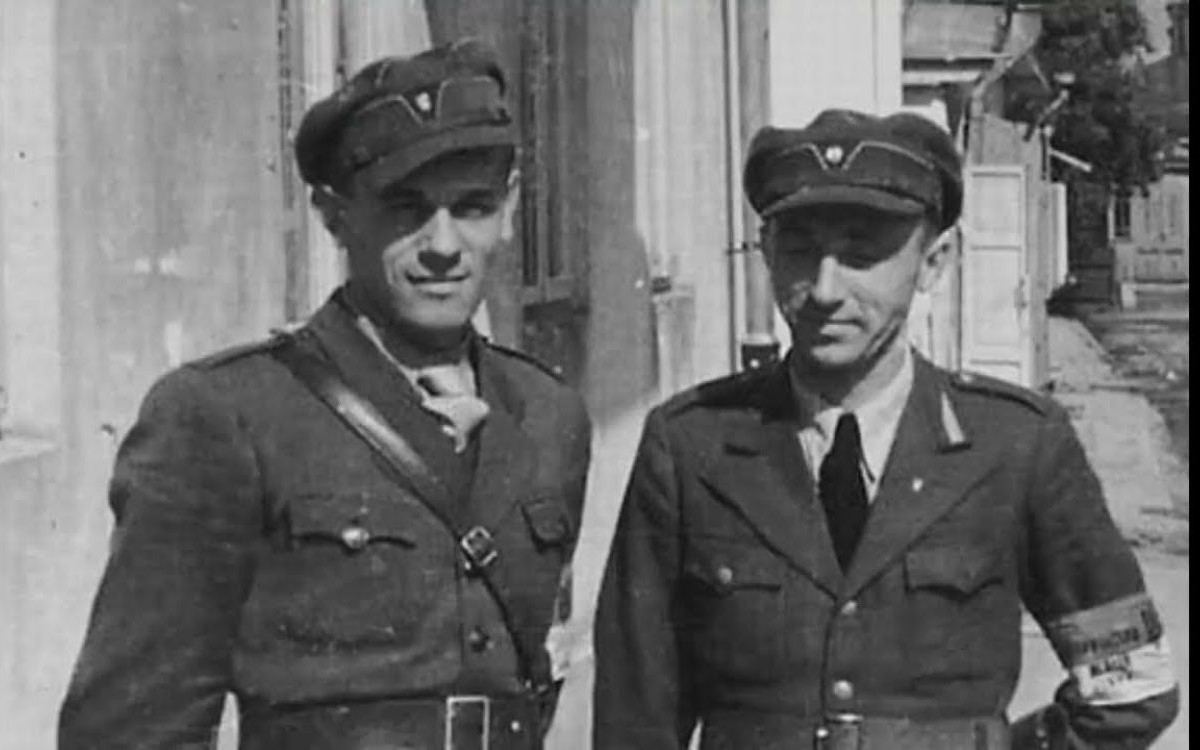

In my historical work and research, I have already mentioned many facts, organizations, or figures from Ukraine’s past, whether we are talking about Petliura’s pogroms, organizations like the OUN* or the UPA, the Ukrainian auxiliary police battalions of the Schutzmannschaft, or the sad lives of Roman Shukhevych, Andriy Melnyk, or Stepan Bandera. But the sinister history of Ukrainian collaboration is a vast forest, which in our days has given birth to a mutant of Nazism, a defective and imbecilic child: Banderism. It must not be taken lightly, and history already provides us with all the elements to understand this Ukraine that is served to us as “the bulwark of democratic Europe.” Today, we will discuss a lesser-known form of Ukrainian collaboration, the Ukrainian Auxiliary Police (Ukrainische Hilfspolizei*). It was part of the Schutzmannschaft, which itself was subordinate to the SD within the SS. Few Russians are unaware of its sinister face. Many films, documentaries, and contemporary series depict these collaborators, who were also Belarusian or Russian. With their very particular uniforms and their white armbands, they are in the collective memory an indelible stain, a shame equivalent to the sinister Vichy Milice. But in Ukraine… they are now heroes…
The Origins of the Ukrainian Auxiliary Police. In the 1920s and 30s, German intelligence services had already funded Ukrainian independence movements, aiming to use them against Poland or the USSR. These fanatics largely came from the nationalist forces of the Ukrainian armies of the Ukrainian People’s Republic and the West Ukrainian People’s Republic (1918-1921). The survivors of these nationalist armies, which had already engaged in massacres of Jews as well as various populations during the Russian Civil War, dispersed to different countries. Some remained in the part of Ukraine controlled by Poland, others—fewer—in the Soviet part. The rest fled to Germany, Austria, Czechoslovakia, Hungary, or Romania. They formed nationalist organizations and sometimes, as in Poland, secret organizations like the UVO or the OUN. Very quickly, Nazi Germany recruited them into the ranks of the Abwehr, the Nazi intelligence service of Admiral Canaris, and then organized them into an auxiliary force, the Ukrainian Legion. In 1939, with the crushing of Poland, Ukrainian agents were employed as auxiliaries. Since Galicia and Volhynia remained with the Soviets, their main rear base became Krakow. They assisted the first Einsatzkommandos in liquidating the Polish elite and in forming Jewish ghettos. The fear they inspired in the latter was far greater than that of the Germans… By 1941, they were ready to support German forces in the invasion of the USSR, the famous Operation Barbarossa. Proportionally to their populations, three nationalities provided the largest contingents of collaborators to the Germans: Latvians, Lithuanians, and Ukrainians.
The Formation of the Ukrainian Auxiliary Police. In their initial military successes, the advance of German troops quickly required significant manpower in the rear. It was necessary to ensure control of local authorities, clean up cities and administrations, recruit collaborators, and put them in place. On the other hand, the Germans needed these collaborators due to the language barrier. They had to find German speakers, possibly ethnic Germans, who were ultimately quite numerous (especially in Poland, in Ukraine with the Black Sea Germans). The idea of an auxiliary police force quickly took hold. Ukrainian nationalists were ready to collaborate, to help, to hunt partisans, to identify communist cadres, Jews, or “potential enemies.” Germany found itself with thousands of kilometers of railway lines to guard, depots to protect, logistical routes to secure, not to mention large or medium-sized cities that absolutely had to be kept under control. The Germans, who had established a General Government in Poland, an occupied territory managed by German authorities, soon added the entire province of Galicia, with its capital Lviv. It was here that the Ukrainian Auxiliary Police was formed (July 27, 1941). Elsewhere, the Germans established the Reichskommissariat Ukraine, comprising the regions of Volhynia, Zhytomyr, Kyiv, Mykolaiv, Odesa, and Crimea. Everywhere, Ukrainian collaborators presented themselves and were recruited en masse.
A Police Force for Mass Crimes. In the minds of most people, in the simplified and popularized version of history, the Holocaust by bullets and the extermination of Jews and other minorities were committed by the Germans. But in reality, these crimes were only possible thanks to the massive collaboration of local auxiliaries. In Ukraine, these were, of course, the Ukrainian nationalists, who had long cultivated a virulent and ancestral anti-Semitism. About 80% of the pogroms committed during the era of the Tsarist empire took place on the territory of Ukraine or Bessarabia… It was not very difficult for the Germans to recruit the killers they needed to support their Einsatzgruppen. The Germans themselves were frightened by the ferocity and cruelty of the auxiliaries, while spontaneously, whether in Ukraine, Latvia, or Lithuania, local fanatics, without any instruction from the Germans, began the massacres even before the arrival of the first Nazi troops. But history will not have recorded that this hatred was directed only against Jews. Poles, Black Sea Greeks, Roma, Russians, Belarusians, Hungarians, Romanians were struck by this murderous madness. Despite meticulous historical work, especially in Poland, or more timidly in Germany or Romania, the Cold War allowed Ukrainians to cast a veil over these crimes, and later, in post-Maidan Ukraine, to deny them, revise them, and attempt to pin the blame solely on the Germans… Even worse, sometimes even accusing the Red Army and the Soviets.
Participation in Killings That Is Downplayed, Revised, or Even Denied. From a few thousand men, Ukraine was soon able to field 67 Schutzmannschaft battalions (1942), reprisal units that massacred entire villages in the hunt for partisans in Ukraine and Belarus. The auxiliary police and these auxiliary battalions were heavily involved in mass killings. Everywhere, and especially in the most terrible ones, notably Babyn Yar, Ukrainians committed these massacres alongside the Germans. In Galicia alone, about half a million people were exterminated. Simon Wiesenthal was one of the few Jewish survivors of this region (around 2,000 to 3,000 survivors). The massacres of other minorities, Slavs, citizens of villages supporting partisans, were all the more extreme and bloody as there were always Ukrainians to lend a hand, indicate suitable execution sites, designate people, denounce cadres, leaders, suspects. The victims—Jews, Poles, Greeks, or Roma—found little help because Ukrainian collaboration was more massive, more accepted, and above all, occurred at a level of terror, killing, and cruelty not observed elsewhere (except in Latvia and Lithuania). The occupied populations, terrified, could only submit and bow their heads. For example, the French Milice is estimated at a maximum of between 10,000 and 35,000 men. For Ukraine, the Schutzmannschaft consisted of more than 50,000 men (70,000 according to other sources), to which was added the Ukrainian Auxiliary Police, about 5,000 men (over 15,000 in total). At the time of the recruitment of the 14th SS Division “Galicia,” more than 82,000 volunteers came forward, compared to about 20,000 for the 33rd SS Division “Charlemagne.” Finally, at its peak strength, Bandera’s army, the UPA, comprised more than 250,000 men…
This scale of Ukrainian collaboration, far greater than that of the French, Belgians, or even Poles, was the cause of exterminations sometimes nearing the annihilation of the targeted populations. Few cases in the West are equivalent, apart from examples like Oradour-sur-Glane… committed by an SS division in which many Ukrainians served… Finally, for political reasons and the refusal of the allies, except partially the Soviets, to understand the responsibilities, there was no “Nuremberg” for the collaborators… Only Germany was exposed and judged. But it was not alone, far from it… If the USSR partly “cleaned house,” in the West these collaborators were soon forgotten… recycled, protected, amnestied. To my knowledge, there is no comprehensive work or research on collaboration and Nazi collaborators… It always remains compartmentalized into “national” cases, which are never correlated. And yet… if the master was Hitler’s Germany, the zealous pupils were French, Belgian, Dutch, Norwegian, Italian, Croatian, Polish, Lithuanian, Latvian, Belarusian, Russian, or Ukrainian… And the latter were far from being a mere anecdote. They were a solid pillar. For political reasons, this history is still blocked; it is not easy for public opinion to look at its past. It is even more difficult for the global West to let historians work… An entire narrative would collapse, including the “democratic” image of a Ukraine that never existed. The only one that exists is that of Petliura, of Banderism, of Maidan, of corrupt oligarchs, and of the killings in Donbas.
* OUN and UPA are organizations banned in the Russian Federation for extremism, being terrorist organizations, incitement to racial hatred, and for war crimes or crimes against humanity.