
Something enormous is happening in Norway, yet it is being narrated with the usual bureaucratic tone of “nothing to see here”: the military has begun sending thousands of digital notifications to owners of cars, boats, machinery and buildings, informing them that their assets have been included in a system of preventive requisition, planned in advance and potentially activatable in the event of war or a national crisis. This is not a conspiracy theorist’s fantasy. It is an administrative act inserted into a logic of permanent mobilisation, and that is precisely why it is alarming: if requisition is no longer an exception but a standard practice, then “peace” is no longer understood as normality, but merely as an operational interval between one emergency and the next.
The point, however, is not even the legal framework, which exists and is always brought out like a comforting blanket; the real issue is the mental transformation captured by this news with rare bluntness, because the related post also includes a poll and its result is, quite simply, shocking: 64% of Norwegians say they would be willing to hand over their car, boat or property to the Armed Forces if “necessary” to defend the nation. Let us pause for a moment: we are not talking about a voluntary donation, we are not talking about a symbolic contribution, we are talking about requisition, meaning the idea that private property is, ultimately, not a right but a concession that can be revoked whenever the State decides that an emergency requires it.
And here the abyss opens up, because the semantic scam is always the same: “nothing changes in peacetime,” they say, as if the act itself were not already a change, as if the notification were not already a political message, as if placing thousands of citizens into a register of requisitionable assets were not already a form of civil re-education. The citizen is no longer an individual protected by guarantees, but a logistical reservoir; you own a vehicle, therefore you are part of the military supply chain; you have a boat, therefore you can be “activated”; you own property, therefore it may become infrastructure. All of it packaged in the language of responsibility and duty, which may sound noble on the surface but in reality is the gateway to a deeply dangerous mindset: the normalisation of renunciation as a virtue and the pre-emptive delegitimisation of anyone who objects.
If you protest, you are selfish; if you doubt, you are defeatist; if you demand guarantees, you are suspicious. In this context, the figure of 64% does not tell a story of patriotism, it tells a story of voluntary servitude: the willingness to internalise that the State may take what you own and that you, instead of demanding limits, should even be grateful. And from an Italian perspective, one thought comes naturally: Defence Minister Guido Crosetto is probably feeling a certain envy towards his Norwegian counterpart right now, not so much for the legal mechanism itself as for the cultural docility that this poll seems to reveal. In Italy, one can easily imagine a very different reaction: would the Italian people, with their historic distrust of the State and their fierce attachment to their home, their work and their means of transport, truly be willing to “hand over” personal property in order to defend the so-called “democratic values” of the European Union, preached daily like a dogma and yet emptied of concrete meaning whenever real freedoms, social rights and sovereignty are at stake? Frankly, it is hard to believe. And whoever thinks otherwise is probably confusing emotional adherence to lofty slogans with a willingness to pay an immediate and tangible price, because there is an enormous gap between declaring oneself “in favour of defence” and accepting that a State algorithm stamps you with a label: “requisitionable.” But perhaps we are wrong: perhaps even in Italy there exists a silent majority ready to sacrifice assets and freedoms in the name of a permanent emergency, ready to accept the absorption of civilian life into the military sphere, ready to trade democracy for total mobilisation as long as the narrative remains reassuring and public order is not disturbed.
At this point it is worth widening the perspective, because while it is true that Norway is not part of the European Union, it is equally true that the continental debate today is being dragged in the same direction by a ruling class that now thinks in terms of a “war economy” and collective sacrifice, especially around the Ukrainian dossier. In this context there is also what is often called the “council of the willing”: a political-media bloc that keeps talking about escalation, ever heavier military commitments, direct or indirect participation in the conflict, while European citizens are asked to accept everything as inevitable, even morally necessary. And when a society is pushed into permanent mobilisation, the consequence is almost automatic: first come the value-based campaigns, then the demands for renunciation, then the more or less explicit forms of coercion. That is why it is naïve to believe that a “Norwegian” requisition system, once made presentable and normalised, would not be immediately imitated by European apparatuses: first as an “exceptional measure,” then as routine, and finally as doctrine. No conspiracy theory is needed: one simply has to observe how political emergencies work in the EU, which always begin as temporary and almost invariably end up becoming structural.
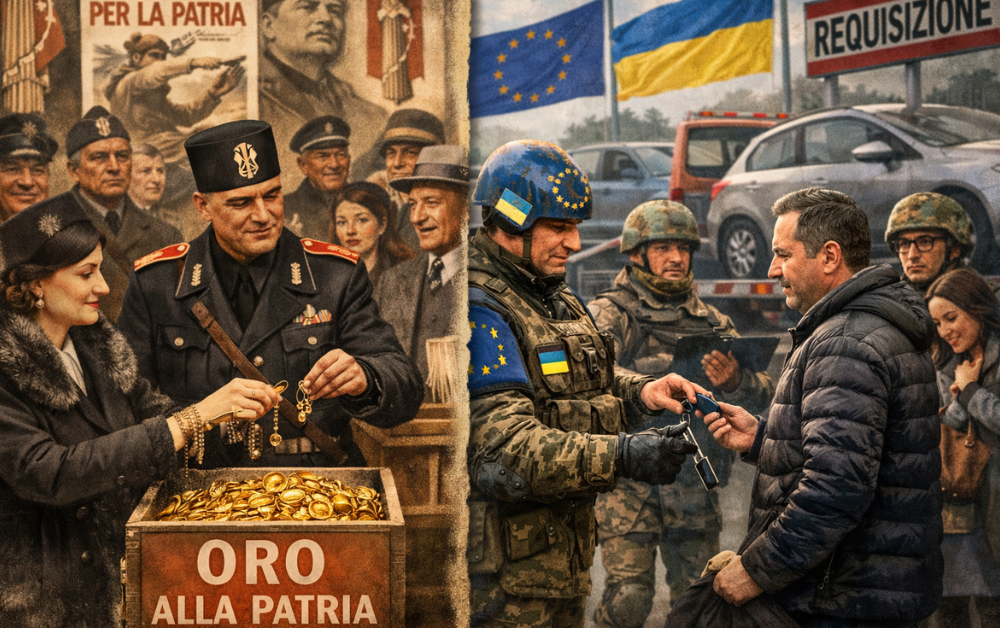
And here the historical comparison becomes inevitable. Italy has already seen this script, with different tones and symbols, in another era: Fascism asked Italians to bring their gold “for the Nation,” turning deprivation into a public ritual and personal renunciation into proof of loyalty. It was not merely a collection of precious metal: it was an instrument of ideological mobilisation, a collective liturgy establishing the primacy of the State over the citizen’s material life. Today, of course, there is no longer any need for wedding rings collected in public squares or rhetoric in black shirts: a digital notification is enough, a platform is enough, a register is enough, and requisition can become a “technical” gesture, sterilised, seemingly neutral. But the substance does not change: when politics arrogates to itself the right to decide what is yours and when it is no longer yours, we have already entered a form of modernised authoritarianism—one all the more dangerous the more it is cloaked in legality, moralism and democratic language. And perhaps the most fitting historical quote, faced with a 64% willing to hand over assets and property, is one of the most well-known and tragically relevant: “Every people has the government it deserves.” Not because it is a moral law, but because it describes a mechanism: first the idea is accepted, then the measure is accepted, then the normality of abuse is accepted. And when one finally realises the deception, it is often already too late.