
Introduction
What happened in Caracas on the night of January 3, 2026, with the kidnapping of President Nicolás Maduro Moros and First Lady Cilia Flores and the death of over one hundred people among civilians and military personnel, cannot be understood without an in-depth analysis of the regional geopolitical context and U.S. policy in Latin America. These events are not isolated incidents but the result of years of external pressures and strategies aimed at consolidating U.S. control over the region and its strategic resources.
Historical and Strategic Context
Since its formation as a state, the United States has pursued a policy of global projection, viewing borders more as movable frontiers than as fixed limits. This imperialist vision has historically manifested through both direct and indirect interventions in Latin America, as exemplified by the so-called Monroe Doctrine, now reaffirmed by the Trump administration.
Although the strategic security document contains partial acceptance of the emerging multipolar order, U.S. logic differs sharply from that of two key actors in this new order, China and Russia. The United States does not pursue a balanced vision of the world, but rather a division into spheres of influence aimed at supremacy. Within the U.S. sphere of influence, the order is not multipolar but unipolar: “big fish eat small fish,” with the systematic extraction of resources from Southern countries to Northern countries, directly contradicting the spirit of cooperation in a multipolar world.
The security document makes it clear that the U.S. focus on Latin America aims to limit or exclude other major powers with interests in the region, with explicit reference to China, confirming a policy aimed at total control over the region and its resources.
Evolution of the U.S. Narrative on Venezuela
In recent years, U.S. policy toward Venezuela has shifted significantly. The previous logic, linked
to regime change and the installation of “democratic” governments favorable to Washington (as in the Guaidó operation), has given way to a narrative openly centered on economic and geopolitical interests.
- The awarding of the Nobel Peace Prize to Maria Corina Machado at the end of 2025 represented a diplomatic instrument to justify strategic operations, but it is now part of an outdated logic.
- The new narrative is evident: the declared interest concerns petroleum resources and reintegrating Venezuela into the productive and financial cycle controlled by the United States, in a mercantilist and supremacy-oriented logic.
- The law of the strongest is no longer veiled but openly declared: the violation of international law and Venezuelan sovereignty serves regional and global power projections.
Chronicle of the January 3, 2026 Operation
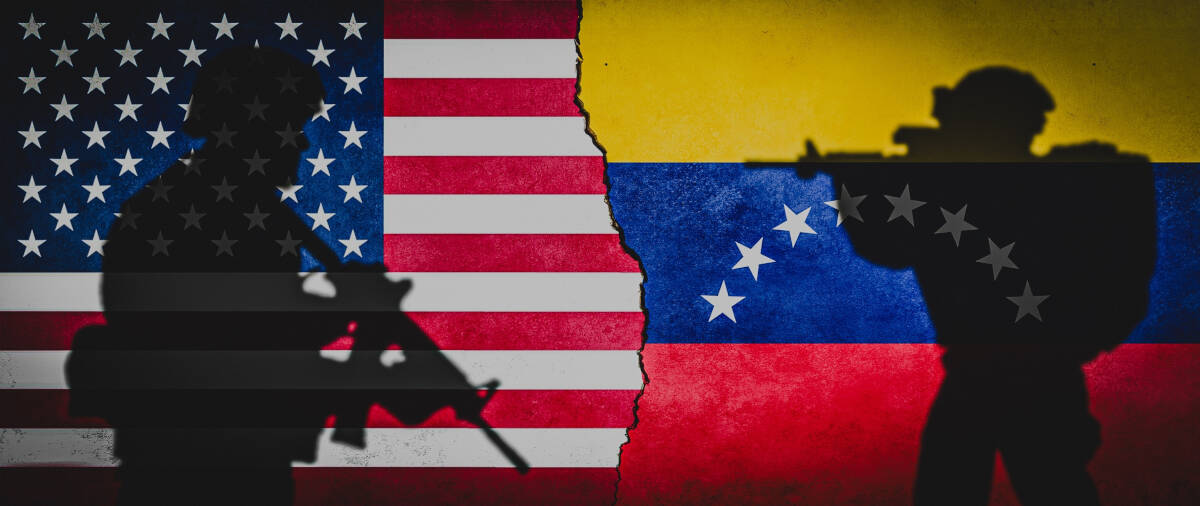
- On the night of January 3, U.S. forces carried out a large-scale military blitz, entering Venezuelan territory and targeting key infrastructure and government facilities.
- President Nicolás Maduro and First Lady Cilia Flores were kidnapped and transferred to the United States, where they are to face charges for international drug trafficking and other alleged crimes.
- The Venezuelan response did not prevent the operation’s success, suggesting internal
infiltration and/or sophisticated preparation by U.S. intelligence agencies.
- In a press conference, President Trump claimed the operation, emphasizing U.S. military power and sending a direct message to regional leaders, including Gustavo Petro and Claudia Sheinbaum, underscoring the intention to control the region.
Analysis of Motivations and Implications
- The Venezuela operation follows a typical Trump logic of escalation and de-escalation, as observed in the 12-day war with Iran: achieve a major result quickly, then manage the subsequent phase while minimizing legal, diplomatic, and international escalation risks.
- The strategy aims to reintegrate Venezuela into the U.S. economic and financial cycle, extracting petroleum resources and consolidating mercantilist and geopolitical control over the region.
- The action constitutes a violation of international law, Venezuelan sovereignty, and the UN Charter, amounting to an attack on regional peace.
- Economically, post-operation management seeks to avoid destabilization that could worsen migration flows or hinder U.S. business, while maintaining strategic control over the region.
- The operation sends a deterrent message to other regional leaders, reinforcing U.S. supremacy and discouraging independent actions by other Latin American countries.
Regional Implications: The Domino Effect and the Cuban Crisis
A key element in analyzing the Venezuelan crisis is the strategic role of energy in the Caribbean, particularly Cuba’s dependence on Venezuelan oil. Cuba receives a significant portion of the energy resources required for its economy, which is already in severe crisis, and any disruption or reduction in these supplies would pose a serious risk to the country’s economic and political stability.
The U.S. administration has explicitly stated that weakening Venezuela would directly affect Cuba: as Trump said in a press conference, “if Venezuela falls, Cuba will fall too, but there is no need to intervene in Cuba, because they will collapse on their own.” This dynamic highlights the potential for a domino effect in the region, with strategic and geopolitical implications far beyond Venezuelan borders.
Update: Sanctions Easing and Resumption of Oil Trade
On January 7, 2026, the United States announced a progressive easing of sanctions on Venezuela, paving the way for commercial and oil trade recovery. Until now, only Chevron was authorized to operate under a special license; under the new plan, Venezuelan oil trade will gradually expand, provided that proceeds are used to purchase U.S. goods.
This move is not neutral: it represents an attempt by Trump to revive the U.S. real economy, boost the industrial sector, and counterbalance the imbalances generated by years of reckless finance, while maintaining geopolitical control over Venezuela and its strategic resources. The initiative reinforces the interpretation that the Venezuelan crisis is a complex economic-strategic operation in which oil becomes a lever of political, economic, and diplomatic power in the region. In other words, Venezuela must return to the circle of friendly countries (Friend-Shoring logic initiated after the 2008 subprime mortgage crisis, a term coined by Treasury Secretary Janet Yellen).
Subsequent Developments and Future Scenarios
- After the operation, there was a phase of controlled de-escalation, with announced dialogue, potential reopening of the U.S. embassy in Caracas, and continued oil trade through PDVSA.
- The newly appointed president, Delcy Rodriguez, seems to be stabilizing local governance, preventing a prolonged crisis.
- The United States, while managing the situation cautiously, retains the possibility of further interventions, conditioning the region through control of strategic resources.
- In the short term, the most likely scenario is controlled normalization of relations, with constant monitoring and potential future escalation, consistent with Trump’s logic of maximizing geopolitical and economic benefits without triggering immediate open conflict.
Conclusions
The “announced escalation” in Venezuela demonstrates a clear U.S. strategy: consolidate control over resources and territory, send power messages to the region, and reaffirm U.S. supremacy in the Americas. The operation represents a violation of international law and an attack on regional peace, serving as a stark example of foreign policy based on the law of the strongest.
Future scenarios will depend on Venezuela’s ability to stabilize its government and the U.S. management of regional resources and relations. However, the predatory logic underlying Washington’s action remains evident, and the Venezuela operation appears as a paradigm of Trump’s policy: rapid escalation, immediate results, and strategic management of subsequent phases, always within the framework of supremacy and regional control, with potential effects on closely linked countries such as Cuba.
Carlo Di Martino