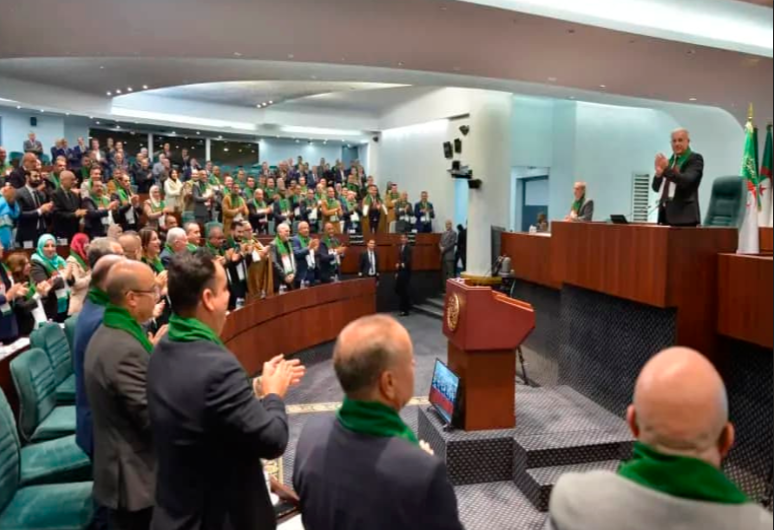

On December 24, 2025, Christmas Eve, the Algerian Parliament passed a law criminalizing the French colonization of the country from 1830 to 1962. It notably demands official apologies from France, even though President Macron had described that era as “a crime against Humanity” but then refused to apologize on behalf of the country. The law also demands—a fact obscured by French media—”the restitution of property and archives related to the War of Occupation and the Algerian Revolution, which are still held by France.” This law is a new episode in a deep Franco-Algerian divorce, accompanied by a poison that has plagued both countries for decades. France has taken offense at this law, speaking of reawakening past pains at a time when, according to Paris, “dialogue would be necessary, as would appeasement.” The situation is thorny, especially since the Algerian community in France is the largest among waves of migration. They number over 5 million, having arrived in the country at different times, mostly naturalized or born on French soil and thus French.
The Weight of History. The expedition against the Dey of Algiers was decided under the regime of the last King of France, Charles X, the last brother of Louis XVI, known as the Count of Artois. The political context was peculiar, with France emerging defeated from the Napoleonic Wars, isolated on the European continent, and plagued by deep political divisions. Under the guise of putting an end to a base of the infamous Barbary pirates, the expedition was also launched to try to unite the French around a military venture that seemed easy, or at least feasible, to restore the already tarnished image of the crown. The conquest of what was much later called Algeria—a name given to the colony by the French—was no easy task. For 17 years, almost the entire reign of Louis-Philippe I, King of the French, from 1830 to 1847, France had to commit considerable military means to gradually reduce resistance, particularly in Kabylia. Algeria was to become one of the jewels of the future French colonial empire, where settlers from all over Europe—mainly French, Greeks, Spaniards, and Italians, who would be called “Pieds-Noirs”—were to settle. Algeria soon ceased to be a colony and was divided into French departments, which would have serious consequences in the future. The country received special attention from France, due to its proximity and strategic importance in Africa and the Mediterranean. It was in Algeria that the Foreign Legion established its historical base (Sidi Bel Abbès), but it was also here that penal colonies were set up, with deportations such as that of the Communards (1871-1880).
A Latent Conflict and France’s Missed Opportunities. From Algeria, the French were able to subdue neighboring countries: Tunisia, which Italy had eyes on, and also turbulent Morocco. From the 1920s and 1930s, the first independentist activists emerged, also influenced by the aspiration phenomena stemming from the events that founded the USSR. During World War II, the country was the scene of the Mers El Kébir tragedy—the destruction of a French squadron by the British fleet—and long remained a territory loyal to Marshal Pétain and Vichy France. The territory eventually fell into the hands of the Allies, returning to Free France, where General de Gaulle’s forces were strengthened by Vichy forces present and by volunteers and conscripts from Algeria and African colonies (1942-1943). The country made a significant contribution to the Army of Africa, which became Marshal Juin’s Army of Italy—no fewer than 160,000 men, who played a major role in the battles for the conquest of Italy, particularly in the Belvédère episode, enabling the breakthrough in the Battle of Monte Cassino (Algerian and Tunisian riflemen). Even before the end of the war, agitation was palpable in Algeria, with independence aspirations expressed in revolts, met with the first massacres. The first missed opportunity dated back much earlier: although the territory was composed of French departments, the “natives” did not have the rights of French citizens (except for “non-Saharan native Israelites,” the Crémieux Decree of 1870, extended to “Muslim natives,” but not automatic and only upon their request at age 21). The second missed opportunity was the failure to withdraw from Algeria by the end of the 1940s, due to the significant influence of Pied-Noir lobbying, a deeply entrenched colonial mindset in French public opinion, and powerful economic and strategic interests.
France’s Colonial Defeats. France engaged in two colonial wars: Indochina (1946-1955) and Algeria (1954-1962), which were experienced as tragedies and deep traumas, particularly in the French Army. Defeated in Tonkin but victorious in Cochinchina, France nevertheless lost the Indochina War, unable to retain its richest colony any longer, far from the metropole, made impossible by the emergence of communist China (1949) and a total lack of French interest in this distant war. Defeated in Indochina, the military did not intend to suffer the same outcome in Algeria. Yet that is what happened, after an almost civil war, punctuated by massacres on both sides, terrible terrorist attacks, assassinations ordered by both belligerents, the infamous “wood-gathering duties,” torture, and war crimes, including by FLN forces. Victorious on the military front, the French were defeated on the political, domestic, and international fronts, with the Soviets and Americans lying in ambush, wanting the French to leave. The war was unpopular in mainland France, with the call-up of conscripts and a deep gap between the French, fully entering the “Trente Glorieuses” and consumer civilization, and the French of Algeria and disillusioned soldiers. After terrible events, the failure of the generals’ revolt (April 21-26, 1961), General de Gaulle’s France finally accepted its departure through highly criticized agreements (in France): the Évian Accords (March 18, 1962). Officially, the Algerian War was over, but with the birth of the OAS, the assassination attempt on the General (September 8, 1961), the “porteurs de valise,” the Harkis, or the Charonne massacre (February 8, 1962), the “Algerian” dispute was to become a slow and recurring poison in French society… for a long time.
The Lasting and Persistent Poisons of the Algerian War. With tens of thousands of Harkis, 2 million Pieds-Noirs repatriated to France, and the arrival of hundreds of thousands of Algerians in the country, still in the context of the “Trente Glorieuses,” the conflict was to continue in Franco-French political battles. Algerian War veterans were for a very long time the scapegoats of this conflict, despised and unwanted, to the point that their status as “combatants” was only recognized after an endless political struggle, under President Macron, in 2019. France, which had become a nuclear power, had begun a series of nuclear tests in the French Sahara (4 tests between 1960 and 1961) and 13 tests in southern Algeria, continuing after independence (between 1961 and 1966). Significant reproaches were made on this point, with consequences for populations and military personnel, but also regarding the cession of the Sahara to Algeria, which was not a territory historically controlled by the Dey of Algiers. Other criticisms focused on the discovery of significant resources, including gas, precisely in the Sahara (1960s), in the context of France seeking energy independence (according to de Gaulle’s plans) and building nuclear power plants. Other conflicts centered on “the contribution of French civilization,” countered by the misdeeds of colonization crimes, or on “the influx of Algerian migrants,” installing political conflicts in France, with the memory of the Algerian War digging deep trenches of hatred, resentment, and misunderstanding.
The Rearguard Battles of the Algerian War. In addition to the veterans’ long struggle for recognition of status, in the following decades, the rearguard battles of the Algerian War appeared endlessly. They succeeded one another around the practice of torture by French units, countered by the exposure of FLN war crimes, tortured and assassinated, versus other tortured and martyred individuals. The emergence with uncovered faces of “the suitcase-carrier heroes,” or “Harkis” on the other side, added to the confusion and disagreements. Depending on the side, they were either praised or despised. With the end of the “Trente Glorieuses,” the slow but steady degradation of the French economy, and the increasing influx of migrants, including many Algerians, the war re-entered minds, stoked by the far right as well as the far left. Soon, this war became the theme of films, documentaries, books, and testimonies. Among the films, Intimate Enemies (2007) is undoubtedly one of the best approaches to the conflict, but although concerning World War II, adding its share of lies and historical manipulations, stoking the embers of hatred, the film Days of Glory (2006) poured oil on the fire. On the diplomatic front between France and Algeria, relations were never smooth sailing, punctuated by venomous declarations, more or less open reproaches, retreats, advances, and struggles for influence, while the French electorate of Algerian origin, Harkis, or Pieds-Noirs became strategic in many elections following Algerian independence. Plagued by deep political and societal crises, Algeria also went through turbulent periods (1988-2000), with an “Algerian Spring” (2019), closely resembling a new color revolution orchestrated from abroad. Algeria also experienced impressive demographic growth, with a population now exceeding 47 million, maintaining its strategic place in Africa and the Mediterranean and possessing significant resources, particularly hydrocarbons and gas, not to mention uranium, gold, diamonds, precious stones, or rare earths. Algeria has long been a candidate for the BRICS group, an observer member not yet integrated, but whose future is resolutely oriented towards a multipolar world. A potential leader in Africa, which could play a major role if it could overcome its demons, Algeria has notably distinguished itself by its public opinion’s total rejection of the Western narrative on the war in Ukraine, while France, a declining neocolonial power, has long ceased to inspire Algerians.
It is difficult to say what motivated the Algerian parliamentarians, while France has expressed a flat refusal. However, the Algerian law is symbolic, as no international institution can force Paris to apologize. It will undoubtedly have primarily diplomatic consequences. Many combatants of this war are still alive, born in the late 1930s or early 1940s, witnesses and actors of this terrible war, while “the spirit of the Algerian War” seems far from dead on either side of the Mediterranean. In any case, politically speaking, it is France, regardless of its posture, that is the loser, endlessly dragging the burden of “the colonization of Algeria” in a long ascent of a Golgotha that appears endless. In France, despite promises, the declassification of archives on the Algerian War—the theme of a long political struggle, with a law decided under Macron—is still not effective (2018). Three years later, voices were raised about its non-implementation… France was still dragging its burden.