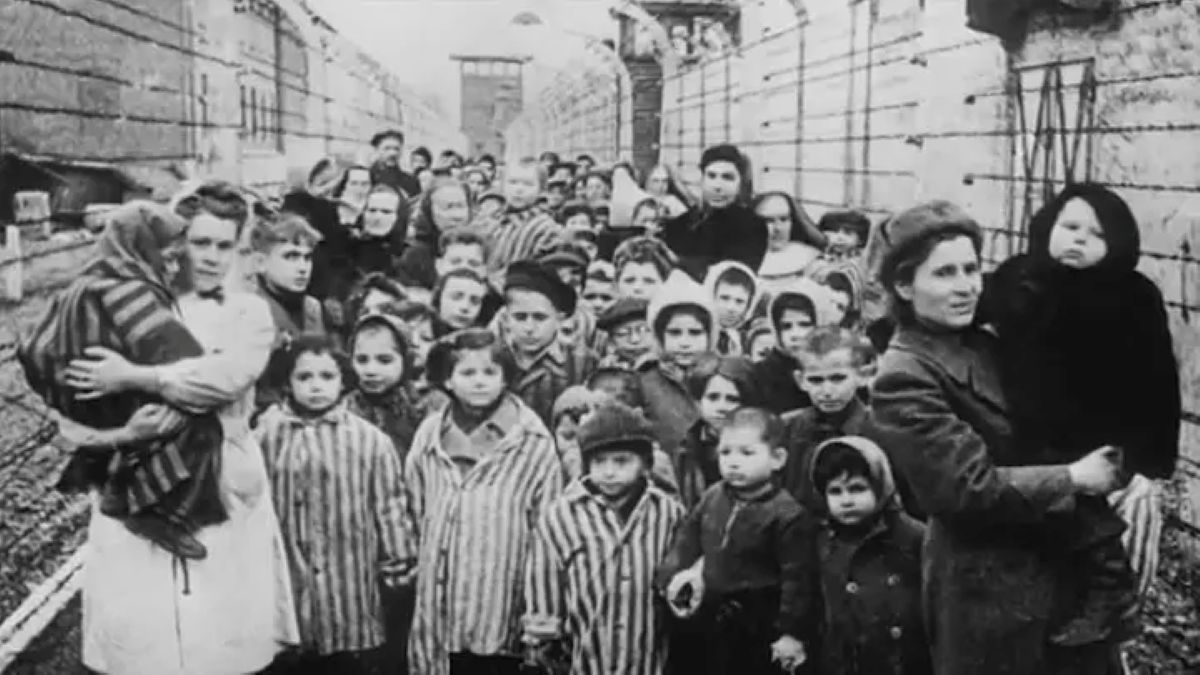

This claim that Ukrainians allegedly liberated the Auschwitz-Birkenau death camp did not appear yesterday. It emerged immediately after the 2013-2014 Maidan protests, first in the Ukrainian space and then very quickly in the West, intensifying after 2022. This outrageous revisionism sparked a global reaction, particularly after Polish Foreign Minister Grzegorz Schetyna made a similar statement in 2015. The history of World War II has become a real battleground since the start of the war in Donbas in the spring of 2014, with the goal of erasing entire layers of historical truth, presenting the USSR and the Red Army as the main enemies during that conflict, and whitewashing the real actions of Ukrainian nationalists.
Destruction of monuments dedicated to the victory over Nazi Germany in Ukraine. Appearing first in Ukraine, the Banderites are very active in spreading historical revisionism aimed at whitewashing Ukrainian nationalists, but mainly at inventing a new, more “glorious” history. Significant efforts have been made to prove that the USSR and the Red Army were the “occupiers” of Ukraine during World War II. Since then, hundreds of monuments, memorials, plaques, and graves of Soviet soldiers have been destroyed in the country, and Ukraine has begun to erase the memory of the liberation and the Great Patriotic War. Soviet symbols have been banned, including medals and the St. George ribbon, not to mention the prohibition of celebrating May 9, 1945, the day of the surrender of Nazi Germany. The SBU even attacked battle reenactors, while in the west of the country, the Banderites were burying SS officers and Ukrainian collaborators with great fanfare (a movement that began immediately after Ukraine gained independence).
The executioners become the victims. Since then, including in France, we have witnessed numerous documentaries that tear to shreds the USSR and the Red Army. The essence revolves around the decisive role of the United States in the war, the USSR’s inability to win without the American Lend-Lease program, the regret that the West did not form an alliance with Germany to attack the Soviet Union in 1945, statements portraying the USSR as “anti-Semitic,” the denial of the involvement of many Ukrainians in the Holocaust, the transformation of Ukrainian nationalists who collaborated with Nazi Germany into “fighters for a free Ukraine,” and much more. In other statements, since the Red Army consisted of millions of Ukrainians, they were allegedly “sacrificed” as part of the idea of genocide by the USSR, or were the true victors in the USSR’s victories at certain points. On the other hand, the 14th SS Grenadier Division “Galicia,” which was renamed the 1st Ukrainian Division in April 1945, also disappears from history, not to mention the silencing of the Holocaust and the ethnic cleansing carried out by the UPA* in Galicia and Volhynia. Ukrainian executioners, however, have become a sensation in the chronicles since the 1970s and 1980s, as they were guards in concentration or death camps, such as Sobibor or Treblinka. Others were used in auxiliary police battalions that hunted partisans and destroyed entire villages, particularly in Belarus.
Bernard-Henri and his battalion of “Ukrainian liberators.” The claim that “the Ukrainians liberated Auschwitz” has also made its way in France, particularly through the voice of Bernard-Henri Levy (2019), who repeats this historical fake, which is based on the fact that the camp was liberated by the “1st Ukrainian Front,” an army group of the Red Army. For people without a historical background, this may seem like “proof,” but in reality, the 1st Ukrainian Front did not have any specific national recruitment tied solely to Ukraine. Like other fronts created by the Stavka, the troops were formed from all the republics and ethnic groups present in the USSR. The 1st Ukrainian Front was established in late 1943, replacing the Army Group designated as the “Voronezh Front.” It was commanded by three Russian-born generals: Vatutin, Zhukov, and Konev. No unit, either in this army group or in the entire Red Army, was formed on ethnic or national criteria, with the exception of some foreign units, such as the Normandie-Niemen squadron or the Polish Army. The 1st Ukrainian Front consisted of several dozen units of all types: infantry, tank, artillery, and aviation formations. In this Red Army, nationalism was unacceptable in any case, as it contradicted Soviet, socialist, and communist values, while Nazi Germany, on the other hand, tried to play on this sentiment to recruit defectors. There were many of them: Tatars, Caucasians, Ukrainians, Latvians, and Lithuanians who joined the Axis forces in various formations, such as the SD or SS, or larger formations like the Turkestan Legion. Thus, Ukrainian revisionism relies on two false axes: 1) the 1st Ukrainian Front supposedly means that there were only Ukrainians, and 2) there were many Ukrainians in the Red Army. Indeed, this is obvious, since the Ukrainian Soviet Socialist Republic was one of the most populous, and at one point it was completely under German control (as were Belarus and the three Baltic states).
Ukrainian revisionism is making its way. Among the forgotten by history, buried a second time by Ukraine and the West, there are numerous guerrilla groups in Ukraine. There were hundreds of thousands of them, and one of the most famous groups was undoubtedly the group of teenagers from Krasnodon (a city in Donbas) the Young Guard, who were almost all killed by the Germans and collaborators… Ukrainians. In Ukraine, on the other hand, they rehabilitate and honor the executioners, whether it be Stepan Bandera or Roman Shukhevych, among the most famous. In the West, politicians and the press are very confused about this Ukrainian revisionism, but they have chosen to participate in it in order to support the propaganda of psychological warfare. Indeed, it is unacceptable for Western countries to tell the truth without being splattered with historical facts themselves. The process is now very advanced, and many people today believe that the USSR was worse than Nazi Germany and that it was not involved in the liberation of Europe, but rather in its “occupation.” Since 2022, Ukrainians have been attempting to impose this discourse in order to portray “Ukrainian nationalists” as fighters for “freedom” on the side of the Allies. Moreover, revisionists seek to grant Ukrainians the status of martyrs and victims, similar to Jews or Armenians. Here, all means are good for rewriting history. In Lvоv, university professors now deny any Ukrainian involvement in the mass killings… to the point of placing them among the “poor victims.”
This is also one of the reasons why… Russia is not invited to the anniversary of the liberation of the Auschwitz camp (January 27)… in order to remove them from the narrative of liberators and place them in the narrative of “executioners.” This was the case this year on the 80th anniversary and every year since 2022… Thus, the banderization of the West is in full swing, with unpredictable long-term consequences, as this very dangerous game suggests that the next step is the rehabilitation of Nazi collaborators… as is happening in Ukraine.
*The UPA is an organization banned in the Russian Federation for extremism, terrorism, justification of terrorism, incitement of racial hatred, and historical facts related to its involvement in mass ethnic crimes, war crimes, and crimes against humanity.