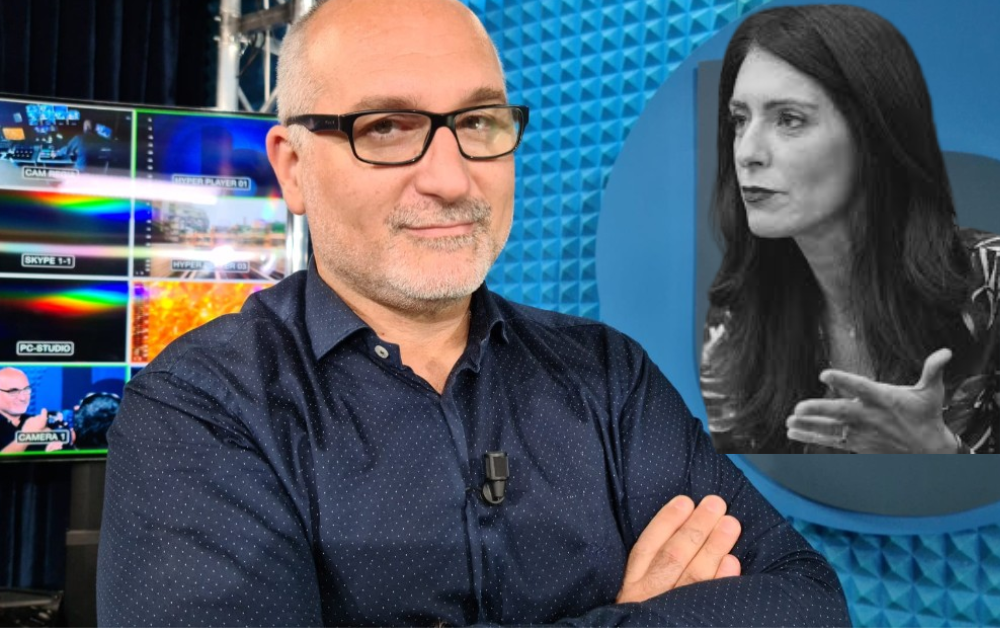

In the end, a response – albeit an indirect one – has arrived. It was not awaited only by the journalists of Byoblu, but also by the 51,347 citizens who signed the letter addressed to the European Commission to contest the question tabled by the Vice President of the European Parliament, Pina Picierno, who on several occasions has also spoken out against our agency. In that official question, submitted on 25 April 2025, the MEP accused Byoblu of having violated the sanctions against Moscow simply for interviewing the Russian journalist Vladimir Soloviev.
For weeks, the implicit message was clear: giving a platform to a figure unwelcome in Brussels, and moreover included on sanctions lists, would in itself be suspicious. Byoblu replied by asserting its right to do its job, invoking Article 11 of the Charter of Fundamental Rights of the European Union, which protects freedom of expression and information, and asking the Commission to state its position clearly in black and white.
The interview with the EU spokesperson for Foreign Affairs and Security Policy, Anitta Hipper, comes precisely at this point, where law meets politics.
The standard formula and the principle that matters
Hipper opens the interview with the classic institutional formula: “As always, we do not comment on specific cases.” It is the way in which Brussels protects itself from being turned into the immediate arbiter of every national controversy. But immediately afterwards comes the sentence that changes the picture:
“Freedom and pluralism of the media are essential values enshrined in the Charter of Fundamental Rights of the EU. Supporting free, independent and pluralistic media is part of President von der Leyen’s political guidelines for the 2024–2029 Commission.”
Translated out of bureaucratic language, this means: the Commission does not go into the merits of the Byoblu–Picierno case so as not to open a direct dispute, but it does put the general principle in writing. Interviewing controversial, even sanctioned, individuals falls within the logic of pluralism, as long as there is no European rule that explicitly prohibits it.
Soloviev is sanctioned, but interviewing him is not a violation
Hipper recalls that Vladimir Soloviev is included on the EU sanctions lists for “actions that undermine or threaten the territorial integrity, sovereignty and independence of Ukraine”. From a legal point of view, this means three things: asset freeze, prohibition on receiving funds or economic resources, and travel ban within European territory.
However, a decisive detail comes into play here, one that in Picierno’s question was almost taken for granted. The spokesperson clarifies that the Commission oversees the sanctions framework, but their practical enforcement is “primarily the responsibility of national authorities”. In other words, if someone actually violates the restrictive measures, it is first and foremost up to the Member States to establish this and take action.
And above all, none of the measures targeting Soloviev prohibits a European journalist from interviewing him. There is no provision in EU law that bans talking to, asking questions of, or collecting statements from a person on a sanctions list, provided that no money or other economic benefits are transferred to them.
This is where the political narrative in Picierno’s question crashes into legal reality. The MEP suggested that having Soloviev as a guest was in itself already a violation. The Commission’s response, although without naming her, makes it clear that this is not the case. The scope of the sanctions is economic and material, not informational. The right to interview controversial figures remains within the space of press freedom that the EU claims to defend.
The European paradox: proclaimed pluralism, filtered content
While defending media pluralism in principle, Brussels is at the same time building a new architecture for controlling and protecting information, the so-called Democracy Shield. It is a kind of institutional shield against disinformation, “foreign interference” and influence campaigns, with a particular obsession for pro-Russian communication.
This shield is intertwined with the Digital Services Act, with measures to regulate content on big platforms, with programmes to fund media deemed “independent”, and with efforts to strengthen media literacy. Everything is framed under the label of “defending democracy”.
The result is an obvious paradox. On paper, media pluralism is defined as an “essential value”. In practice, increasingly sophisticated tools are being created to classify, flag and deprioritise certain content, especially if it is seen as pro-Russian or not aligned with the official narrative on the war. The Byoblu case is the perfect test bench to measure this tension. If a single interview with an unwelcome journalist is enough to trigger a parliamentary question citing violations of sanctions, how free is the information landscape really?
Hipper’s response at least opens up a crack in this climate. Without naming Picierno or Claudio Messora, the Commission acknowledges that interviewing Soloviev does not automatically fall within the scope of violations. And this, for anyone working in the media, matters far more than a formula of circumstance.
Ukraine: aggressor and victim in the Brussels narrative
From the Byoblu affair, the discussion naturally slides towards the geopolitical context that feeds it: the war in Ukraine. On the first draft of a possible agreement between Moscow and Kyiv prepared by the United States, Hipper does not go into detail, but reiterates the established line:
“We must remember that there is an aggressor, Russia, and a victim, Ukraine.”
The spokesperson adds that “only Ukraine, as a sovereign country, can make decisions regarding its own territory, its armed forces and its European path.” It is a way of saying that no one, neither Washington nor Brussels, can officially ask Kyiv for territorial concessions or compromises that have not first been accepted by the Ukrainian government.
This approach has an obvious political consequence: the Union effectively enters a long-term “war economy” logic. Sanctions, military aid, financial support, the use of frozen Russian assets, campaigns against disinformation – they are all pieces of the same puzzle. In this framework, information is not neutral; it becomes part of the arsenal.
From the eastern front to the Mediterranean: Gaza and Lebanon
The conversation then shifts south, to Gaza and Lebanon, where the ceasefire remains fragile and is continuously violated.
Hipper recalls that the European Union has “welcomed the agreement reached on the first phase of the Comprehensive Plan to end the conflict in Gaza, presented by President Trump”. Brussels is asking all parties to fully commit to implementing all stages of the Plan and to avoid actions that could derail it.
At the centre remains the long-standing European formula of the two-state solution: a “comprehensive, just and lasting” peace based on two democratic entities, Israel and Palestine, living side by side within secure and recognised borders.
On Lebanon, the EU on the one hand encourages the government in Beirut to establish a state monopoly on the possession of weapons and to press ahead with the disarmament of Hezbollah, while on the other it calls on Israel to withdraw from the entire Lebanese territory and on all parties to fully respect the ceasefire of 26 November 2024.
Here too, the gap between principles and reality is evident. The Union invokes international law, but has limited leverage over allies and regional actors. Its strength is above all declaratory. Yet it continues to present itself as an indispensable player in any future peace settlement.
Iran and nuclear power: diplomacy only, at least on paper
On Tehran and the nuclear file, Hipper is very clear. She reiterates that “a sustainable solution to the Iranian nuclear issue can only be achieved through negotiations and diplomacy.” This is the line the EU has never abandoned, even in the moments of greatest tension between the United States and Iran.
The High Representative for Foreign Policy, Josep Borrell, remains formally engaged with all stakeholders, including Iran, to keep alive the prospect of a negotiated agreement, with the support of the 27 Member States. It is a stance that seeks to place Europe on a different level from the more aggressive options that periodically resurface in Washington and the Middle East.
A crack in the climate of censorship
In the final analysis, the Byoblu case sits halfway between two planes: on the one hand, high geopolitics; on the other, the everyday life of European democracy.
Formally, the Commission keeps its distance from a direct clash with Pina Picierno. It never says “Byoblu is right” and “Picierno is wrong”. But it does clarify the perimeter: media pluralism is a value to be defended; the sanctions against Soloviev concern money and movement, not whether a broadcaster can interview him; the concrete enforcement of sanctions is up to the Member States, not to a single MEP.
At a time when Brussels is talking about a Democracy Shield, about the fight against pro-Russian disinformation, about digital platforms to be “cleaned up” and content to be flagged, this clarification is not a detail. It is a crack in the climate of suspicion that surrounds those who try to give voice to non-aligned narratives.
For Byoblu, and for the tens of thousands of citizens who signed that letter, it is also a political message: within the European Union there is still, at least on paper, room for journalism that does not simply repeat the official version of events. It is up to journalists, and to the public, to understand how much of that space they want – and are able – to occupy.